Example: biology
Number: Number and Place Value with Reasoning
the value of each digit (appears also in Reading and Writing Numbers) find the effect of dividing a -or two digit number by 10 and 100, identifying the value of the digits in the answer as units, tenths and from F ractions) identify the value of each digit to three decimal places and multiply and divide numbers by 10, 100 and 1000 where the ...
Tags:
Information
Domain:
Source:
Link to this page:
Documents from same domain

Number: Number and Place Value
www.ncetm.org.ukwhole numbers , including through zero use negative numbers in context, and calculate ... Writing Numbers)find the effect of dividing a one recognise and use thousandths and relate them to tenths, hundredths and ... round decimals with two decimal places to the nearest whole number and to one

Number: Addition and Subtraction with Reasoning
www.ncetm.org.uksolve addition and subtraction multi -step problems in contexts, deciding which operations and methods to use and why solve simple problems in a practical context involving addition and subtraction of money of the same unit, including giving change (copied from Measurement) Solve problems involving addition, subtraction, multiplication and division

Mastery approaches to mathematics and the new national ...
www.ncetm.org.ukMastery approaches to mathematics and the new national curriculum ... The focus is on the development of deep structural knowledge and the ability to make connections. Making connections in mathematics deepens knowledge of ... In highly successful systems, teachers are clear that their role is to teach in a
Mathematics glossary for teachers in Key Stages 1 to 3
www.ncetm.org.ukpublication Mathematics glossary for teachers in key stages 1 to 4 published by the Qualifications and Curriculum Authority in 2003. It is intended to be used alongside the 2014 National Curriculum for teachers to check the meaning of the terms. This glossary is part of a wider suite of support of materials from the

Questions, tasks and activities to support assessment
www.ncetm.org.ukOngoing assessment as an integral part of teaching The questions, tasks, and activities that are offered in the materials are intended to be a useful vehicle for assessing whether pupils have mastered the mathematics taught. However, the best forms of ongoing, formative assessment arise from well-structured classroom
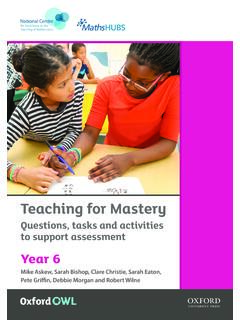
Questions, tasks and activities to support assessment
www.ncetm.org.ukdeveloping mastery of the content laid out for each year. Schools, however, are only ‘required to teach the relevant programme of study by the end of the key stage. Within each key stage, schools therefore have the flexibility to introduce content earlier or later than set out in the programme of study’ (National curriculum page 4).

The Essence of Maths Teaching for Mastery
www.ncetm.org.ukThe Essence of Maths Teaching for Mastery ... leads back and forth interaction, including questioning, short tasks, explanation, demonstration, and discussion. ... Significant time is spent developing deep knowledge of the key ideas that are needed to underpin future learning. The structure and connections within the

Number: Multiplication and Division with Reasoning
www.ncetm.org.ukNumber: Multiplication and Division with Reasoning ... formal written methods (appears also in Written Methods) together three numbers Use a fact 20 x 3 = 60. ... (copied from Addition and Subtraction) estimate and use inverse operations to check answers to a calculation

Questions, tasks and activities to support assessment
www.ncetm.org.ukQuestions, tasks and activities to support assessment Year 5 Mike Askew, Sarah Bishop, Clare Christie, Sarah Eaton, Pete Gri˜ n and Debbie Morgan

Number: Multiplication and Division
www.ncetm.org.ukincluding: multiplying by 0 and 1; dividing by 1; multiplying together three multiply and divide numbers mentally drawing upon known facts perform mental calculations, including with mixed operations and large numbers show that multiplication of two numbers can be done in any order (commutative) and division of one number by another cannot
Related documents
Marketing Analysis- Marketing Plan - Rutgers University
anniesproject.rutgers.eduBy identifying and targeting specific market segments, a firm can also develop more effective packaging, price, and promotion strategies. ... educational meetings to learn and network are good places to start answering these questions no ... the manager can estimate the potential value of sales per household.
Educational Resources: An Integral Component for Effective ...
files.eric.ed.govputting in place certain mechanisms towards ensuring the success of such institutions. In the school system, part ... Moral or Value goals: ... According to NOUN (2006) school administration is a social process concerned with identifying, maintaining, stimulating, controlling and unifying, formally and informally organized human and material ...

Small Business Safety and Health Handbook
www.osha.govoyers like you place a high value on . the well-being of your workers . Like many small businesses, you may employ family members and personal acquaintances . And, if you don’t know your workers before they are hired, the size of your workplace will promote the closeness and concern . for one another that small businesses value .
Mathematics guidance: key stages 1 and 2 (covers years 1 to 6)
assets.publishing.service.gov.ukand that 0.1 is 10 times the size of 0.01. 6NPV–1 Understand the relationship between powers of 10 from 1 hundredth to 10 million, and use this to make a given number 10, 100, 1,000, 1 tenth, 1 hundredth or 1 thousandth times the size (multiply and divide by 10, 100 and 1,000). 2NPV–1 Recognise the place value of each digit
Mathematics guidance: key stages 1 and 2 - GOV.UK
assets.publishing.service.gov.ukand that 0.1 is 10 times the size of 0.01. 6NPV–1 Understand the relationship between powers of 10 from 1 hundredth to 10 million, and use this to make a given number 10, 100, 1,000, 1 tenth, 1 hundredth or 1 thousandth times the size (multiply and divide by 10, 100 and 1,000). 2NPV–1 Recognise the place value of each digit

BASIC PRINCIPLES OF MONITORING AND EVALUATION
www.ilo.org1. Formulating objectives: identifying in clear, measurable terms the results being sought and developing a conceptual framework for how the results will be achieved. 2. Identifying indicators: for each objective, specifying exactly what is to be measured along a scale or dimension. 3.

National Air Quality Objectives - Home - Defra, UK
uk-air.defra.gov.ukTarget value 25vg m Limit value 2 5vg ma Target of reduction in corrcentrations at urban background not to be exceeded more than 18 times a year 40ug.mA Target of not to be exceeded more than 25 times a year averaged years Between 2010 and 2020 1 January 2010 1 January 2010 1 December 2010 Retain existing New (European obligations still
Chapter 9: Critical and Creative Thinking Skills
www.opdt-johnson.com1. Look at or define a criterion. 2. Look at the subject. 3. Compare the subject to the criterion. 4. Describe the subject relative to the criterion. Creating Groups: Impose order on a field by identifying and grouping common themes or patterns. Thinking Frame 1. Look at the whole. 2. Identify reoccurring items, themes, or patterns. 3. Arrange ...

Educators My Time, Our Place - ACECQA
www.acecqa.gov.au1 . introduction: using the guide with the framework 3. 2 . ongoing learning and reflective practice for improvement 6. 3 . decision making: implementing the framework 11. 4 . linking beliefs and theory with practice 21. 5 . holistic approaches 26. 6 . collaborating with children 31. 7 . learning through play 35. 8 . intentionality 42. 9 ...