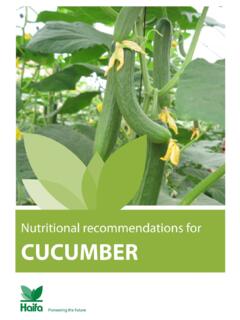
Transcription of Nutritional recommendations for - Haifa-Group
1 1 Nutritional recommendations for potato Botanical name: Solanum tuberosum L. Synonyms: Spuds; Pomme de terre; Patata; Kartoffel Contents: 1. General growing conditions .. 3 The plant .. 3 Soil type and pH .. 3 Special sensitivities of the potato plant .. 4 Chloride .. 4 Boron deficiency .. 4 Storage conditions .. 4 Irrigation .. 4 Crop uses .. 5 Crop growth stages .. 5 2. Nutritional requirements .. 6 Nutrient uptake curves .. 6 Main functions of plant nutrients .. 8 Nutritional disorders in potatoes .. 17 Leaf analysis standards .. 23 Plant nutrient requirements .. 23 3. Fertilization recommendations .. 24 General 24 Haifa NutriNet web software for Nutigation programs ..24 a) Base dressing ..24 b) Nutrigation ..25 Side dressing with Multi-K.
2 26 Poly-Feed water-soluble NPK Multicote Agri controlled release fertilizer ..28 Foliar nutrition ..28 Examples of potato fertilization with Multi-K in various countries .. 30 South Africa ..30 Australia ..31 Poland ..32 Israel ..33 Appendix I: Haifa specialty fertilizers .. 34 Appendix II: Conversion tables .. 37 3 1. General growing conditions The plant The potato (Solanum tuberosum) is an herbaceous annual that grows up to 100 cm (40 inches) tall and produces tubers, which are botanically thickened stems that are so rich in starch that they rank as the world's fourth most important food crop, after maize, wheat and rice. The potato belongs to the Solanaceae, and shares the genus Solanum with at least 1,000 other species, including tomato and eggplant. S. tuberosum is divided into two, only slightly different, subspecies: andigena, which is adapted to short day conditions and is mainly grown in the Andes, and tuberosum, the potato now cultivated around the world, which is believed to descend from a small introduction to Europe of andigena potatoes that later adapted to longer day conditions.
3 Figure 1: A scheme of the potato plant Soil type and pH Potatoes will grow on most soils, organic as well as mineral ones. But, light and medium texture soils are recommended where mechanical harvesting is practiced, to avoid difficulties in harvesting when weather conditions are adverse at harvest time. Lowest possible soil pH is Soil pH below generally results in impaired growth. Too alkaline conditions can adversely affect skin quality and can induce micronutrients deficiencies. 4 Special sensitivities of the potato plant Chloride Potatoes are sensitive to the chloride anion. Chloride damage is manifested by scorching of the leaf tips and margins, and leaves yellowing and distortion. Fertilization with chloride-free fertilizers will, therefore, contribute to increased yields and to the improvement of their quality.
4 Boron deficiency Hollow Heart , by comparison, is characterized by formation of a cavity near the tuber centre, without any external indication of this syndrome. It is the result of soil boron deficiency. Rapid growth of the tuber, sometimes due to too low plant density, may cause this syndrome, too. Storage conditions Black heart symptom of potatoes is caused by a limited supply of oxygen to the tubers during their storage, and cannot be alleviated by improved growth conditions. Irrigation During the early growth phase, until tuber formation, it is essential to keep the soil constantly and uniformly wet to a depth of at least 10-15cm. The frequency of irrigation cycles during this period should be determined according to the specific soil type and climate conditions. During the second growth phase, during tuber development, irrigation will be less frequent and applied once every 3-5 days.
5 This allows efficient root respiration and intensifying growth rate. Potatoes can be irrigated almost until harvest. Irrigation at tuber initiation can affect the skin quality of daughter tubers by influencing phytopathogens, either favorably or adversely, according to conditions, and moisture rate present. A monitored drip system equipped with a Nutrigation (fertigation) device is the preferable method of irrigation (Fig. 2) Figure 2: Drip-irrigated potato field in southern Israel 5 Crop uses Potatoes are consumed fresh, and are being processed to chips and crisps. Potatoes are also used for the production of starch. Selected plots are grown for seed production. Potatoes grown for processing are valued for yield, size, shape, and mainly for dry matter content (measured by specific gravity).
6 As the specific gravity increases, the water content of the potato decreases, improving the frying properties and flavor. Management factors, including plant nutrition treatments, will influence potato yield, quality, and storage properties. Crop growth stages potato growth is classified into five distinct growth phases (Fig. 3). The exact timing of these growth phases depends on many environmental and management factors that vary between locations and cultivars. However, these distinct stages of growth need to be considered when managing the crop. Figure 3: Main stages of growth and development of potatoes. The Nutritional requirements of the developing potato change during the growing season. Stage I Sprout development Sprout develops from eyes on seed tubers and grows upward to emerge from the soil.
7 Roots begin to develop at the base of emerging sprouts. Stage II Vegetative growth Leaves and brunch stems develop from aboveground nodes along emerged sprouts. Roots and stolons develop at below-ground nodes. Photosynthesis begins. Stage III Tuber initiation Tubers form at stolon tips but are not yet appreciably enlarging. In most cultivars the end of this stage coincides with early flowering. Stage IV Tuber bulking Tuber cells expand with the accumulation of water, nutrients, and carbohydrates. Tubers become the dominant site for deposition of carbohydrates and mobile inorganic nutrients. Stage V Maturation Vines turn yellow and lose leaves, photo-synthesis decreases, tuber growth slows, and vines eventually die. Tuber dry matter content reaches a maximum and tuber skins set. 6 2.
8 Nutritional requirements Nutrient uptake curves Nutrients uptake is at its greatest during tuber bulking up (intensive volume increase process). The amount of nutrients removed by a potato crop is closely related to yield. Usually, twice the yield will result twice the removal of nutrients. Nutrients need to be applied as accurately as possible to the zone of uptake, slightly before, or at the time that the crop needs them. Failure to ensure that each plant gets the right balance of nutrients can spoil crop quality and reduce yield. The highest requirement for potassium, as shown on Figure 4, is during the bulking up stage of the tubers. The flowering of potato plants is an indication when this morphological stage starts. Consequently, the ideal side-dressing period with Multi-K would be during the tuber bulking stage.
9 Figure 4: Uptake of macronutrient uptake by a whole potato plant Source: Harris (1978) The daily requirements of potato tubers during the critical bulking stage are kg/ha N, kg/ha P and kg/ha K. Potassium requirements of potato tubers during the bulking stage are very high as they are considered to be luxury consumers of potassium. Daily yield increase during the critical tuber bulking stage can reach 1000 - 1500 kg/ha/day. Therefore, it is important to supply the required plant nutrients during the tuber bulking stage in right N-P-K ratio and in ample quantities. 050100150200250300350400N P K Bulking up KNO3 Total uptake (kg/ha) 7 Figure 5: Uptake of macro and secondary nutrients by vines and tubers of potato plants yielding 55 ton/ha.
10 Source: Reiz, 1991 Figure 6: Uptake of micro-nutrients by vines and tubers of potato plants yielding 55 ton/ha. Source: Reiz, 1991 0100200300400500600 NPKCaMgTubersVinesRemoval (kg/ha) Removal (kg/ha) 8 Main functions of plant nutrients Table 1: Summary of main functions of plant nutrients Nutrient Functions Nitrogen (N) Synthesis of proteins (growth and yield). Phosphorus (P) Cellular division and formation of energetic structures. Potassium (K) Transport of sugars, stomata control, cofactor of many enzymes, reduces susceptibility to plant diseases. Calcium (Ca) A major building block in cell walls, and reduces susceptibility to diseases. Sulfur (S) Synthesis of essential amino acids cystine and methionine. Magnesium (Mg) Central part of chlorophyll molecule.