Example: stock market
O. Linear Differential Operators
o. linear differential operators 5 For the more general case (17), we begin by noting that to say the polynomial p(D) has the number aas an s-fold zero is the same as saying p(D) has a factorization
Tags:
Information
Domain:
Source:
Link to this page:
Documents from same domain
Introduction to Linear Algebra, 5th Edition
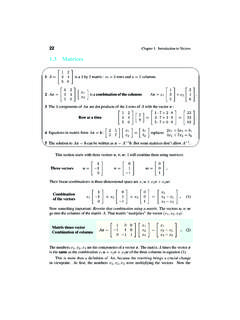
math.mit.edu1.3 Matrices 1 A = ... Linear Equations One more change in viewpoint is crucial. Up to now, the numbers x 1,x 2,x 3 were known. The right hand side b was not known. We found that vector of differences by multiplying A times x. Now we think of b as known and we look for x.

Linear programming 1 Basics - MIT Mathematics
math.mit.edu2 subject to: 5x 1 + 7x 2 8 4x 1 + 2x 2 15 2x 1 + x 2 3 x 1 0;x 2 0: Some more terminology. A solution x= (x 1;x 2) is said to be feasible with respect to the above linear program if it satis es all the above constraints. The set of feasible solutions is called the feasible space or feasible region. A feasible solution is optimal if its ...
Eigenvalues and Eigenvectors
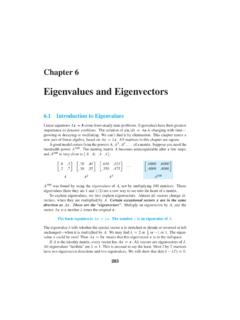
math.mit.eduSpecial properties of a matrix lead to special eigenvalues and eigenvectors. That is a major theme of this chapter (it is captured in a table at the very end). 286 Chapter 6.
Eigenvalues and Eigenvectors - MIT Mathematics
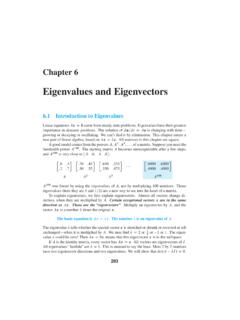
math.mit.edu6.1. Introduction to Eigenvalues 287 Eigenvalues The number is an eigenvalue of Aif and only if I is singular: det.A I/ D 0: (3) This “characteristic equation” det.A I/ D 0 involves only , not x. When A is n by n,
4 Cauchy’s integral formula - MIT Mathematics
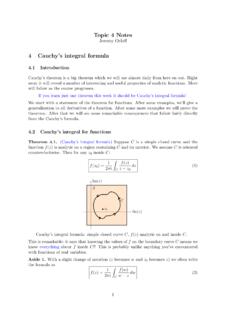
math.mit.edu4 Cauchy’s integral formula 4.1 Introduction ... 4 CAUCHY’S INTEGRAL FORMULA 4 4.3.1 Another approach to some basic examples Suppose Cis a simple closed curve around 0. We have seen that Z C 1 z ... Since an integral is basically a sum, this translates to the triangle inequality for integrals.
A FRIENDLY INTRODUCTION TO GROUP THEORY
math.mit.eduA FRIENDLY INTRODUCTION TO GROUP THEORY 3 A good way to check your understanding of the above de nitions is to make sure you understand why the following equation is correct: jhgij= o(g): (1) De nition 5: A group Gis called abelian (or commutative) if gh = hg for all g;h2G. A group is called cyclic if it is generated by a single element, that is,
4.3 Least Squares Approximations
math.mit.edu4.3. Least Squares Approximations 221 Figure 4.7: The projection p DAbx is closest to b,sobxminimizes E Dkb Axk2. In this section the situation is just the opposite. There are no solutions to Ax Db. Instead of splitting up x we are splitting up b. Figure 4.3 shows the big picture for least squares. Instead of Ax Db we solve Abx Dp.
Square Roots via Newton’s Method
math.mit.eduSquare Roots via Newton’s Method S. G. Johnson, MIT Course 18.335 February 4, 2015 1 Overview ...
V7. Laplace’s Equation and Harmonic Functions
math.mit.eduA. Existence. Does there exist a φ(x,y) harmonic in some region containing Cand its interior R, and taking on the prescribed boundary values? B. Uniqueness. If it exists, is there only one such φ(x,y)? C. Solving. If there is a unique φ(x,y), determine it by some explicit formula, or approximate it by some numerical method.
The Limit of a Sequence - MIT Mathematics
math.mit.edu“obvious” using the definition of limit we started with in Chapter 1, but we are committed now and for the rest of the book to using the newer Definition 3.1 of limit, and therefore the theorem requires proof. Theorem 3.2B {an} increasing, L = liman ⇒ an ≤ L for all n; {an} decreasing, L = liman ⇒ an ≥ L for all n. Proof.
Related documents

Span, Linear Independence and Basis - East Tennessee State ...
faculty.etsu.eduSpan, Linear Independence and Basis Linear Algebra MATH 2010 † Span: { Linear Combination: A vector v in a vector space V is called a linear combination of vectors u1, u2, ..., uk in V if there exists scalars c1, c2, ..., ck such that v can be written in the form v = c1u1 +c2u2 +:::+ckuk { Example: Is v = [2;1;5] is a linear combination of u1 = [1;2;1], u2 = [1;0;2], u3 = …

Matrix Representations of Linear Transformations and ...
math.colorado.eduA linear combination of vectors v 1;:::;v k2Rnis the nite sum a 1v 1 + + a kv k (0.1) which is a vector in Rn (because Rn is a subspace of itself, right?). The a i 2R are called the coe cients of the linear combination. If a 1 = = a k = 0, then the linear combination is said to be trivial.

The General Linear Group - Massachusetts Institute of ...
www-math.mit.edua linear combination of the first i − 1 rows. There are qi−1 linear combinations of the first i − 1 rows, so there are qn − qi−1 possibilities for the ith row. Once we build the entire matrix this way, we know that the rows are all linearly independent by choice. Also, we can
21. Orthonormal Bases - University of California, Davis
www.math.ucdavis.edua basis, we can write any vector vuniquely as a linear combination of the vectors in T: v= c1u 1 + :::cnu n: Since T is orthonormal, there is a very easy way to nd the coe cients of this linear combination. By taking the dot product of vwith any of the vectors in T, we get: v u i = c1u 1 u i + :::+ ciu i u i + :::+ cnu n u i

Tutorial on Linear Algebra - Massachusetts Institute of ...
cbmm.mit.eduLinear Algebra When is a matrix invertible In general, for an inverse matrix −1to exist, has to be square and its’ columns have to form a linearly independent set of vectors –no column can be a linear combination of the others. A necessary and sufficient condition is that det ≠0.

System of linear equations - IM PAN
www.impan.plTwo linear systems using the same set of variables are equivalent if each of the equations in the second system can be derived algebraically from the equations in the first system, and vice-versa. Two systems are equivalent if either both are inconsistent or each equation of any of them is a linear combination of the equations of the other one.
Second Order Linear Differential Equations
www.math.utah.edutwo solutions, then so is the sum; in fact, so is any linear combination Af x Bg x . Thus, once we know two solutions (they must be independent in the sense that one isn’t a constant multiple of the other) we can solve the initial value problem in theorem 12.1 by solving for A and B. Example 12.1 Solve y y 0 y 0 4 y 0 1

5Properties of Linear, Time-Invariant Systems
ocw.mit.eduoutput generated by an input to the overall cascade combination does not de-pend on the order in which the systems are cascaded. This property of LTI systems plays an extremely important role in system design, implementation, and analysis. It is generally not true for arbitrary systems that are not linear
Chapter 9 Center of Mass & Linear Momentum - SMU
www.physics.smu.eduNext note that the combination of disk S and plate P is composite plate C. Thus, the position x S+P of com S+P must coincide with the position x C of com C, which is at the origin; so x S+P =x C ... total linear momentum is conserved. (2) The collision is one-dimensional in the sense that