Transcription of Objects365: A Large-Scale, High-Quality Dataset for Object ...
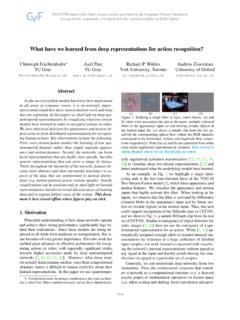
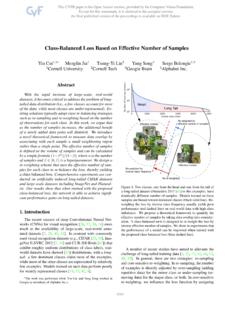
1 Objects365: A large - scale , High-Quality Dataset for Object Detection Shuai Shao , Zeming Li , Tianyuan Zhang , Chao Peng . Gang Yu , Xiangyu Zhang, Jing Li, Jian Sun Megvii Technology {shaoshuai, lizeming, zhangtianyuan, pengchao, yugang, zhangxiangyu, lijing, Abstract 45. In this paper, we introduce a new large - scale Object de- 40 mmAP on COCO. tection Dataset , Objects365, which has 365 Object cate- 35 33 gories over 600K training images. More than 10 million, from scratch High-Quality bounding boxes are manually labeled through from ImageNet a three-step, carefully designed annotation pipeline. It is the 30 from Objects365. from ImageNet -> Objects365. largest Object detection Dataset (with full annotation) so far from ImageNet -> OpenImages and establishes a more challenging benchmark for the com- 25.}
2 0K 60 K 120 K 180 K 240 K 300 K 360 K 420 K 480 K 540 K. munity. Objects365 can serve as a better feature learning Iterations After Convergence Dataset for localization-sensitive tasks like Object detection and semantic segmentation. The Objects365 pre-trained models significantly outperform ImageNet pre-trained mod- Figure 1. Results of netuning COCO from ImageNet vs Ob- els with points gain (42 vs ) based on the standard jects365. With a small number of iterations, 90K, for training, our Objects365 pre-trained model (green curve) can signi cantly out- setting of 90K iterations on COCO benchmark. Even com- perform the algorithm netuned from ImageNet (orange curve), pared with much long training time like 540K iterations, our even with much longer training time, , 540K iterations.
3 All Objects365 pretrained model with 90K iterations still have results use a FPN based Resnet50 backbone. points gain (42 vs ). Meanwhile, the finetuning time can be greatly reduced (up to 10 times) when reaching the same accuracy. Better generalization ability of Object365 ing Object detection benchmarks like PASCAL and COCO. has also been verified on CityPersons, VOC segmentation, It contains 365 categories, 638K images, and 10, 101K. and ADE tasks. The Dataset as well as the pretrained- bounding boxes. We compare our Dataset with existing ob- models have been released at ject detection benchmarks with full annotations in Table 1. Our Dataset contains 5 more images, 4 more categories, and 10 more boxes than COCO [24].
4 It can serve as a 1. Introduction more challenging benchmark for the detection community. quality . In addition to the size, annotation quality is of Object detection is a fundamental task in computer vi- great importance when building a Dataset . To ensure qual- sion. PASCAL VOC [8] and COCO [24], have contributed ity, we divide the annotation pipeline into three steps, which greatly to rapid advances of Object detection. From tradi- can signi cantly reduce the job requirement for the annota- tional approaches like DPM [9] to deep-learning based ap- tors. Besides the annotators, we also include inspectors and proaches like R-CNN [13] and FPN [22], the above two examiners to review the quality of the annotations.
5 To re- datasets serve as golden benchmarks to evaluate algo- duce ambiguities during the annotation process, we apply rithms and boost research progresses. In this paper, we two consistency rules. This annotation pipeline ensures that move a step further to introduce a new large - scale , high - we obtain High-Quality annotation with high ef ciency. quality Object detection Dataset , Objects365, which focuses on three aspects: scale , quality , and generalization. Generalization. The feature learned from Objects365. is superior for many localization-sensitive tasks like ob- scale . Objects365 is signi cantly larger than the exist- ject detection and semantic segmentation.
6 Convention- indicates equal contribution. ally, ImageNet [5] pre-trained basenets like Resnet [17]. Corresponding Author. are widely employed as a backbone for the Object de- 8430. tection/segmentation algorithms. However, there are two Besides the general Object detection datasets, there are issues related to ImageNet pretraining. On one hand, also a lot of other detection benchmarks like face detec- the feature learned on ImageNet classi cation task is less tion [19, 35], pedestrian detection [7, 36, 31], and hu- localization-sensitive. On the other hand, only the back- man/vehicle detection for the autonomous driving [11, 2], bone part are pre-trained but the head part is initialized with all of which play an important role in the detection commu- the random weights.
7 Nity. Our Objects365 Dataset directly addresses the above two issues and provides a better alternative for feature learning. As shown in Figure 1, the Objects365 pre-trained features 3. Objects365 Dataset can signi cantly outperform the counterparts based on Im- In this section, we present the details on the collection, ageNet, even the one with suf cient longer training time annotation, statistics, and quality of the Dataset respectively. (540K iterations) as discussed in [15]. Moreover, using Ob- jects365 feature, we can obtain comparable results with one order-of-magnitude less training time. Data Collection Data Source 2. Related Work General Object Detection Object detection task has been To make the image sources more diverse, we collect images a fundamental research topic for a while.
8 DPM [9] is one mainly from Flicker 1 . All the images conform to licensing of the most famous Object detection algorithms to be used for research purposes. Sample images can be found on our before the introduction of deep learning techniques. R- website2 . CNN [13] is one of the rst work to integrate the convo- lutional neural network for Object detection. Later, with the rapid development of convolutional neural network, most Object Categories Object detection algorithms started to utilize deep learn- ing techniques. Roughly, we can divide the existing ob- Based on the collected images, we rst select eleven super- ject detection algorithms into two categories: single-stage categories which are common and diverse to cover most ob- detector and two-stage detector.
9 The main difference lies ject instances. They are: human and related accessories, on whether to pool the feature maps for a second stage. living room, clothes, kitchen, instrument, transportation, SSD [25], DSSD [10] and YOLO series [27, 28, 29] are bathroom, electronics, food (vegetables), office supplies, some widely used single-stage detector with ef cient speed. and animal. Based on the super-categories, we further pro- RetinaNet [23] is introduced with strong performance even pose 442 categories which widely exists in our daily lives. compared with the two-stage detector. For the two-stage As some of the Object categories are rarely found, we rst detector, the early work like Fast R-CNN [12], Faster R- annotate all 442 categories in the rst 100K images and then CNN [30], R-FCN [3], try to speed up the algorithms.
10 In select the most frequent 365 Object categories as our tar- FPN [22] and Mask R-CNN [16], feature pyramid structure get objects. Also, to be compatible with the existing Object and ROI-Align are proposed to boost the performance. De- detection benchmarks, the 365 categories include the cate- formable ConvNet [4, 39], Soft Sampling [34], SNIP [32], gories de ned in PASCAL VOC [8] and COCO [24] bench- SNIPER [33], and Cascade R-CNN [1], DetNet [21] are in- marks. troduced to further improve the performance. large - scale Detection Dataset The large - scale Dataset is Non-Iconic Images an important reason for the continuous improvement of the Object detection algorithms, especially for deep learning As our Objects365 Dataset focuses on Object detection, we based techniques.