Transcription of Oleochemicals Series (Complete)
1 Oleochemicals . A SUSTAINABLE ALTERNATIVE. In this section on Oleochemicals we will look at the important role that these chemicals play in all of our lives, cover some general aspects of the industry and the technology, and look at three of the most important categories of Oleochemicals (Fatty Acids, Methyl Esters and Fatty Alcohols) in more detail. WHAT IS AN OLEOCHEMICAL? The simplest definition of an oleochemical, is a chemical produced from natural oils and fats. Of the 105 million tonnes or so of fats and oils produced worldwide, every year, about 80% is utilised for human food. About 5% is consumed as part of animal feeds and about 15% is used to produce chemicals. About 16 million tonnes finds its way into the chemical industry, usually in the form of coconut oil, palm kernel oil, palm oil and tallow (animal fat).
2 These oils fall into two groups - lauric oils ( coconut and palm kernel) that are rich in carbon chains consisting of 12 and 14 linked carbon atoms, and those with carbon chains of 16 and 18 carbon atoms (tallow and palm). Both of these categories are very important to the surfactant industry where, for domestic use, a balance between cleansing properties and mildness towards the skin is especially important. Other oils like rapeseed, soya and sunflower are also used, but those mentioned above have long been the main workhorses in the industry. UNDERSTANDING THE TECHNOLOGY AND TERMINOLOGY OF Oleochemicals PRODUCTION. In the course of discussing the major Oleochemicals groups, it is inevitable that a lot of fairly specialised terminology will be used.
3 Now is the time to explain some of the more commonly used terms and jargon likely to be encountered. As already stated, Oleochemicals are made from natural oils, but the crude oils generally need some form of pre-treatment before processing. The most common pre-treatments are refining, to remove free fatty acids and some impurities from the oil prior to bleaching, to remove colour and then deodorising to strip out odoriferous and further chemical impurities. The final product of these pre-treatment processes is referred to, not surprisingly, as refined, bleached and deodorised or, more commonly, RBD oil. Some whole oils ( oils that still have their complete range of carbon chainlengths) are fractionated or otherwise separated, to give rise to liquid portions (known as oleines) and more solid portions (known as stearines).
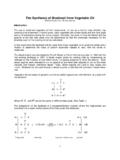
4 Stearines are said to be highly saturated ( each carbon is surrounded by the full number of hydrogen atoms allowed for the molecule), whereas oleines contain more unsaturated molecules (where there is not enough hydrogen to give saturation and some of the carbon atoms bind to each other with multiple (usually double) bonds). This oil is now ready to be subjected to one or more of the processing steps that will result in its conversion to one of the major groups of Oleochemicals . It might be hydrolysed (reacted with water at high temperature and pressure) to form fatty acids and glycerine. It might be subjected to methanolysis (reaction with methanol using a catalyst) to generate methyl esters of the component fatty acids and, of course, glycerine.
5 It might seem to some that the whole point of the processing steps used is to break the oil molecule up to give access to the bit with the long carbon chains for further processing, while removing the glycerine backbone of the triglyceride molecules (which is what all fats and oils are, chemically). This, while being a huge oversimplification is, however, not too far from the truth to prevent it serving as a usable model. The products of these reactions might now be hydrogenated (reacted with hydrogen at high temperature and pressure in the presence of a catalyst), either to remove unsaturation or to reduce one chemical species to another (as in the case of the hydrogenation of methyl esters to make fatty alcohols). Finally, further purification and separation steps may be applied to tailor the chemical for its proposed market.
6 It may be distilled simply to remove impurities from the main chemical by exploiting the difference in their boiling points, or a more sophisticated form of distillation, known as fractionation, may be applied to generate chemical mixtures containing the appropriate lengths of carbon chain. If we assume that the oils used are made up of carbon chains ranging from 6 to 22 carbons long, fractionation into materials containing 6 to 10 carbons (light-cut chemicals), 12 to 14 carbons (mid-cut chemicals) or 16 to 22 carbons (heavy-cut chemicals) widens the usage of the particular oleochemical in question. If necessary, fractionation can be tailored to give single molecular species of high purity (99%+). For example, lauric acid (C12 fatty acid ) of purity is not uncommon.
7 A BIT ABOUT ECONOMICS. The Palm Oil Utilisation Chart (overleaf) clearly reflects the predominant use of fats and oils in direct food usage. The categories at the periphery of most of the flowchart routes do much, however, to add value to the fat/oil molecule produced. Considering just palm oil selling at about US$ 390/MT, fatty alcohols sell at approximately US$ 1200/MT, methyl esters at US$ 980/MT and fatty acids at about US$ 760/MT. These prices, of course, fluctuate with the oil price and also depending on the price of ethylene, which is also a raw material from which 1. the above chemical species can be manufactured. The big advantage for Oleochemicals is that they are produced from renewable resources and are thus sustainable and viewed by many as the green alternative to chemicals from hydrocarbon oils.
8 Oleochemicals - FATTY ACIDS. This section will concentrate on Fatty Acids produced from natural fats and oils ( not those derived from petroleum products). Firstly though, we will recap briefly on Nomenclature. We spent some time clarifying the structure of Oleochemicals and we saw how carbon atoms link together to form carbon chains of varying length (usually even numbered in nature, although animal fats from ruminant animals can have odd-numbered chains). A fatty acid has at least one carboxyl group (a carbon attached to two oxygens (-O) and a hydrogen (-H), usually represented as -COOH in shorthand) appended to the carbon chain (the last carbon in the chain being the one that the oxygen and hydrogen inhabit). We will only be talking about chains with one carboxyl group attached (generally called monocarboxylic acids ).
9 The acids can be named in many ways, which can be confusing, so we will try and keep it as simple as possible. The table opposite shows the acid designations as either the length of the carbon chain or the common name . While it is interesting to know the common name for a particular acid , we will try to use the chainlength in any discussion so you do not have to translate. Finally, it is usual to speak about unsaturated acids using their chainlength suffixed with an indication of the number of double bonds present. Thus, C16=1 is the C16 acid with one double bond; C18=2 is the C18 acid with two double bonds and so on. SELECTING RAW MATERIALS FOR FATTY acid PRODUCTION. In principle, fatty acids can be produced from any oil or fat by hydrolytic or lipolytic splitting (reaction with water using high pressure and temperature or enzymes).
10 In practice, only around eight or so fats/oils contribute to the bulk of fatty acid production, with some variation depending on geography. EUROPEAN UTILISATION NORTH AMERICAN UTILISATION. Tallow Type 69% 55%. coconut /Palm Kernel 9% 15%. Soya 7% 4%. Tall Oil Fatty acid 11% 24%. Other 4% 2%. The utilisation of different oils produces acids with differing carbon chainlength distributions which allows the market to characterise a fatty acid into groups according to the major chainlength featuring in the acid . 2. The following table shows the approximate chainlength distributions of the main oils used - COMMON NAME OF acid CHAINLENGTH CNO PKO SOYA RAPE TALLOW PALM. Caproic C6. Caprylic C8 7 3. Capric C10 6 3. lauric C12 47 47 1. Myristic C14 19 16 1 3 1.