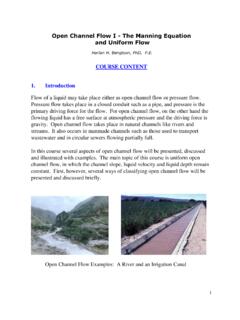
Transcription of OPEN-CHANNEL FLOW
1 OPEN-CHANNEL FLOW OPEN-CHANNEL flow is a flow of liquid (basically water) in a conduit with a free surface. That is a surface on which pressure is equal to local atmospheric surfacePatmPatmClassification of OPEN-CHANNEL FlowsOpen- channel flows are characterized by the presence of a liquid-gas interface called the free Natural flows : rivers, creeks, floods, etc. Human-made systems: fresh-water aquaducts, irrigation, sewers, drainage ditches, channelsNatural channelsArtificial channelsOpen cross sectionCovered cross sectionTotal Head at A Cross Section: The total head at a cross section is: where H=total headZ=elevation of the channel bottomP/g = y = the vertical depth of flow (provided that pressure distribution is hydrostatic)V2/2g= velocity headg2V + P+z=H2avEGLD atumxzy V2/2gQSf :the slope of energy grade lineSw :the slope of the water surfaceEnergy Grade Line & Hydraulic Grade Line in open channel FlowSf:the slope of energy grade lineSw:the slope of the water surfaceSo.
2 The slope of the bottomz1z2 Datum lineChannel bottomEGLy1y2V12/2gV22/2ghf12 OPEN-CHANNEL FlowHGLEGLHGLPipe centerlineDatum lineP1/ z1z2P2/ V12/2gV22/2gPipe Flow12 Comparison of open channel Flow and Pipe FlowComparison of open channel Flow & Pipe Flow1)OCF must have a free surface2)A free surface is subject to atmospheric pressure3)The driving force is mainly the component of gravity along the flow )HGL is coincident with the free )Flow area is determined by the geometry of the channel plus the level of free surface, which is likely to change along the flow direction and with as well as )No free surface in pipe flow2)No direct atmospheric pressure, hydraulic pressure )The driving force is mainly the pressure force along the flow )HGL is (usually) above the conduit5)Flow area is fixed by the pipe dimensions The cross section of a pipe is usually of open channel Flow & Pipe Flow6)The cross section may be of any from circular to irregular forms of natural streams, which may change along the flow direction and as well as with )Relative roughness changes with the level of free surface8)The depth of flow, discharge and the slopes of channel bottom and of the free surface are )The cross section of a pipe is usually circular7)The relative roughness is a fixed )No such of open channel Canal Flume Chute Drop Culvert open -Flow TunnelKinds of open channel CANAL is usually a long and mild-sloped channel built in the ground.
3 Kinds of open channel FLUME is a channel usually supported on or above the surface of the ground to carry water across a of open channel CHUTE is a channel having steep of open channel DROP is similar to a chute, but the change in elevation is affected in a short of open channel CULVERT is a covered channel flowing partly full, which is installed to drain water through highway and railroad of open channel open -FLOW TUNNEL is a comparatively long covered channel used to carry water through a hill or any obstruction on the Geometry A channel built with constant cross section and constant bottom slope is called a PRISMATIC channel . Otherwise, the channel is NONPRISMATIC. THE channel SECTIONis the cross section of a channel taken normalto the direction of the flow. THE VERTICAL channel SECTIONis the vertical section passing through the lowest or bottom point of the channel channel section (B-B)The vertical channel section (A-A)yGeometric Elements of channel Section THE DEPTH OF FLOW, y, is the verticaldistance of the lowest point of a channel section from the free surface.
4 Datumzh dyGeometric Elements of channel Section THE DEPTH OF FLOW SECTION, d, is the depth of flow normalto the direction of flow. Datum zh dy is the channel bottom slope d = ycos .For mild-sloped channels y Elements of channel Section THE TOP WIDTH, T,is the width of the channel section at the free surface. THE WATER AREA, A,is the cross-sectional area of the flow normal to the direction of flow. THE WETTED PERIMETER, P,is the length of the line of intersection of the channel wetted surface with a cross-sectional plane normal to the direction of flow. THE HYDRAULIC RADIUS, R = A/P,is the ratio of the water area to its wetted perimeter. THE HYDRAULIC DEPTH, D = A/T, is the ratio of the water area to the top = A(d)TPChannel Geometry The wetted perimeter does not include the free surface. Examples of R for common geometries shown in Figure at the hDBhflow areawetted perimeterPhydraulic radiushRtop widthBhydraulic depthhDbh()hmhb+2mh()2sin81D Bh32hb2+212mhb++212mh+D 21 BhB238+**hbbh2+()212mhbhmhb+++212mmh+D sin141222832hBhB+bmhb2+mh2()D2/sin Ah23()hDh 2or10 < ()mhbhmhb2++h2182/sinsinD h32*Valid forwhereBh/4= 1> If()()()[]221ln/112/ ++++=BPthenhGeometric elements for different channel cross sectionsTypes of Flow Criterion: Change in flow depth with respect to time and spaceSteady flow ( y/ t=0)Unsteady flow ( y/ t 0)Uniform Flow( y/ x=0)Varied Flow( y/ x 0)Uniform Flow( y/ x=0)Varied Flow( y/ x 0)GVFRVFGVFRVFOCFTime is a criterionSpace is a criterionTypes of Flow Criterion.
5 Change in discharge with respect to time and spaceOCFTime is a criterionSpace is a criterionSteady flow ( Q/ t=0)Unsteady flow ( Q/ t 0)Continuous Flow( Q/ x=0)Spatially-Varied Flow ( Q/ x 0)Continuous Flow( Q/ x=0)Spatially-Varied Flow ( Q/ x 0)Classification of OPEN-CHANNEL flows Obstructions cause the flow depth to vary. Rapidly varied flow (RVF) occurs over a short distance near the obstacle. Gradually varied flow (GVF) occurs over larger distances and usually connects UF and non-uniform flow in a channel . State of Flow Effect of viscosity: ====VRReOCFL aminar OCF, Re< 500 Transitional OCF, 500 < Re< 1000 Turbulent OCF,Re> 1000 Note that Rin Reynold number is Hydraulic RadiusEffect of Gravity In OPEN-CHANNEL flow the driving force (that is the force causing the motion) is the component of gravity along the channel bottom. Therefore, it is clear that, the effect of gravity is very important in OPEN-CHANNEL flow.
6 In an OPEN-CHANNEL flow Froude number is defined as: In an OPEN-CHANNEL flow, there are three types of flow depending on the value of Froude number:Fr>1 Supercritical FlowFr=1 Critical FlowFr<1 Subcritical FlowgDV=For gDV==F and ,ForceGravity Force Inertia=Fr22rrIn wave mechanics, the speed of propagation of a small amplitude wave is called the celerity, we disturb water, which is not moving, a disturbance wave occur, and it propagates in all directions with a celerity, C, as:For a rectangular channel , the hydraulic depth, D= , Froude number becomes:CV=gyV=Frgy=CCCCCC Now let us consider propagation of a small amplitude wave in a supercritical open channel flow: Since V > C, it CANNOT propagate upstream it can propagate only towards downstream with a pattern as follows: This means the flow at upstream will not be affected. In other words, there is no hydraulic communication between upstream and downstream > 1, ; V > CCCD isturbance will be felt only within this regionV Now let us consider propagation of a small amplitude wave in a subcritical open channel flow: Since V < C, it CANpropagate both upstream and downstream with a pattern as follows: This means the flow at upstream and downstream will both be affected.
7 In other words, there is hydraulic communication between upstream and downstream < 1, ; V < CCCV < CNow let us consider propagation of a small amplitude wave in a critical open channel flow:Since V = C, it can propagate only downstream with a pattern as follows:This means the flow at downstream will be affected. Fr= 1, ; V = CCCS tate of Flow Effect of gravity:D in Froude Number is Hydraulic DepthgDVFr====gDV<<<<gDV====gDV>>>>Velocity Profiles In order to understand the velocity distribution, it is customary to plot the isovels, which are the equal velocity lines at a cross Velocity is zero on bottom and sides of channel due to no-slip conditionthe maximum velocity is usually below the free surface. It is usually three-dimensional flow. However, 1D flow approximation is usually made with good success for many practical DistributionThe velocity distribution in an OPEN-CHANNEL flow is quite nonuniform because of : Nonuniform shear stress along the wetted perimeter, Presence of free surface on which the shear stress is Flow in Channels Flow in open channels is classified as being uniformor nonuniform, depending upon the depth y.
8 Depth in Uniform Flow is called normal depth yn Uniform depthoccurs when the flow depth (and thus the average flow velocity) remains constant Common in long straight runs Average flow velocity is called uniform-flow velocity V0 Uniform depth is maintained as long as the slope, cross-section, and surface roughness of the channel remain unchanged. During uniform flow, the terminal velocity reached, and the head loss equals the elevation drop2gV211 2gV222 xSo 2y1yx energy grade linehydraulic grade linevelocity headUniform Flow in ChannelsxSf lh2g22Vy2z2g21Vy1z21+++=++Sf=Sw=SoxShfl =DatumNon-uniform gradually varied =SfSf Sw SoChezy equation (1768)Introduced by the French engineer Antoine Chezy in 1768 while designing a canal for the water-supply system of Paris 150 < C < 60smsmC = Chezy coefficientwhere60 is for rough and 150 is for smoothalso a function of R(like fin Darcy-Weisbach)Darcy-Weisbach equation (1840)g2VR4 Lfg2 VDLfh2h2f==g2VR4 LfLS2hf=fh2fhSRfg8Vg8 VfSR= =hfV C R S=IMPORTANT:In Uniform Flow Sf=SoManning Equation for Uniform FlowDischarge:VAQ=2/1o3/2 SARn1Q=1/2o2/3SR n1V=Manning Equation(1891)Notes.
9 The Manning Equation 1) is dimensionally nonhomogeneous2) is very sensitive to n(English system)1/2f2/3hSR of Dimensions of nn??Is Is nnonly a function of roughness?only a function of roughness?(SI System)NO!T /L1/31/2f2/3hSR n1V=Values of Manning nValues of Manning nd = median size of bed material6 in ftd in mRelation between Resistance CoefficientsExample 1A trapezoidal channel has a base width b = 6 m and side slopes 1H:1V. The channel bottom slope is So = and the Manning roughness coefficient is n = Computea)the depth of uniform flow if Q = m3/sb)the state of flowyob = 6 myo11 Solution of Example 1a) Manning s equation is used for uniform flow;So = n = Q = m3/sY(m)A(m2)P(m)R(m)AR2 22 6 y 22bP )y(by /2)2.( +=+=+=+= )6()6( +++=oooooyyyyyby trial & error yo= myob = 6 myo11b) The state of flow gDVFrave==== , TAD==== , oy2bT++++==== A = (6+ ) = m2 T = 6+2 x =9 m D = / 9 = m <1 Subcritical Solution of Example 1 FloodPlainCompound ChannelGeneralized section representationactual cross sectioncompound-composite cross section.
10 Composite Section A channel section, which is composed, of different roughness along the wetted perimeter is called composite section. For such sections an equivalent Manning roughness can be defined asni,Pin1,P1 ====iiieqPP n n2 ==== ====niiFF eq. s'Pavlovski1f/eqS RnA Q32====Compound channel is the channel for which the cross section is composed of several distinct subsections312 Discharge computation in Compound Channels To compute the discharge, the channel is divided into 3 subsections by using vertical interfaces as shown in the figure: Then the discharge in each subsection is computed separately by using the Manning equation. In computation of wetted perimeter, water-to-water contact surfaces are not ============ ====31iitotalo3/2iiiiiQQ1,2,3i SPAnAQExample 2 Determine the discharge passing through the cross section of the compound channel shown below.