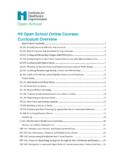
Transcription of Open School IHI Open School Online Courses: …
1 open School IHI open School Online Courses: course Summary Sheets Improvement 3 QI 101: Introduction to Health Care Improvement* .. 3 QI 102: How to Improve with the Model for Improvement* .. 5 QI 103: Testing and Measuring Changes with PDSA Cycles* .. 7 QI 104: Interpreting Data: Run Charts, Control Charts, and other Measurement Tools* .. 9 QI 105: Leading Quality Improvement* .. 11 QI 201: Planning for Spread: From Local Improvements to System-Wide Change .. 13 QI 202: Addressing Small Problems to Build Safer, More Reliable Systems.
2 15 Patient Safety .. 17 PS 101: Introduction to Patient Safety* .. 17 PS 102: From Error to Harm* .. 20 PS 103: Human Factors and Safety* .. 22 PS 104: Teamwork and Communication* .. 25 PS 105: Responding to Adverse Events* ..28 PS 201: Root Cause Analyses and Actions .. 30 PS 202: Achieving Total Systems Safety .. 33 PS 203: Pursuing Professional Accountability and a Just Culture .. 37 PS x1: Partnering to Heal: Teaming Up Against Healthcare-Associated Infections .. 40 PS x2: Preventing Pressure Ulcers .. 41 Leadership .. 43 L 101: Introduction to Health Care Leadership*.
3 43 Person- and Family-Centered Care .. 45 PFC 101: Introduction to Person- and Family-Centered Care* .. 45 PFC 102: Key Dimensions of Patient- and Family-Centered Care .. 47 PFC 201: A Guide to Shadowing: Seeing Care through the Eyes of Patients and Families .. 49 PFC 202: Having the Conversation: Basic Skills for Conversations about End-of-Life Care .. 50 2 53 State Street, Boston MA 02109 Triple Aim for Populations .. 52 TA 101: Introduction to the Triple Aim for Populations* .. 52 TA 102: Improving Health Equity .. 54 TA 103: Increasing Value and Reducing Waste at the Point of Care.
4 56 Graduate Medical 58 GME 201: Why Engage Trainees in Quality and Safety? .. 58 GME 202: The Faculty Role: Understanding & Modeling Fundamentals of Quality & Safety .. 59 GME 203: Designing Educational Experiences in Health Care Improvement .. 60 GME 204: A Roadmap for Facilitating Experiential Learning in Quality Improvement .. 61 GME 205: Aligning Graduate Medical Education with Organizational Quality & Safety Goals .. 62 Key 100 = Introductory concepts for all health care audiences 200 = Intermediate concepts and specialized topic areas 300 = Project-based learning *Basic Certificate in Quality and Safety = The open School offers a certificate of completion to learners who complete 13 essential courses: QI 101 105, PS 101 105, TA 101, PFC 101, & L 101 About Us The IHI open School s multimedia Online courses cover a range of topics in quality improvement, patient safety, system design, leadership, and population management.
5 Through narrative, video, and interactive discussion, the courses offer a dynamic learning environment to inspire students and health professionals of all levels. Courses are broken into digestible 15- to 40-minute lessons each focused on practical learning around a narrow topic designed for busy learners and educators. Institutional faculty and organizational leaders around the world rely on the courses as an easy way to bring essential training to students and staff. Visit to learn more about how the open School can help improve your interactions with patients, the safety within your organization, or any of the systems in which you live and work.
6 3 Improvement Capability QI 101: Introduction to Health Care Improvement* Lesson 1: Health and Health Care Today As medical science and information evolve at a record pace, health systems must face new challenges: o Providers are becoming more specialized, contributing to gaps in communication and care. o Populations are aging, and the disease burden is shifting toward chronic conditions. o Patient and families are better informed and want personalized care. o There is growing availability of and demand for complicated procedures.
7 Many health care systems, including the one in the United States, are struggling to make high-quality care available and affordable to all. Based on where someone lives and certain characteristics at birth, there are significant differences in the type of health and health care one is likely to experience; this is often true even within the same country or hometown. Although the root causes of inequalities in health care and human health by no means begin or end in the clinical setting, providers can do their part to help by learning and applying the science of improvement.
8 Lesson 2: The Institute of Medicine s Aims for Improvement In 2001, the Institute of Medicine (IOM) released a report, Crossing the Quality Chasm: Health Care in the 21st Century, that defined six key dimensions of our health care system upon which to focus improvement efforts. The report said care should be: o Safe: Avoid injuries to patients from the care that is intended to help them. o Timely: Reduce waits and sometimes harmful delays. o Effective: Provide the appropriate level of services. o Efficient: Avoid waste of equipment, supplies, ideas, and energy.
9 O Equitable: Care shouldn t vary in quality because of personal characteristics. o Patient-Centered: Care should be considerate of individual preferences. A helpful pneumonic to remember the IOM s six dimensions is STEEEP. 4 Lesson 3: Changing Systems with the Science of Improvement Every system is perfectly designed to get the results it gets; the only way to get different results is to change the system. The science of improvement has its origins in manufacturing in the 1920s, when famous engineers such as Walter A. Shewart and W.
10 Edwards Deming introduced a new type of science: applied science. Traditional scientific discovery is only helpful if people can apply it. Deming s System of Profound Knowledge is a simple way of understanding the four key aspects of a system that you need to think about in order to improve: o Systems thinking: What is the whole system that you re trying to manage? How do the different parts interact with and rely on one another? o Variation: What is the variation in results trying to tell you about the system? o Theory of knowledge: What are the predictions about the system s performance?