Transcription of Oregon Accessibility Manual
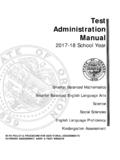
1 Oregon Accessibility Manual Final for 2017-18 School Year Smarter Balanced Mathematics Smarter Balanced English Language Arts Science Social Sciences English Language Proficiency Extended Assessments Kindergarten assessment WITH ADDITIONAL GUIDANCE FOR NAEP It is the policy of the State Board of Education and a priority of the Oregon Department of Education that there will be no discrimination or harassment on the grounds of race, color, religion, sex, sexual orientation, national origin, age or disability in any educational programs, activities or employment. Persons having questions about equal opportunity and nondiscrimination should contact the Deputy Superintendent of Public Instruction with the Oregon Department of Education. Oregon DEPARTMENT OF EDUCATION 255 Capitol Street NE Salem, OR 97310 (503) 947-5600 Salam Noor Deputy Superintendent of Public Instruction Sarah Drinkwater Assistant Superintendent All or any part of this document may be photocopied for educational purposes without permission from the Oregon Department of Education and distributed for the cost of reproduction.
2 This document is available for download from the Oregon Department of Education s Web site at It has been adapted from the Council of Chief State School Officers (CCSSO) publication Accommodations Manual : How to Select, Administer, and Evaluate Use of Accommodations for Instruction and assessment of Students with Disabilities, 2005 and the Smarter Usability, Accessibility , and Accommodations Guidelines, 2015. Contributors to the Oregon Accessibility Manual Vacant Director, assessment Holly Dalton Early Literacy and Math Specialist Carla Martinez Administrative Specialist Jon Wiens Director, Accountability Reporting Noelle Gorbett Science assessment Specialist Sheila Somerville Electronic Publishing Design Specialist Tony Bertrand English Language Arts and Social Sciences assessment Specialist Ren e LeDoux Administrative Specialist Bryan Toller Mathematics assessment Specialist Holly Carter assessment Operations and Policy Analyst Bradley J.
3 Lenhardt Monitoring and assessment Specialist Ben Wolcott English Language Proficiency assessment Specialist Contributing Organizations English Language Proficiency assessment for the 21st Century (ELPA21) National assessment of Educational Progress (NAEP) College Board Smarter Balanced assessment Consortium Equity, Accountability, Excellence & Integrity Table of Contents Introduction .. 4 SMARTER BALANCED .. 9 OAKS Science and Social Sciences .. 27 EXTENDED ASSESSMENTS .. 44 KINDERGARTEN ASSESSMENTS .. 56 ELPA21 .. 66 Appendix A: Embedded Accessibility Support Settings .. 78 Appendix B: Guidelines for Signed Interpretation Support (For OAKS, Extended assessment , and Kindergarten assessment Only) .. 90 Appendix C: Selection, Administration, and Evaluation of Accessibility Supports (STEPS and TEACHER TOOLS) .. 95 APPENDIX D: Oregon S Accessibility PANEL .. 117 APPENDIX E: APPROVAL PROCESS FOR A NEW Accessibility SUPPORT.
4 119 APPENDIX F: NATIONAL assessment OF EDUCATIONAL PROGRESS (NAEP) .. 122 Smarter Balanced Resources .. 138 INDEX .. 139 CHANGE LOG .. 140 ALL ROLES 4 | P a g e INTRODUCTION The Oregon Department of Education (ODE) strives to provide every student with a positive and productive assessment experience, generating results that are a fair and accurate estimate of each student s achievement. Further, ODE is building on a framework of Accessibility for all students, including English Learners (ELs), students with disabilities, and ELs with disabilities. In the process of developing its next-generation assessments to measure students knowledge and skills as they progress toward college and career readiness, ODE recognizes that the validity of assessment results depends on each and every student having appropriate universal tools, designated supports, and accommodations (cf. Table 1) when needed based on the constructs being measured by each assessment .
5 The Oregon Accessibility Manual (OAM) applies to the 2017-2018 school year and guides the selection and administration of universal tools, designated supports, and accommodations for Oregon s Statewide Assessments: The Smarter Balanced assessment (Smarter Balanced) in Mathematics and English Language Arts (ELA); The Oregon assessment of Knowledge and Skills (OAKS) in Science and Social Sciences; The Extended Assessments (XA) in Mathematics, ELA, and Science ; The Kindergarten assessment (KA); and The English Language Proficiency assessment for the 21st Century (ELPA21) ODE has made a few important changes to the 2017-18 Oregon Accessibility Manual compared to the 2016-17 Oregon Accessibility Manual . These changes are captured in the Change Log section of this Manual (cf. pp. 136ff). Smarter Balanced ELA and Mathematics assessments are based on the Common Core State Standards (CCSS), adopted by the Oregon State Board of Education in 2010; similarly, ELPA21 is based on the new ELP standards adopted by the State Board in 2013 that correspond to the Common Core State Standards and Next Generation Science Standards.
6 Thus, the universal tools, designated supports, and accommodations that are appropriate for these assessments may be different from those that were allowed in prior years. For Oregon s statewide assessments, districts and schools may only make available to students the universal tools, designated supports, and accommodations that are included in this OAM. Accessibility supports are intended to reduce or even eliminate the effects of a student s learning challenges during instruction and on the results of assessments. Implemented appropriately, these supports should not reduce learning expectations, nor should they give a student an unfair advantage over his or her classmates. Use of these supports during administration of an Oregon statewide assessment is based on individual student need and should not impact the validity of the assessment results. Since students will have previous experiences with those supports selected for use on statewide assessments, many of the same supports are typically used during instruction.
7 The OAM also presents a process for the selection, administration, and evaluation of the effectiveness of instructional and assessment supports (Appendix C). The process described in this Manual is designed for use by general education teachers, teachers of English Learners, special education teachers, test administrators, district level assessment staff, Individualized Education Program (IEP) teams, Section 504 Plan committees, or any other school team as they work with students to select and use appropriate supports during participation in Oregon s statewide assessments. ALL ROLES 5 | P a g e The specific universal tools, designated supports, and accommodations approved for Oregon s statewide assessments may change in the future if additional tools, supports, or accommodations are identified for the assessment based on state experience and research findings. For the Smarter Balanced ELA and Mathematics assessments, the Smarter Balanced Consortium has established a standing committee, including representatives from member states, that review suggested additional universal tools, designated supports, and accommodations to determine if changes are warranted.
8 Proposed changes to the list of universal tools, designated supports, and accommodations are brought to Governing members for review, input, and vote for approval. Furthermore, for Smarter Balanced, member states may issue temporary approvals ( , one summative assessment administration) for individual unique student accommodations or designated supports. State leads from member states of the Smarter Balanced Consortium will evaluate formal requests for unique accommodations/ designated supports and determine whether or not the request poses a threat to the measurement of the construct. Intended Audience and Recommended Use The OAM applies to all students. It emphasizes an individualized approach to the implementation of assessment practices for those students who have diverse needs and participate in Oregon s statewide assessments. This document focuses on universal tools, designated supports, and accommodations for Oregon s statewide assessment system.
9 At the same time, it supports important instructional decisions about Accessibility and accommodations for students who participate in these assessments. It recognizes the critical connection between Accessibility and supports in instruction and Accessibility and supports during assessment . The OAM is also supported by the Test Administration Manual . Oregon s online statewide assessments (Smarter Balanced Mathematics and ELA, OAKS Science and Social Sciences, and ELPA21) contain embedded and non-embedded universal tools, designated supports, and accommodations (defined in Table 1 (below). Embedded resources are those that are part of the computerized test delivery system, whereas non-embedded resources are provided outside of that system ( , by a test administrator). Oregon s paper-based Extended and Kindergarten Assessments only support non-embedded resources. Table : Definitions for Universal Tools, Designated Supports, and Accommodations Type Definition Universal Tools Access features of the assessment that are either provided as digitally delivered components of the test administration system or separate from it.)
10 Universal tools are available to all students based on student preference and selection. Designated Supports Access features of the assessment available for use by any student for whom the need has been indicated by an educator (or team of educators with parent/guardian and student). They are either provided as digitally delivered components of the test administration system or separate from it. ALL ROLES 6 | P a g e Type Definition Accommodations Accommodations are changes in procedures or materials that increase equitable access during the statewide assessments. assessment accommodations generate valid assessment results for students who need them; they allow these students to show what they know and can do. Note: accommodations are available only for students with documented Individualized Education Programs (IEPs) or Section 504 Plans. Accommodations do not compromise the learning expectations, construct, grade-level standard or intended outcome of the assessment .