Transcription of Organizational Behaviour and Leadership - …
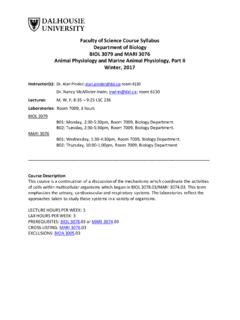
1 2015 Dalhousie University College of Continuing Education Page 1 Local Government Certificate Programs Organizational Behaviour and Leadership Description of the course Organizational Behavior and Leadership examines theories of individual behavior and Leadership within local government organizations. In particular, the course focuses on management in the public sector, theories of Leadership , council/staff roles and relationships, the structures and culture of local government organizations, notions of motivations in the public sector, the empowerment of staff, and Organizational change. Learning Objectives Explain what the field of Organizational behavior concerns, and something of its history and development, as well as its relationship to other fields of study Explain some of the uses of Organizational behavior research and theory, and its value to employees, managers, citizens and people working in a variety of kinds of organizations.
2 Including unions and non-profit associations Define what an organization is and discuss differing definitions Demonstrate an understanding of organizations as complex and pluralistic places where both conflict and cooperation are normal occurrences Identify some of the unique characteristics of local government organizations Describe some of the current challenges in the Canadian workplace Critically assess Organizational Behavior assumptions and arguments Examine what your study of Organizational behavior might mean to yourself, your career, and your local government organization Apply the concept of the open system as a means of understanding the relationship between the local government organization and its environment Analyze how elected officials and administrative staff form part of a system of relationships that blend political and administrative roles Explain what Organizational structure is and why it is important Demonstrate the importance of Organizational structure to the manager Summarize significant historical and current trends in the design of organizations, particularly in the public sector and in local government Recommend diagnostic concepts useful in identifying variations.
3 Strengths and weaknesses in the design of Organizational structures Discuss a variety of design options for structuring organizations, and to consider some of their strengths and weaknesses Identify and describe some typical structural patterns in local government organizations, the reasons for them, and some of the challenges they present to local government managers, elected officials and citizens 2015 Dalhousie University College of Continuing Education Page 2 Understand the concept of Organizational culture and how it can be described and diagnosed Illustrate why Organizational culture is important to managers Apply what we are learning about Organizational culture to local government organizations Explain how Organizational culture is created, sustained and changed Outline some of the currently influential theoretical perspectives on motivation.
4 And to explore their practical implications Discuss the various factors that contribute to motivation or lack of it Participate in some of the debates about why there are often motivation problems in the workplace Illustrate the importance of reward systems, including compensation, in motivating employees, and some of the options now in use Demonstrate the manager s role in creating and sustaining a workplace in which employees are motivated and productive Apply material to local government employees, jobs and organizations Explain what is involved in job satisfaction Describe some of the theories about management Explain job characteristics model and job design options and Apply material to local government employees.
5 Jobs and organizations Discuss some conceptual tools useful in understanding groups and teams Outline what contributes to successful group and team performance in the workplace Apply diagnostic concepts about teams and groups to the local government workplace Illustrate an understanding of some of the meanings of the concept of empowerment Demonstrate what is needed for people to be truly empowered in a workplace Outline the possibilities of empowerment in local government organizations Describe how managers can contribute to successful team performance in an empowered environment Explain some reasons why many experiments in empowerment are unsuccessful Use the case of empowerment to understand the common problem of the implementation gap the gap between theory and practice.
6 Describe what power is, how its presence is recognized, and how it is used in organizations Outline the various types and bases of power in organizations Discuss how power is distributed, and how and why its location changes Explain why it is important to understand power and its uses in organizations Illustrate both the positive and the oppressive faces of power Relate the benefits to managers of sharing power Explain how the power structure of organizations is gendered, and how sexual harassment is an abuse of power Demonstrate some of the reasons for the massive change we are experiencing in local government organizations, and some of the ways they are changing Critically assess the proposition that change can and should be planned Outline several models of change and the potential benefits and shortcomings of each model Describe why there is resistance to change, who may resist, and how resistance can be addressed 2015 Dalhousie University College of Continuing Education Page 3 Examine why proposals for change, when implemented, often fall short of their promise Apply what we are learning to the management of change in local government organizations Summarize the concept of Organizational learning.
7 And consider how it may apply in local government Describe the relationship between individual and Organizational learning Recommend and apply models of Organizational learning Course Outline Module 1 This course in Organizational Behaviour in local government settings will consider some of these current realities against the background of what can be learned from theory and research in Organizational Behaviour and public administration. Our study of Organizational Behaviour will equip us with a tool kit of concepts that will help you to make sense of the workplace. You will be encouraged and challenged to consider various points of view and to apply concepts from our readings and discussions to your local government organization, job and career.
8 Through on-line discussion you will be asked to relate and compare your personal experience, knowledge and point of view with those of others in the course. The ultimate objective of our work together is to deepen our understanding of local government organizations and our place in them. Module 2 In Unit 2, we examine the various kinds of Leadership that may be exercised in the local government context. The assignment for this module asks you to apply and interrelate some of the concepts you have learned in Units 1 and 2. Module 3 Continuous change in the structure and culture of their organizations has been a troubling reality for most Canadian public sector administrators, including those in local governments, over the past decade.
9 The ongoing turmoil of downsizing, de-layering, restructuring, amalgamation, outsourcing, privatization and partnerships has kept the work of managers and employees stressful and challenging and created many human problems of survivor guilt, sagging morale, anxiety about the future, a sense of powerlessness, burnout and overwork. Many of these restructuring projects have been driven by mantras such as market-driven, lean and mean, doing more with less, or driving the work and responsibility down to front-line employees. Often, there is the expectation that changing the organization s structure will also change its culture so as to refocus it on desired values, such as customer service or value for money.
10 But changing the structure does not always mean that Organizational values and ways of doing things have really changed. Module 4 The issue of motivation is central to the study of Organizational Behaviour and has long been a matter of concern to managers and employees. However, a comprehensive overview of published research on work motivation among public sector workers has found that little is known about the links between motivation and performance, and about the motivational context for government workers. While it is known that there are important differences between public and private sector organizations, we do not know how those differences specifically affect motivation of public sector employees at various levels.