Transcription of Introduction to Organizational Behaviour
1 Page 1 of 6 York University Faculty of Liberal Arts and Professional Studies School of Administrative Studies Introduction to Organizational Behaviour AP/ADMS 2400 Winter 2017 Section N Course Syllabus Last Update: January 5, 2017 Instructor: Adriana Berlingieri, PhD E-Mail: Class time: Mondays, 2:30pm, Room SLH B Office Hours: Wednesdays, 3:00pm-5:00pm, Atkinson 242 Course website: * When sending an email, please identify yourself with your full name, section, and student ID. COURSE DESCRIPTION & PREREQUISITES Introduces concepts of individual and group Behaviour as they affect performance in organizations. Topics covered include motivation, communication, decision-making, leadership and structural issues. Lectures and case discussions are employed to develop theoretical models and illustrate their use. Prerequisites: AP/ADMS 1000 Note: AP/ADMS 1000 cannot be taken concurrently with AP/ADMS 2400 COURSE OBJECTIVES The learning objectives of this course are to: 4 develop your understanding of major concepts and theories of individual and group behavior in organizations that guide management thinking today.
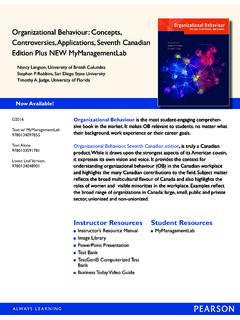
2 4 develop your ability to apply these concepts and theories to to recognize, analyze and suggest solutions to Organizational problems. 4 assist you in developing skills that will help you become a successful and contributing member of an organization (manager or otherwise). These objectives will be accomplished through lectures, class discussions, and exercises. REQUIRED COURSE TEXTBOOK/READINGS Organizational Behaviour : Concepts, controversies , Applications (7th Canadian Ed.)by Langton, Robbins & Judge, 2016. Published by Pearson Education Canada. [Note: Earlier editions not appropriate] York U s Bookstore provides three alternatives for purchase of the textbook: Regular textbook, e-Book, and loose-leaf (LL). You may choose the alternative that works best for you to access the required readings. Limited access to library reserves @ Bronfman. Introduction to Organizational Behaviour (AP/ADMS2400) Winter 2017, Course Syllabus York University 2016-2017 Page 2 of 6 IMPORTANT NOTES 4 Communication with the Course Director: Emails to the course director must include a professional greeting ( Dear Professor X), the student s name, student number, and the course/section enrolled in.
3 Please be respectful of this request to allow for efficient response to your message. Emails not containing this information may not be responded to. 4 About course registration: Please direct all registration questions to the main office of the School of Administrative Studies (Atkinson 282), ( ). Course Directors (instructors) cannot enroll or approve your enrollment to the course. If the section is full, the best strategy to enroll in the class is to visit the online course registration system regularly until a space becomes available. Please note that students can write exams and submit any work only in the section that they are registered in. 4 Students must attend and write exams in the section that they are registered in. 4 Any requests for a Course Performance Summary (CPS form, required for some petitions) should be submitted with all relevant materials to the SAS main office (282 Atkinson). COURSE EVALUATION Your course grade will be based on two components: Midterm examination: 40% (Sunday, February 12, 2pm-4pm) Final Examination: 60% GENERAL EXAMINATION POLICIES 4 Students seeking religious accommodations or alternate exam provisions are expected to follow York University policies and guidelines regarding advance notice and procedures.
4 4 Students must present identification at exams as determined by policies posted on the website of the Office of the Registrar. 4 Electronic devices and wireless devices (including cell phones and wearable devices) must be turned off during the examination. MIDTERM EXAMINATION 4 Date and time: Sunday, February 12, 2017, 2pm-4pm (duration: 2 hours) 4 Weighting: 40% of the final course grade. 4 Location: To be announced closer to the exam date. 4 Format: This is a closed-book exam. No materials allowed. Exam questions may include a combination of multiple choice, definitions, short/long written answers, and case-based questions. 4 Coverage: Content of Lectures 1 through 5, including all assigned readings and all in-class content and materials (including exercises, videos, cases and class discussions). 4 What to Bring? Pen, pencil, a good eraser. Proper identification (YU-Card / sessional identification card).
5 You may wish to bring a bottle of water, and maybe something sweet to keep you going (no noisy wrappers please). 4 Additional details will be provided, as needed, in class and on the course website. Continued on the next page Introduction to Organizational Behaviour (AP/ADMS2400) Winter 2017, Course Syllabus York University 2016-2017 Page 3 of 6 MIDTERM EXAMINATION CONFLICTS & MISSED MIDTERM EXAMINATIONS 4 Any exam conflicts (religious accommodations, or overlap with another YU midterm examination) must be communicated by the student to the Course Director (instructor) via email no later than January 29 2017. When the conflict is with other midterm examinations, full details about the other exams must be provided course, section, date and time of exam. 4 The weight of the Midterm Examination cannot be transferred to the Final Examination. 4 Students who were unable to write the Midterm Examination on its original date may request approval to write a make-up Midterm Examination.
6 To be considered, requests must include valid documentation and received no later than 5 (five) business days from the date of the Midterm Examination as detailed below. NOTE: Students whose requests are not approved, or those who did not submit a request within the required timeline, will receive a grade of zero on the Midterm Examination. 4 When a student did not write the exam on its original date due to medical reasons, the student must communicate this matter promptly to the Course Director (instructor) via email, and submit an Attending Physician's Statement (APS) to 282 Atkinson no later than five (5) working days after the exam. A Doctor s Note will not be accepted. The APS must indicate that the student s condition was significantly severe as to affect their ability to write the exam as required. Form: 4 When a student did not write (or asks in advance not to write) the exam on its original date due to a reason other than medical, the student may appeal to write a make-up exam based on compassionate grounds.
7 The student must communicate this matter promptly (in advance when relevant) to the Course Director (instructor) via email. Students must submit a signed statement indicating the reason for the request (such as, a death in the immediate family), and provide relevant documentation to support this request along with this statement to 282 Atkinson. 4 When approval is granted for a make-up exam, students will be informed by e-mail. It is the responsibility of the student to inquire about the results of their request if they do not receive an e-mail notice by February 21st. FINAL EXAMINATION 4 Date and time: The exam will take place during the formal examination period for the semester. Date and time will be published by the Registrar s Office. Duration: 3 hours. 4 Weighting: 60% of the final course grade. 4 Format and coverage: The final exam will test your understanding and application of course content.
8 This is a closed-book exam. No course materials, papers, notes, books, etc. are allowed. Further information will be provided prior to the exam date. 4 Conflict exams for final exams are handled through the Registrar s Office. WEEKLY COURSE SCHEDULE The weekly course schedule and assigned readings are provided on the next page. Check your section s website for lecture dates. * Visit the course website regularly for updates, schedule changes, and any additional materials and tasks. When a chapter is assigned, students are responsible for the content of the complete chapter, unless specific pages or exclusions are noted. Introduction to Organizational Behaviour (AP/ADMS2400) Winter 2017, Course Syllabus York University 2016-2017 Page 4 of 6 WEEKLY COURSE SCHEDULE (CONT.) IMPORTANT NOTES ABOUT THE WEEKLY SCHEDULE Learning Outcomes: Each of our textbook chapters begins with a listing of Learning Outcomes (LOs) all LOs are assigned, unless otherwise noted in the table below.
9 Your Course Director may provide updates or changes to these requirements during the term. OB at Work : Each of our textbook chapters concludes with this section (pages framed in orange). The first page of this section is normally assigned as required reading ( for for for You ). The rest of the pages in this section are optional, unless assigned by your Course Director. Please note that PIAs, videos, and simulations on MyManagementLab which are listed along the margins of the chapter pages are optional, unless assigned by your Course Director. Lecture Topic Required Readings (LOs = Chapter s Learning Outcomes) 1 Introduction Chapter 1, pp. 2-27 (all LOs) 2 Perception, Personality & Emotions Chapter 2, pp. 36-71 (all LOs) 3 Attitudes, Values & Diversity Chapter 3, pp. 78-112 (all LOs) 4 Motivation Chapter 4, pp. 126-158 (all LOs) Chapter 5, pp. 174-184 (LO#3, LO#4 & LO#5) 5 Organizational Justice & Individual Decision Making Chapter 4, pp.
10 148-151 ( Fair Process and Treatment , LO#6) Chapter 12, pp. 412-422 (LO#1 & LO#2) Midterm Exam -- Sunday, February 12th (2pm-4pm) Reading Week (February 18th-24th) 6 Groups, Teamwork & Group Decision Making Chapter 6, pp. 202-233 (all LOs) Chapter 12, pp. 422-428 (LO#3 & LO#4) 7 Communication & Trust Chapter 7, pp. 246-267 (all LOs) & OB on the Edge about Trust (pp. 240-245) 8 Power & Leadership Chapter 8, pp. 274-290 (LO#1 through LO#7) Chapter 11, pp. 378-405 (all LOs details TBA) 9 Conflict & Negotiations Chapter 9, pp. 308-333 (all LOs) 10 Organizational Culture & Socialization Chapter 10, pp. 346-370 (all LOs) 11 Organizational Change & Stress Chapter 14, 486-508 (all LOs) & OB on the Edge about Stress (pp. 118-125) Final Exam -- During the formal Winter Term examination period (April 7th 24th) Introduction to Organizational Behaviour (AP/ADMS2400) Winter 2017, Course Syllabus York University 2016-2017 Page 5 of 6 RELEVANT SCHOOL & UNIVERSITY INFORMATION AND POLICIES 4 Getting support when you need it: Visit the following sites for various information resources that are available to you (academic and non-academic): Manage your Academic Record: Learning Commons: Writing Centre: Counselling and Disability Services: Office of Student Community Relations: Additional student resources: 4 For important sessional dates, please refer to: 4 Deferred standing may be granted to students who are unable to write their final examination at the scheduled time or to submit their outstanding course work on the last day of classes.