Transcription of Overcoming Language Barriers - NY DCJS
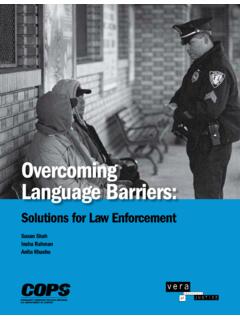
1 Overcoming Language Barriers :Solutions for Law EnforcementSusan ShahInsha RahmanAnita KhashuThis project was supported by Cooperative Agreement #2005-HS-WX-K001 by the Department of Justice Office of Community Oriented Policing Services. Points of view or opinions contained in this document are those of the authors and do not necessarily represent the official position or policies of the Department of SummaryIn order to do their jobs effectively and safely, sworn and civilian law enforcement personnel must be able to communicate with the people they serve including the growing number of immigrant communities that do not speak English it may seem daunting to take on the task of Overcoming Language Barriers , there are cost-effective steps that agencies can take. And these steps can be tailored to meet each agency s unique needs and capacities. The practical suggestions offered in this report range from relatively simple such as training staff on how to utilize telephonic and ad hoc interpreters to the comparatively ambitious such as pooling Language resources among local government agencies.
2 For those law enforcement agencies that are able to develop a comprehensive Language assistance response, this report offers guidance on how to create Language access policies, staff trainings, and partnerships with local community organizations to educate immigrant residents. Whether or not your agency is able to implement all of the strategies suggested in this report, you will learn from what other departments have done. You may even be inspired to adapt these practices, adding to the growing list of innovations in this important topic in law enforcement. From Vera s DirectorThe number of immigrants living within the United States is growing. Unlike in the past, however, many are settling in suburbs, small towns, and rural areas, bringing new cultures and languages to places previously unaccustomed to such cultural diversity. As a result, many law enforcement agencies around the nation are dealing with unfamiliar languages as they work to ensure public safety.
3 Overcoming these challenges is essential. When Language Barriers prevent immigrants from, say, reporting a crime or describing a suspect, it becomes harder for officers to provide protection or gather evidence. And police often work in high pressure situations where communication needs to happen report draws upon real-life lessons from Translating Justice, a project of Vera s Center on Immigration and Justice, which worked with law enforcement agencies in California, Nevada, and Ohio to develop Language access plans and policies suitable for their particular jurisdictions. The report provides practical guidance for how law enforcement agencies of different sizes, capacities, and circumstances can begin to address Language Barriers they encounter. For more information about Vera s Translating Justice project or other technical advice on Overcoming Language Barriers , visit or call (212) 334-1300.
4 Michael P. Jacobson Director, Vera Institute of Justice O V E R C O M I N G L A N G U A G E B A R R I E R S : S O L U T I O N S F O R L A W E N F O R C E M E N T At the core of community policing are partnerships and problem solving, but those essential elements can be hindered if law enforcement is not able to communicate with the growing diverse population in this country. Recognizing the need to improve communication and interaction with limited English proficient individuals is among the next steps in advancing community policing. By developing and implementing a Language access plan, law enforcement agencies will be able to strengthen their police-community relations, increase trust, and be better positioned to address public safety problems. C A Rl R . PE Ed, director, department of Justice Office of Community Oriented Policing ServicesOvercoming Language Barriers : Solutions for Law EnforcementA Changing Population Requires a Change in Law EnforcementHow Law Enforcement Can Bridge the Language Gap Know Who You are Serving Establish Language Access Policies and Protocols and Evaluate Success Educate Staff About Language Access Identify and Train Bilingual Staff Notify the Public About Your Agency s Language Assistance Services Pool Language Access ResourcesIt is Possible to Ensure Language AccessStrategies for Your Agency to Ensure Language AccessResources368911111313141516 O V E R C O M I N G L A N G U A G E B A R R I E R S.
5 S O L U T I O N S F O R L A W E N F O R C E M E N TAround five o clock one morning, a police officer driving along Main Street sees a beat-up car swerve erratically as it approaches an empty intersection. The car slows but continues through the red light, so the officer begins to follow, turning on his emergency light bar. Moments later, the officer approaches the car on foot as the driver, slumped in his seat, slowly lowers the window. The officer asks the driver for his license and registration. Qu ? the man replies, still slumped forward. The officer repeats his question. No hablo ingl s, is the reply. The third time he asks, the police officer mimes the motion of removing a wallet from his back pocket. The driver reacts by opening the door and starting to get out. Stay in the car and put your hands on the steering wheel, the officer commands, abruptly. But still the driver does not understand.
6 Whether during a routine car stop or in a high stakes homicide investigation, as a law enforcement officer you need to be able to communicate effectively to do your job. Yet, as growing numbers of immigrants become more geographi-cally dispersed throughout the United States, incidents like the one described above where communication breaks down are commonplace. Law enforcement agencies of diverse sizes and means around the country are responding with a variety of promising and effective new strategies for com-municating with victims, suspects, and witnesses who speak little or no English. Even where police departments and sheriffs offices have limited resources and few or no bilingual officers, some have found ways to bridge the Language gap and make services more accessible. O V E R C O M I N G L A N G U A G E B A R R I E R S : S O L U T I O N S F O R L A W E N F O R C E M E N T This report highlights a range of tools that law enforcement agencies can use to improve communication with non-English speaking persons within their jurisdic-tions.
7 It draws upon lessons learned from a project involving the Vera Institute of Justice and law enforcement agencies in Anaheim, California; Clark County (Las Vegas), Nevada; and Clark County, Ohio, that was funded by the Department of Justice s Office of Community Oriented Policing Services. (For more informa-tion about this project, see About Translating Justice on page 6.) Our population is much different than it was 19 years ago, when I first became sheriff. I ve taken an oath to serve and protect all in my county, not just the ones who we can understand. There are so many times when a Language barrier could cost someone his or her life. S hE R If f GE n E K E l ly, Clark County, OhioA Changing Population Requires Changes in Law EnforcementIn recent years, the United States has seen the biggest wave of immigration since the early 20th century. The number of residents born in a different country increased by 57 percent between 1990 and 2000, going from mil-lion to Most of the new arrivals emigrated from Latin America, although many traveled from Asia and Africa.
8 In comparison, Europe, once the primary source of immigrants, now contributes a relative trickle. Even faced with increased border, port, and airport security since September 11, 2001, large numbers of immigrants continue to arrive. In another departure from the past, today s newcomers are moving beyond gate-way cities like New York and Los Angeles and settling in suburbs, small towns, and rural areas, attracted by greater economic opportunity and a lower cost of living. Latino immigrants predominantly from rural Mexico are now the backbone of the seasonal and year-round agricultural workforce in a growing number of rural areas across the Midwest and South. Western states, meanwhile, have seen growth in a variety of immigrant groups. More than one-third of the nation s foreign-born population lived in the West in 2000; most were of either Hispanic or Asian origin.
9 O V E R C O M I N G L A N G U A G E B A R R I E R S : S O L U T I O N S F O R L A W E N F O R C E M E N TGlossary A BIlIN gUAl: Able to speak effectively in two IMMIgrANT: A person who leaves one country to settle in another. Motives for immigration can include economic, religious, political, or social factors. A INTErPrETATION: The process of orally rendering communication from one Language into another. Interpretation deals with oral or signed speech. Someone who interprets is called an Language A CCESS: A term used to describe an agency or organization s efforts to make its programs and services accessible to lEP lIMITED E NglISH PrOFICIENT ( lEP): A person is lEP if his/her native Language is not English and s/he has a limited ability to speak, read, write, or understand English. A TElEPHONIC INTErPrETINg SErVICE: An over-the-phone interpretation service in which off-site interpreters assist public and private organizations in communicating with people who are TrANSlATION: Changing a written text from one Language into an equivalent written text in another Language .
10 Translation deals with written texts. A translator performs the act of s immigrants bring with them a diverse range of cultures and, more criti-cally, languages. The 2000 Census found that almost 20 percent of residents speak a Language other than English at home, and 8 percent qualify as limited English proficient (LEP).2 For public safety and social service agencies, the chal-lenge of communicating and building trust with these new residents can be first responders for public safety, law enforcement personnel face a special burden. Police officers cannot perform their duties well when they cannot com-municate with the people they serve. When Language Barriers prevent individuals from reporting a crime or describing a suspect, for example, it becomes that much harder for police to gather evidence or provide protection. As one officer said, Language discordance is our biggest challenge when serving the Hispanic community.