Example: tourism industry
OXIDATIVE-PHOSPHORYLATION FADH2 NADH
moving protons across a membrane—the PMF. Probably it takes more than 20 kJ/mol to swing the flagellum motor around. Thus it is perfectly possible that ATP synthesis could take multiple protons to make each ATP. [2] Active transport means that you spend energy transporting metabolites and proteins across the membrane.
Tags:
Information
Domain:
Source:
Link to this page:
Documents from same domain
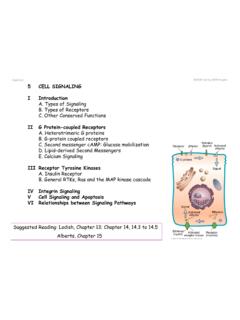
I Introduction II G Protein-coupled Receptors III Receptor ...
mcb.berkeley.eduSignaling 5 MCB110-Spring 2008-Nogales In paracrine signaling the signaling molecule affects only target cells in the proximity of the signaling cell. An example is the conduction of an electric signal from one nerve cell to another or to a muscle cell. In this case the signaling molecule is a neurotransmitter. In autocrine signaling cells ...
Making Electrocompetent Cells - Department of …
mcb.berkeley.eduMaking Electrocompetent Cells Day 1 1. Streak out frozen glycerol stock of bacterial cells (Top 10, DH5α, etc.) onto an LB plate (no antibiotics).
NEUROBIOLOGY LABORATORY MCB 160L
mcb.berkeley.eduNeurobiology is a very diverse field. The nervous system is studied by an incredible variety of techniques in electrophysiology, biochemistry, anatomy, cell biology, molecular biology,
PENTOSE PHOSPHATE PATHWAY
mcb.berkeley.eduMetabolism Lecture 5 — PENTOSE PHOSPHATE PATHWAY — Restricted for students enrolled in MCB102, UC Berkeley, Spring 2008 ONLY Oxidative Phase: Glucose-6-P Ribose-5-P Glucose 6-phosphate dehydrogenase.
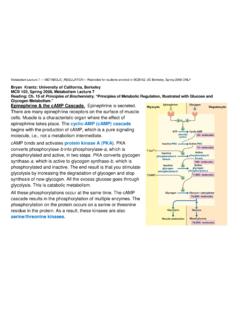
cyclic-AMP (cAMP) cascade protein kinase A (PKA). PKA
mcb.berkeley.eduMetabolism Lecture 7 — METABOLIC_REGULATION— Restricted for students enrolled in MCB102, UC Berkeley, Spring 2008 ONLY Phases of the TCA Cycle. [1] Acetyl-CoA production: Organic fuels Acetyl-CoA [2] Acetyl-CoA oxidation: Acetyl-CoA enters TCA and is enzymatically oxidized, but energy is conserved in electron carriers, NADH FADH 2
cyclic-AMP (cAMP) cascade protein kinase A (PKA). …
mcb.berkeley.eduThe cyclic-AMP (cAMP) cascade begins with the production of cAMP, which is a pure signaling molecule, i.e., not a metabolism intermediate. cAMP binds and activates protein kinase A (PKA). PKA converts phosphorylase-b into phosphorylase-a, which is phosphorylated and active, in two steps. PKA converts glycogen
PowerPoint Presentation - ALZHEIMER’S DISEASE
mcb.berkeley.eduAlzheimer’s Disease Progresses Through Distinct Stages Mild Moderate Severe Memory loss Language problems Mood swings Personality changes Diminished
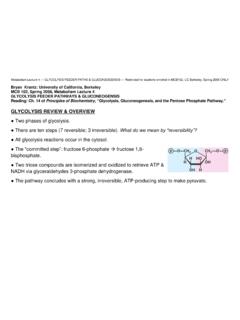
GLYCOLYSIS REVIEW & OVERVIEW
mcb.berkeley.eduThe “committed step”: fructose 6-phosphate fructose 1,6-bisphosphate. Two triose compounds are isomerized and oxidized to retrieve ATP & NADH via glyceraldehydes 3-phosphate dehydrogenase. The pathway concludes with a strong, irreversible, ATP …
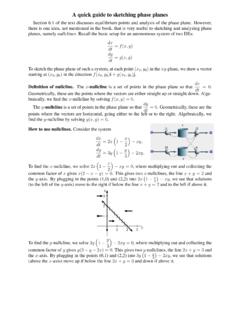
A quick guide to sketching phase planes
mcb.berkeley.eduA quick guide to sketching phase planes Section 6.1 of the text discusses equilibrium points and analysis of the phase plane. However, there is one idea, not mentioned in the book, that is very useful to sketching and analyzing phase planes, namely nullclines. Recall the basic setup for an autonomous system of two DEs: dx dt = f(x,y) dy dt = g(x,y)
Practice problems answ
mcb.berkeley.eduPractice problems (with answers) This is the degree of difficulty of the questions that will be on the test. This is not a practice test because I did not consider how long it would take to finish these problems. It also does not have a matching section, which I will include on the test. 1. DNA polymorphisms on the Y chromosome and on mtDNA ...
Related documents
Bacterial Classification, Structure and Function
www.columbia.edulecture will: 1. Cover different classification schemes for grouping bacteria, especially the use of ... The precursor is then linked to a lipid-like carrier in the cell membrane (bactoprenol) and N-acetyl glucosamine (NAG) is added to the NAM. This ... the need for transport mechanisms across this membrane.

Human Physiology/Cell physiology
www.sd27j.orgPassive Transport Across the Cell Membrane Passive transport describes the movement of substances down a concentration gradient and does not require energy use. • Bulk flow is the collective movement of substances in the same direction in response to a force, such as pressure. Blood moving through a vessel is an example of bulk flow.

Chapter 4 Pedigree Analysis in Human Genetics
www.bio.brandeis.eduions across the plasma membrane • Reduces fluid in glandular ... Autosomal Recessive Trait •Hemoglobin is an oxygen transport molecule in red blood cells (RBC) •Sickle cell hemoglobin is abnormal and causes RBCs to become crescent or sickle shaped •RBCs are fragile

Human Physiology (Biology 4) Lecture Notes
laney.educ. transport of vesicles (1) special motor proteins (e.g. kinesin) attach to vesicle and microtubule, pulling vesicle along d. movement of cilia and flagella (1) project from surface of cell (2) cilia are shorter, hairlike, many on a single cell; move substances across surface of …

UNDERGRADUATE
www.mona.uwi.edufunctions of the major types of membrane proteins. Movement of substances across cell membrane; membrane potentials and excitable membranes. 5. Extracellular Matrices: Proteins and proteoglycans, cartilage, bone and biomineralisation. 6. Enzyme Activity: Mechanisms of enzyme catalysis; an introduction to enzyme kinetics. 7.

FUNCTIONS OF THE NERVOUS SYSTEM
www.pc.maricopa.edu2. If the plasma membrane of a Schwann cell wraps many times around an axon, it forms a myelin sheath. 3. The plasma membrane of a Schwann cell forms a myelin sheath around one axon. 4. Satellite cells are specialized Schwann cells that surround the cell bodies of neurons in the peripheral nervous system. They provide support and nutrients.

Cell Str UC tU re and F C tion 9 Cellular Respiration and ...
www.pearson.comInner membrane of mitochondria or plasma membrane of prokaryotes Occurs in: Figure 9.2 Cellular Respiration Oxidizes Glucose to Make ATP. Cells produce atP from glucose via a series of processes: (1) glycolysis, (2) pyruvate processing, (3) the citric acid cycle, and (4) electron transport and oxidative

Basic Concepts in Pharmacokinetics - Warwick
warwick.ac.ukinto the bloodstream (or lymph), usually across a membrane Systemic routes of drug administration: Intravascular – placement of the drug directly into blood (intravenous (iv) or intra-arterial) Extravascular – oral, sublingual, subcutaneous, intramuscular, rectal Most drugs administered extravascularly act systemically. In such

Microbial Growth - Bellarmine University
www.bellarmine.edu- 1 1. Describe the four phases of a microbial growth curve observed when microbes are grown in a batch culture 2. Describe three hypotheses proposed to account for the decline in cell numbers during the death phase of a growth curve 3. Predict how the presence of viable but nonculturable cells in food or water systems might impact public health 46