Example: biology
Oxygen Enriched Combustion Process - Energy Tips
gases. During air–fuel combustion, the chemically inert nitrogen in the air dilutes the reactive oxygen and carries away some of the energy in the hot combustion exhaust gas. An increase in oxygen in the combustion air can reduce the energy loss in the exhaust gases and increase heating system efficiency. Most industrial furnaces
Tags:
Information
Domain:
Source:
Link to this page:
Documents from same domain

Best Practices Guide for Energy-Efficient Data …
www.energy.govFEDERAL ENERGY MANAGEMENT PROGRAM Best Practices Guide for Energy-Efficient Data Center Design Revised March 2011 Prepared by the National Renewable Energy Laboratory (NREL), a national laboratory

Hydrogen Compatibility of Materials
www.energy.gov• Material did not meet specification: ... •B31.12 Hydrogen Piping and Pipelines ... • Technical Reference for Hydrogen Compatibility of Materials

Street Lighting and Blue Light – Frequently Asked …
www.energy.govStreet Lighting and Blue Light – Frequently Asked Questions These frequently asked questions (FAQs) have been assembled in response to ongoing discussion of the
CONTRACT MANAGEMENT PLAN TEMPLATE …
www.energy.govcontract management plan template (optional) contract management plan contracting activity name ... contract management plan for the contract activity name

Transmission Basics - US Department of Energy
www.energy.govTransmission Basics ... Transmission, Distribution System • A typical power generation, transmission and distribution system has these components:
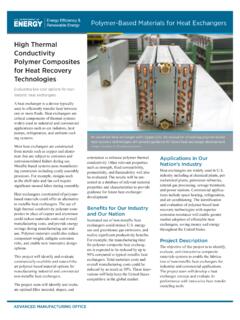
Polymer-Based Materials for Heat Exchangers
www.energy.govmetallic heat exchangers . A heat exchanger is a device typically ... properties and characteristics to provide ... The identification
Identification of Five Chemical Families for Detailed ...
www.energy.govsimultaneously investigate advanced engine designs and the enabling fuel properties. ... Identification of Five Chemical Families for ... HoV heat of vaporization

COLLECTIVE BARGAINING AGREEMENT BETWEEN
www.energy.gov2013 COLLECTIVE BARGAINING AGREEMENT BETWEEN Department of Energy Headquarters and the
UNITED STATES OF AMERICA - Department of Energy
www.energy.govunited states of america department of energy . office of fossil energy _____ ) delfin lng llc ) fe docket no. 13-147-lng

Information Technology (IT) Reporting Format and ...
www.energy.govInformation Technology (IT) Reporting Format and Requirements for the ... (displayed monthly ), ... BY2017 IT Reporting Format and Requirements .
Related documents

GER-4211 - Gas Turbine Emissions and Control
www.ge.comturbine emissions, cycle performance, and maintenance inspection intervals. The latest technology includes Dry Low NO x and catalytic combustion. These topics are covered in other GERs. Emissions Characteristics of Conventional Combustion Systems Typical exhaust emissions from a stationary gas turbine are listed in Table 1. There are two dis ...
1.3 Fuel Oil Combustion
www3.epa.govThe rate of carbon monoxide (CO) emissions from combustion sources depends on the oxidation efficiency of the fuel. By controlling the combustion process carefully, CO emissions can be minimized. Thus if a unit is operated improperly or not well maintained, the resulting concentrations of CO (as well

Office of Environment and Energy January 2015
www.faa.govAviation Emissions, Impacts & Mitigation: A Primer . Aviation Emissions . Aircraft, cars, trucks, and other vehicles operating at the airport create emissions as a result of the combustion of fuel as summarized in Table 1. Aircraft engines produce carbon dioxide (CO. 2), which comprises about 70% of the exhaust, and water vapor (H. 2

COMBUSTION CHAMBERS
www.nitc.ac.inof inlet and exhaust valves. Because of the importance of combustion chamber design, ... High thermal efficiency and low specific fuel consumption ... gas without substantial in crease in the hydrocarbon emissions. It can also burn very lean mixtures within the normal constraints of engine smoothness and response. A faster burning chamber ...

Waste Heat Reduction and Recovery for Improving Furnace ...
www.energy.govEfficiency, Productivity, and Emissions Performance or lean (excess air). Either way, it wastes fuel. Because there is not enough air for complete combustion, oper-ating the burners at rich combustion conditions wastes fuel by allowing it to be discarded with some of its energy unused.
The US Natural Gas Compression Infrastructure ...
netl.doe.govexhaust heat. • Mostly small GTs • Problems with recuperator durability • Difficult for variable speed applications Higher Pressure Ratio : Increases cycle efficiency. • Large aero GTs • Problems with DLN combustion • Problems with compressor cooling. All figures courtesy of Elliott Group, Solar Turbines Inc., Southwest Research ...
Internal Combustion Engines
authors.library.caltech.edu4. Exhaust. The exhaust valve opens and the piston rises, expelling the burned gas from the cylinder. The fuel and air mixture is commonly premixed in a carburetor. Figure 4.2 shows how engine power and fuel consumption depend on equivalence ratio over the range commonly used in internal combustion engines. Ratios below 0.7 and above 1.4 gen
3.3 Gasoline And Diesel Industrial Engines
www3.epa.govcombustion product that appears in the exhaust when the reaction of CO to CO2 cannot proceed to completion. This situation occurs if there is a lack of available oxygen near the hydrocarbon (fuel) molecule during combustion, if the gas temperature is too low, or if the residence time in the cylinder is too short.