Transcription of P2M EOM - Wilden Pumps
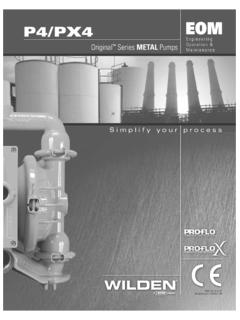
1 EOMS implify your processEngineering Operation &MaintenanceOriginal Series METAL PumpsP2 MWIL-10180-E-02 Replaces EOM-P2M 04/05 TABLE OF CONTENTSPAGE #SECTION 1 CAUTIONS .. 1 SECTION 2 PUMP DESIGNATION SYSTEM .. 2 SECTION 3 HOW IT WORKS (PUMP & AIR SYSTEMS) .. 3 SECTION 4 DIMENSIONAL DRAWINGS A. P2 METAL .. 4 B. P2 METAL SANIFLOFDA .. 4 C. P2 METAL Bolted .. 5 SECTION 5 PERFORMANCE CURVES A. P2 METAL Rubber-Fitted .. 6 B. P2 METAL TPE-Fitted .. 6 C. P2 METAL PTFE-Fitted .. 7 SECTION 6 SUCTION LIFT CURVES .. 7 SECTION 7 INSTALLATION AND OPERATION A. Installation .. 8 B. Operation & Maintenance.
2 9 C. Troubleshooting .. 10 SECTION 8 DIRECTIONS FOR DISASSEMBLY/REASSEMBLY A. P2 METAL Wetted Path Tools Required, Torque Specs, Cautions .. 11 B. Pro-Flo Air Valve/Center Block Disassembly, Cleaning, Inspection .. 13 C. Reassembly Hints & Tips .. 15 SECTION 9 EXPLODED VIEW/PARTS LISTING A. P2 METAL Rubber/TPE-Fitted .. 16 B. P2 METAL PTFE-Fitted .. 18 SECTION 10 ELASTOMER OPTIONS .. 20 ClassI& Clean Air ActAmendments of 19901 Wilden PUMP & ENGINEERING, LLCWIL-10180-E-02 TEMPERATURE LIMITS: Polypropylene 0 C to C 32 F to 175 F Acetal C to C 20 F to 150 F Neoprene C to C 0 F to 200 F Buna-N C to C 10 F to 180 F EPDM C to C 60 F to 280 F Viton 40 C to C 40 F to 350 F Wil-Flex 40 C to C 40 F to 225 F Polyurethane C to C 10 F to 150 F Saniflex C to C 20 F to 220 F PTFE C to C 40 F to 300 FCAUTION: When choosing pump materials, be sure to check the temperature limits for all wetted compo-nents.
3 Example: Viton has a maximum limit of C (350 F) but Acetal has a maximum limit of only C (150 F).CAUTION: Maximum temperature limits are based upon mechanical stress only. Certain chemicals will significantly reduce maximum safe operating tempera-tures. Consult engineering guide for chemical compat-ibility and temperature : Always wear safety glasses when operat-ing pump. If diaphragm rupture occurs, material being pumped may be forced out air : Prevention of static sparking If static sparking occurs, fire or explosion could result. Pump, valves, and containers must be properly grounded when handling flammable fluids and whenever discharge of static electricity is a hazard.
4 CAUTION: Do not exceed bar (125 psig) air supply : Before any maintenance or repair is attempted, the compressed air line to the pump should be disconnected and all air pressure allowed to bleed from pump. Disconnect all intake, discharge and air lines. Drain the pump by turning it upside down and allowing any fluid to flow into a suitable container. CAUTION: Blow out air line for 10 to 20 seconds before attaching to pump to make sure all pipe line debris is clear. Use an in-line air filter. A 5 (micron) air filter is : Tighten all hardware prior to installation. Fittings may loosen during : When installing PTFE diaphragms, it is impor-tant to tighten outer pistons simultaneously (turning in opposite directions) to ensure tight : Before starting disassembly, mark a line from each liquid chamber to its corresponding air chamber.
5 This line will assist in proper alignment during : Verify the chemical compatibility of the process and cleaning fluid to the pump s component materials in the Chemical Resistance Guide (see E4).CAUTION: Do not over-tighten the air inlet reducer bushing. Too much torque on the reducer may damage either the reducer bushing or center section. Do not exceed N m (8 ft-lbs).CAUTION: Do not exceed the maximum torque specification of N m (115 in-lbs) on the liquid chamber to air chamber fasteners on the P2 Bolted 1P2 METALCAUTIONS READ FIRST!2 Wilden PUMP & ENGINEERING, LLCWIL-10180-E-02 SECTION 2 Wilden PUMP DESIGNATION SYSTEMNOTE: MOST ELASTOMERIC MATERIALS USE COLORED DOTS FOR is a registered trademarks of DuPont Dow / XXXXX / XXX / XX / XXX /XXXXO-RINGSMODELVALVE SEATVALVE BALLSDIAPHRAGMSAIR VALVECENTER SECTIONWET TED PARTS & OUTER PISTONSPECIALTYCODE(if applicable)MODEL P2 METAL MATERIAL CODESSPECIALTY CODESWETTED PARTS & OUTER PISTONAA = ALUMINUM / ALUMINUMAZ = ALUMINUM / NO PISTONHH = ALLOY C / ALLOY CHZ = ALLOY C / NO PISTONSS = STAINLESS STEEL / STAINLESS STEELSZ = STAINLESS STEEL / NO PISTONCENTER SECTIONLL = ACETALPP = POLYPROPYLENEAIR VALVEL = ACETALP = POLYPROPYLENEDIAPHRAGMSBNS = BUNA-N (Red Dot)EPS = EPDM (Blue Dot)FSS = SANIFLEX [Hytrel (Cream)]NES = NEOPRENE (Green Dot)
6 PUS = POLYURETHANE (Clear)TEU = PTFE W/EPDM BACK-UP (White)TNL = PTFE W/NEOPRENE BACK-UP O-RING, IPD (White)TSU = PTFE W/SANIFLEX BACK-UP (White)VTS = VITON (White Dot)WFS = WIL-FLEX [Santoprene (Orange Dot)]XBS = CONDUCTIVE BUNA-N (Two Red Dots)VALVE BALLBN = BUNA-N (Red Dot)EP = EPDM (Blue Dot)FS = SANIFLEX [Hytrel (Cream)]FV = SANITARY VITON (Two White Dots)NE = NEOPRENE (Green Dot)PU = POLYURETHANE (Brown)TF = PTFE (White)VT = VITON (White Dot)WF = WIL-FLEX [Santoprene (Orange Dot)]VALVE SEATA = ALUMINUMH = ALLOY CS = STAINLESS STEELVALVE SEAT O-RINGBN = BUNA-N EP = EPDMFS = SANIFLEX [Hytrel (Cream)]PU = POLYURETHANE (Brown)TF = PTFE (White)
7 WF = WIL-FLEX [Santoprene ]0002 Unpainted special instructions0023 Wing nuts0070 Saniflo FDA0079 Tri-clamp fittings, wing nuts0080 Tri-clamp fittings ONLY0100 Wil-Gard II 110V0102 Wil-Gard II sensor wires ONLY0103 Wil-Gard II 220V0104 Wil-Gard II 110V, spark free0206 PFA coated hardware, Wil-Gard II sensor wires ONLY0247 Discharge and inlet facing exhaust0250 Discharge facing forward0502 PFA coated hardware0603 PFA coated hardware, Wil-Gard II 110V0608 PFA coated hardware, Wil-Gard II 220V0720 Hybrid bolted0721 Hybrid bolted, BSPT0722 Hybrid bolted, Saniflo 3 Wilden PUMP & ENGINEERING, LLCWIL-10180-E-02 SECTION 3 THE Wilden PUMP HOW IT WORKSThe Wilden diaphragm pump is an air-operated.
8 Positive displacement, self-priming pump. These drawings show the flow pattern through the pump upon its initial stroke. It is assumed the pump has no fluid in it prior to its initial 1 The air valve directs pressurized air to the back side of diaphragm A. The compressed air is applied directly to the liquid column sepa-rated by elastomeric diaphragms. The diaphragm acts as a separation membrane between the compressed air and liquid, balancing the load and removing mechanical stress from the diaphragm. The compressed air moves the diaphragm away from the center section of the pump. The opposite diaphragm is pulled in by the shaft connected to the pressurized diaphragm.
9 Diaphragm B is on its suction stroke; air behind the diaphragm has been forced out to the atmosphere through the exhaust port of the pump. The movement of diaphragm B toward the center section of the pump creates a vacuum within chamber B. Atmospheric pressure forces fluid into the inlet manifold forcing the inlet valve ball off its seat. Liquid is free to move past the inlet valve ball and fill the liquid chamber (see shaded area).FIGURE 2 When the pressurized diaphragm, diaphragm A, reaches the limit of its discharge stroke, the air valve redirects pressurized air to the back side of diaphragm B. The pressurized air forces diaphragm B away from the center section while pulling diaphragm A to the center section.
10 Diaphragm B is now on its discharge stroke. Diaphragm B forces the inlet valve ball onto its seat due to the hydraulic forces developed in the liquid chamber and manifold of the pump. These same hydraulic forces lift the discharge valve ball off its seat, while the opposite discharge valve ball is forced onto its seat, forcing fluid to flow through the pump discharge. The movement of diaphragm A toward the center section of the pump creates a vacuum within liquid chamber A. Atmospheric pres-sure forces fluid into the inlet manifold of the pump. The inlet valve ball is forced off its seat allowing the fluid being pumped to fill the liquid 3 At completion of the stroke, the air valve again redirects air to the back side of diaphragm A, which starts diaphragm B on its exhaust stroke.