Transcription of Pacemaker Consent Form and Patient Information Sheet ...
1 (Affix identification label here) URN: Family name: Given name(s): Address: Date of birth: Sex: M F I Pacemaker Facility: Page 1 of 2 Continues over page 02/2011 The State of Queensland (Queensland Health), 2011 Permission to reproduce should be sought from DO NOT WRITE IN THIS BINDING MARGIN A. I nterpreter / cultural needs An Interpreter Service is required? Yes No If Yes, is a qualified Interpreter present? Yes No A Cultural Support Person is required? Yes No If Yes, is a Cultural Support Person present?
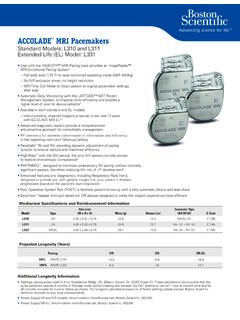
2 Yes No B. Condition and treatment The doctor has explained that you have the following condition: (Doctor to document in Patient s own words) .. This condition requires the following procedure. (Doctor to document - include site and/or side where relevant to the procedure) .. The following will be performed: You will have an injection of Local Anaesthetic. The Pacemaker is put in below the left or right collarbone, just under the skin. The skin is cut to put the pacing wires (leads) into a vein which leads to the heart. The leads are threaded down the vein, into the heart.
3 The doctors can see the lead by using x-rays. Once positioned in the heart, the leads are tested to make sure they are working properly. They are then connected to the pulse generator . The pulse generator is placed under the skin and the skin is sewn back together. C. Risks of a Pacemaker In recommending this procedure your doctor has balanced the benefits and risks of the procedure against the benefits and risks of not proceeding. Your doctor believes there is a net benefit to you going ahead. This is a very complicated assessment. There are risks and complications with this procedure.
4 They include but are not limited to the following. Common risks and complications (more than 5%) include: Bruising at the Pacemaker site. Uncommon risks and complications (1- 5%) include: The Pacemaker lead can move. The lead will need to be put back into place by repeating this procedure. Bad bruising if you are taking blood thinning drugs such as Warfarin, Aspirin, Clopidogrel (Plavix or Iscover) or Dipyridamole (Persantin or Asasantin). Unexpected Pacemaker failure. There is a risk of battery (generator) or lead failure. This is uncommon but means the battery or lead will need to be removed and a new one put in.
5 Infection of the Pacemaker site. This will need treatment with antibiotics and/or removal of the Pacemaker . Rare risks and complications (less than 1%) include: A punctured lung. This may require a tube to be inserted into the chest to reinflate the lung. Blood clot in the subclavian vein. A hole is accidentally made in the heart or heart valve. This will need surgery to repair. Blood clot in the lung. Heart attack. A stroke. This can cause long term disability. Death is possible due to the procedure or other heart problems.
6 D. Significant risks and procedure options (Doctor to document in space provided. Continue in Medical Record if necessary.) .. E. Risks of not having this procedure (Doctor to document in space provided. Continue in Medical Record if necessary.) .. F. Anaesthetic This procedure may require an anaesthetic. (Doctor to document type of anaesthetic discussed) .. Fig 1. National Heart, Lung and Blood Institute PROCEDURAL Consent FORM (Affix identification label here) URN: Family name: Given name(s): Address: Date of birth: Sex: M F I Pacemaker Facility: Page 2 of 2 02/2011 DO NOT WRITE IN THIS BINDING MARGIN G.
7 Patient Consent I acknowledge that the doctor has explained; my medical condition and the proposed procedure, including additional treatment if the doctor finds something unexpected. I understand the risks, including the risks that are specific to me. the anaesthetic required for this procedure. I understand the risks, including the risks that are specific to me. other relevant procedure/treatment options and their associated risks. my prognosis and the risks of not having the procedure. that no guarantee has been made that the procedure will improve my condition even though it has been carried out with due professional care.
8 The procedure may include a blood transfusion. tissues and blood may be removed and could be used for diagnosis or management of my condition, stored and disposed of sensitively by the hospital. if immediate life-threatening events happen during the procedure, they will be treated based on my discussions with the doctor or my Acute Resuscitation Plan. a doctor other than the Consultant may conduct the procedure. I understand this could be a doctor undergoing further training. I have been given the following Patient Information Sheet /s: Local Anaesthetic and Sedation for Your Procedure Pacemaker I was able to ask questions and raise concerns with the doctor about my condition, the proposed procedure and its risks, and my treatment options.
9 My questions and concerns have been discussed and answered to my satisfaction. I understand I have the right to change my mind at any time, including after I have signed this form but, preferably following a discussion with my doctor. I understand that image/s or video footage may be recorded as part of and during my procedure and that these image/s or video/s will assist the doctor to provide appropriate treatment. On the basis of the above statements, I request to have the procedure Name of Patient : .. Signature:.. Date: .. Patients who lack capacity to provide Consent Consent must be obtained from a substitute decision maker/s in the order below.
10 Does the Patient have an Advance Health Directive (AHD)? Yes Location of the original or certified copy of the AHD: .. No Name of Substitute Decision Maker/s: .. Signature: .. Relationship to Patient : .. Date: .. PH No: .. Source of decision making authority (tick one): Tribunal-appointed Guardian Attorney/s for health matters under Enduring Power of Attorney or AHD Statutory Health Attorney If none of these, the Adult Guardian has provided Consent . Ph 1300 QLD OAG (753 624) H. Doctor/delegate statement I have explained to the Patient all the above points under the Patient Consent section (G) and I am of the opinion that the Patient /substitute decision-maker has understood the Information .