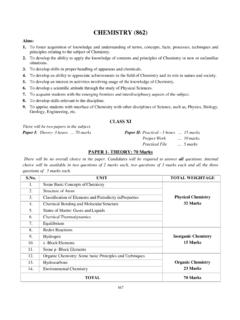
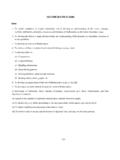
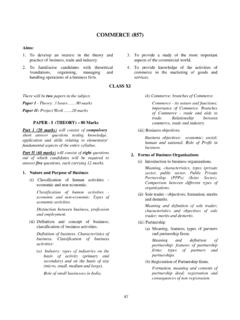
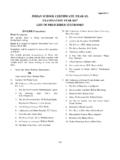
Transcription of PAPER 2: CHEMISTRY - CISCE
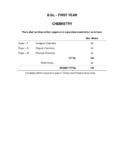
1 SCIENCE (52). CHEMISTRY . SCIENCE PAPER - 2. Aims: 3. To acquire skills in proper handling of apparatus and chemicals. 1. To acquire the knowledge of terms, concepts, processes, techniques and principles related to 4. To develop scientific temper, attitude and the subject. problem solving skills. 2. To develop the ability to apply the knowledge of 5. To recognize Chemical Science as having an contents and principles of CHEMISTRY in important impact on the environment unfamiliar situations. relating to cycles in nature; natural resources, pollution. CLASS IX. There will be one PAPER of two hours duration of 80 terms of molecular motion (particles, atoms, marks and Internal Assessment of practical work molecules); Boyle's Law and Charles' Law;. carrying 20 marks. absolute zero; gas equation; simple relevant The PAPER will be divided into two sections, calculations.
2 Section I (40 marks) and Section II (40 marks). The behaviour of gases under changes of Section I (compulsory) will contain short answer temperature and pressure; explanation in questions on the entire syllabus. terms of molecular motion (particles, atoms, molecules). Boyle's Law (statement, Section II will contain six questions. Candidates will mathematical form, simple calculations). be required to answer any four of these six questions. Charles' Law; (statement, mathematical Note: All chemical reactions should be studied with form, simple calculations). Absolute zero;. reference to the reactants, products, conditions, Kelvin scale of temperature. Gas equation P1. observations and the (balanced) equation. V1 / T1 = P2 V2 / T2; simple relevant calculations based on gas equation.
3 1. Matter and its Composition: Law of Conservation of mass (ii) Relationship between Kelvin Scale and (i) Explanation of change of state of matter on Celsius Scale of temperature; Standard the basis of Kinetic Theory of Matter. temperature and pressure. Main postulates of Kinetic Theory of Matter Conversion of temperature from Celsius and explanation of change of state on the Scale to Kelvin scale and vice versa. basis of. Inter-particle space and Inter- Standard temperature and pressure. (simple particle attraction and collision. calculations). (ii) Law of Conservation of Mass 3. Elements, Compounds and Mixtures Statement and explanation with examples. (i) General characteristics and differences between elements, compounds and mixtures. 2. Study of Gas Laws Reasons for considering a substance as an (i) The behaviour of gases under changes of element, compound or mixture may be given temperature and pressure; explanation in to make the concepts clear.
4 90. (ii) Types of mixtures: of two solids, a solid and Radicals definition of radicals; formula and a liquid, two liquids, liquid and gas, two valencies of the radicals and formula of gases. compounds. Definition of mixture; each type of mixture Chemical equation definition and examples of should be shown to the students (including chemical equations with one reactant and two or both homogeneous and heterogeneous types) three products, two reactants and one product, true solution, suspension and colloidal two reactants and two products and two solution to make the concepts clear. reactants and three or four products; balancing of equations. (By partial equation method and hit (iii) Separation of mixtures involving - use of a and trial method). solvent, filtration, evaporation and distillation, fractional distillation, simple 5.
5 Physical and Chemical Changes PAPER chromatography Centrifugation (i) Definitions and distinction between Physical immiscible liquid. and Chemical changes. The following examples should be used to Simple experiments like dissolution of sugar illustrate the principles of separation of in water, burning of PAPER should be shown mixtures by using following methods to make the concepts of physical and (a) use of solvent and filtration ( sodium chemical change clear. More examples of chloride + sand, (water as solvent), such type may be given. carbon and sulphur (Carbon tetra (ii) Conditions for chemical change. chloride as solvent). Close contact, heat, light, electricity, (b) evaporation sodium chloride from its pressure, catalysts with examples. aqueous solution (iii) Types of chemical change.)
6 (c) distillation purification of water containing dissolved solids. Direct combination; decomposition;. displacement; double decomposition with (d) fractional distillation involves the examples. difference in boiling points of liquids (iv) Energy changes in a chemical change. benzene + toluene. Exothermic and endothermic reactions with (e) simple PAPER chromatography (limited to examples evolution/absorption of heat, separation of colouring matter in ink); light and electricity. (f) Centrifugation (involving separation of (v) Burning: Definition and conditions of cream from milk). burning. (g) immiscible liquids (separating funnel Definition; (Air is used for combustion). water + carbon tetra chloride). conditions for burning (combustible 4. The language of CHEMISTRY substance, supporter of combustion and ignition temperature); comparison of Symbol of an element; valency; formulae of respiration and burning; burning of radicals and formulae of compounds.
7 Balancing magnesium or candle to show that of simple chemical equations. substances gain weight on burning; students Symbol definition; symbols of the elements to be made aware of how the balance of O2. used often. and CO2 is maintained in nature. O2 and CO2. Valency - definition; hydrogen combination and Cycle. number of valence electrons of the metals and non-metals; mono, di, tri and tetra valent 6. Water elements. 91. Water as a compound and as a universal solvent; basis for Modern Periodic law, Modern Periodic its physical and chemical properties. Table (groups 1 to 18 and periods 1 to 7). Why water is considered a compound? Chief 9. Study of the First Element -Hydrogen physical properties should include: density, , Experiment to show that the water we drink, Position of the non-metal (Hydrogen) in the contains dissolved solids and dissolved gases periodic table and general group characteristics (air); their significance.
8 Solutions as 'mixtures' with reference to valency electrons, burning, ion formation applied to the above mentioned of solids in water; saturated solutions;. element. qualitative effect of temperature on solubility ( solutions of calcium sulphate, potassium (i) Hydrogen from water (ii) hydrogen from nitrate, sodium chloride in water). dilute acids (iii) hydrogen from alkalies. Water Pollution Causes household, Hydrogen from water. Cold water and detergents, sewage, industrial waste, offshore metals; hot water and metals; steam and and oil drilling. metals; steam and non-metals. Application of activity series for the above mentioned Treatment of Water Pollution Proper collection preparations. Displacement of hydrogen and disposal of domestic sewage, treatment of from dilute sulphuric acid or hydrochloric industrial waste to yield safe effluents.
9 Acid by zinc or iron (no reaction with copper). Displacement of hydrogen from Chemical Properties: The action of cold water alkalis (NaOH, KOH) by Zn, Al unique on sodium and calcium; the action of hot water nature of these elements. on magnesium and steam on iron; reversibility of reaction between iron and steam. (ii)The preparation and collection of hydrogen by a standard laboratory method other than Students can be shown the action of sodium and electrolysis. calcium on water in the laboratory; they must be In the laboratory preparation, the reason for asked to make observations (equations for the using zinc, the impurities in the gas, their above reactions) and form reactivity series based removal and the precautions in the collection on reactions. of the gas must be mentioned.
10 7. Atomic Structure Industrial manufacture of hydrogen by Structure of an Atom mass number and atomic Bosch process with main reactions and number, Isotopes and Octet Rule. conditions; separation of CO2 and CO from it. Definition of an element, definition of an atom;. constituents of an atom - nucleus (protons, 10. Atmospheric pollution neutrons) with associated electrons; mass (a) Acid rain composition, cause and its impact. number, atomic number. Electron distribution in Sulphur in fossil fuels giving oxides of the orbits - 2n2 rule, Octet rule. Reason for sulphur when burnt. High temperatures in chemical activity of an atom. Definition and furnaces and internal combustion engines examples of isotopes (hydrogen, carbon, chlorine). produce oxides of nitrogen. (Equations to be included).