Example: air traffic controller
Paracentesis for Malignant Ascites Procedure
The commonest causes of malignant ascites are primary tumours of breast, colon, ovary, stomach, pancreas and bronchus. Paracentesis is a simple procedure, which can be performed as a day case (usually only removing 2-4 litres maximum), occasionally if clinically indicated in patients own home (small volume paracentesis) or as an inpatient.
Tags:
Information
Domain:
Source:
Link to this page:
Documents from same domain

Guidelines for the Insertion and Management of Chest …
www.dbth.nhs.ukeffectively. If drain holes are situated within the subcutaneous tissues, air or fluid may escape into the tissues and cause surgical emphysema or collections of potentially infected fluid. Surgical emphysema is the abnormal presence of air within the subcutaneous tissues. Its presence suggests that the drain is occluded or misplaced.
Patient Property and Valuables
www.dbth.nhs.ukPAT/PA 12 v.3 Page 5 of 22 Each ward MUST hold both a patient’s property book (WPR 10780A) and patient’s valuables book (WPR 135A) together with a supply of patient valuables envelopes and disclaimer forms (Appendix C - disclaimer form).The patient valuables book MUST be kept securely in a suitable locked drawer or cupboard. 3.1 When Should a Patients Property be …

Nasogastric Tube Management and Care
www.dbth.nhs.ukInsert the nasogastric feeding tube and confirm it is correctly sited. Confirm correct placement of the nasogastric feeding tube prior to every use. When there are continuous difficulties obtaining an aspirate with a pH less than 5.5 seek advice from senior medical staff.

Peripheral Venous Cannula (PVC) Management Guidelines
www.dbth.nhs.ukManagement Guidelines This procedural document supersedes: PAT/T 45 v.2 – Peripheral Venous Cannulation (PVC) Insertion and Management Guidelines Did you print this document …
WOUND MANAGEMENT POLICY
www.dbth.nhs.uk6.1.2 All wounds will be assessed using evidence based methods to optimise wound healing. The details from the full assessment will be recorded in the appropriate IPOC (Integrated Pathway of Care) i.e. Wound Care, Pressure Ulcer, Leg Ulcer (NMC 2008). 6.1.3 Wound assessments will be completed at every dressing change.

Percutaneous Endoscopic Gastrostomy (PEG)/Enteral Tube ...
www.dbth.nhs.ukPAT/T 16 v.4 Page 8 of 21 When such decisions are being made guidance issued by the General Medical Council (GMC) and the Department of Health should be followed. The decision making process and rationale must be fully documented in the clinical record. Patients have the right to refuse treatment for various reasons. Refer to the Trust Policy ...

Guidance on the Administration of Medicines to Patients ...
www.dbth.nhs.ukThe medicines listed are common examples and do not constitute an exhaustive list. You should consult the relevant section of the current BNF. If you are in any doubt consult a pharmacist before attempting to crush the tablets. 4.7 Taste Some medicines have a bitter taste: they may or may not be coated. Where the crushed tablets
DISCHARGE OF PATIENTS FROM HOSPITAL POLICY
www.dbth.nhs.uko Polypharmacy: i.e. six or more prescribed medications o A high volume of input by A & E, Out of Hours Service, Primary or Social Care Services o A prolonged stay in an acute hospital bed. ... guidance, please refer to the Trust’s Discharge Lounge Operational Policy.
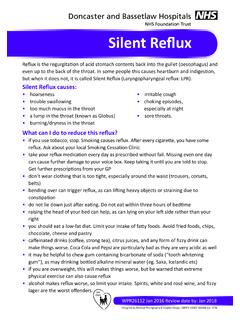
Silent Reflux - Doncaster and Bassetlaw Teaching Hospitals
www.dbth.nhs.uk• it may be helpful to chew gum containing bicarbonate of soda (“tooth whitening gum”), as may drinking bottled alkaline mineral water (eg. Saka, Icelandic etc) • if you are overweight, this will makes things worse, but be warned that extreme physical exercise can also cause reflux • alcohol makes reflux worse, so limit your intake.

Patient Controlled Analgesia (PCA)
www.dbth.nhs.uk6 Patient Care 6 7 Training/Support 8 ... post-operative morbidity and increased patient satisfaction (Walder et al 2001, Level 1). 5. ... this includes attaching the pump/giving set to the patient. Each registered nurse/practitioner will have the …
Related documents
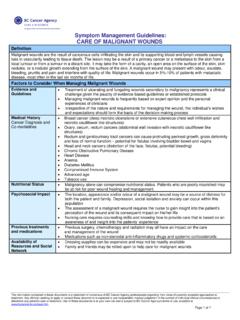
Symptom Management Guidelines: CARE OF MALIGNANT …
www.bccancer.bc.caA malignant wound may present with odour, exudate, bleeding, pruritis and pain and interfere with quality of life. Malignant wounds occur in 5%-10% of patients with metastatic
IEC Therapy Toxicity Assessment and Management Page 1 of ...
www.mdanderson.orgFor patients with known history of seizures, migraines and/or other CNS disorders including malignant disease, consider Neurology consult prior to IEC infusion Central venous access with port-a-cath or double/triple lumen catheter is recommended for IEC infusion as well as for IV fluids and other infusions in case of toxicities
Medicare National Coverage Determination Policy Prostate ...
www.questdiagnostics.comhas been established. This test is also an aid in the management of prostate cancer patients and in detecting metastatic or persistent disease in patients following treatment. Indications PSA is of proven value in differentiating benign from malignant disease in men with lower urinary tract signs & symptoms (e.g.,
PRACTICE GUIDELINE FOR THE Treatment of Patients With …
psychiatryonline.orgTreatment of Patients With Delirium 9 I. SUMMARY OF RECOMMENDATIONS The following executive summary is intended to provide an overview of the organization and scope of recommendations in this practice guideline. The treatment of patients with delirium requires the consideration of many factors and cannot be adequately reviewed in a brief sum-mary.

Rapid Sequence Intubation: Medications, dosages, and ...
med.umkc.eduRapid Sequence Intubation: Medications, dosages, and recommendations !! ! Timeline’of’Rapid’Sequence’Intubation! S!!!!! 1. Preparation!–!Assemble!all ...