Transcription of Passport Program - Ontario
1 Passport ProgramGuidelines for Adults with aDevelopmental Disability and their CaregiversEffective October 1, 20142 Overview 3 Who May Receive Passport Funding? 5 What Supports Does Passport Cover? 6 Definitions Admissible Expenses: Community Participation Activities of Daily Living Caregiver Respite Person-Directed Planning Administration of Direct Funding Inadmissible Expenses Extenuating CircumstancesHow Passport Funding Works 14 Roles and Responsibilities 15 Hiring a Support Worker Quality of Supports Budgeting Reimbursement Misuse of FundingTable of Contents3 OverviewThe transformation of adult developmental services and supports is based on the overarching principle that people who have a developmental disability are members of the community and focuses on independence, dignity and self- determination. The fundamental vision is to support the full inclusion of Ontarians with developmental disabilities in all aspects of society.
2 Passport is a Program that helps adults with a developmental disability be involved in their communities and live as independently as possible by providing funding for community participation services and supports, activities of daily living and person-directed planning. The Program also provides funding for caregiver respite services and supports for primary caregivers of an adult with a developmental disability. The key goals of the Passport Program are to: Foster independence by building on individuals abilities and developing community participation, social and daily living skills. Increase opportunities for participation in the community with supports that respect personal choices and decision-making, and help people achieve their goals. Promote social inclusion and broaden social relationships through the use of community resources and services available to everyone in the community. Help young people make the transition from school to life as an adult in the community.
3 Support families and caregivers of an adult with a developmental disability so they can continue in their supportive are two payment options in the Passport Program . Recipients can choose to manage their own funding to develop their own support arrangements and hire their own support workers and service providers. For those who prefer to receive supports from an agency, the Passport Agency can work with individuals and families to arrange payments with their chosen service provider(s). It is also possible to receive Passport funding through a combination of these two approaches. The services and supports funded under Passport are guided by the following principles:Person-centred/directed services and supports build on individuals strengths and are responsive to their preferences, needs and and Flexibility individuals identify and participate in activities that are meaningful to them. Direct funding is available to give Passport participants more options in how supports are Families and Caregivers - the individual s family and personal support network is recognized as the primary support for adults with a developmental and Equity - funding amounts are based on a provincial application and needs assessment process and funding formula.
4 Accountability individuals, families and service delivery agents must use Passport funding for its intended purpose and comply with spending rules and reporting adult who is eligible for developmental services and supports funded by the Ministry of Community and Social Services, including young adults who are 18 years of age and still in school, may apply for funding through Passport . Access to funding under the Program is subject to available must contact the Developmental Services Ontario office (DSO) in their region to request these services. Once an individual s eligibility has been confirmed and they have completed the Developmental Services Application Package, their information will be transferred to the local Passport Agency. For more information about applying for developmental services for adults with a developmental disability contact the local DSO office or visit Who May Receive Passport Funding?6 Passport funding may be used to compensate certain family members to provide services and supports - however it cannot be used to compensate: Primary caregiver(s) regardless of residence The spouse of a person with a developmental disability regardless of residence A child under the age of 18 The types of services and supports included under the admissible and inadmissible expenses sections that follow represent the intended use of Passport funding.
5 The Passport Program is designed to complement and work together with other government programs, resources and sources of funding to provide a wide range of supports. Passport funding can be used for the following services and supports: Community participation Activities of daily living Caregiver respite Person-directed planning (up to $2,500) Administration of Passport funding (up to 10% of Passport allocation)Services and supports may be purchased from the following types of service providers: Community service providers Developmental services agencies Private service and support providers Adult education providers Personal support workers Neighbours, family members, friendsWhat Supports DoesPassport Funding Cover?7 Activities of Daily Living Services and SupportsUnder SIPDDA, activities of daily living services and supports are defined as: services and supports to assist a person with a developmental disability with personal hygiene, dressing, grooming, meal preparation, administration of medication, and includes training related to money management, banking, using public transportation and other life skills and such other services and supports as may be prescribed.
6 Activities of daily living involve tasks for self-care and the various things people do in everyday life, from using the telephone to cooking to navigating the public transit system. The purpose of activities of daily living supports is to provide supports to adults with a developmental disability that enable them to live as independently as possible with their families. This can be in shared living situations or on their own. DefinitionsCommunity Participation Services and SupportsUnder the Services and Supports to Promote the Social Inclusion of Persons with Developmental Disabilities Act, 2008 (SIPDDA), community participation services and supports means: services and supports to assist a person with a developmental disability with social and recreational activities, work activities, volunteer activities and such other services and supports as may be prescribed. Community participation can involve many different areas of life such as work, leisure, and being involved in the community.
7 The purpose of community participation services and supports is to enable adults with a developmental disability to be involved in activities in the variety of settings that make up community life and to develop a growing network of personal Planning Services and SupportsUnder SIPDDA, person-directed planning services and supports means: services and supports to assist persons with developmental disabilities in identifying their life vision and goals and finding and using services and supports to meet their identified goals with the help of their families or significant others of their choice. Caregiver Respite Services and SupportsUnder SIPDDA, caregiver respite services and supports means: services and supports that are provided to, or for the benefit of, a person with a developmental disability by a person other than the primary caregiver of the person with a developmental disability and that are provided for the purpose of providing a temporary relief to the primary caregiver.
8 Caregiver respite services and supports are intended to give primary caregivers a mental and physical break from their caregiving primary caregiver is the main person who takes responsibility for the support and care of an adult with a developmental disability; he/she may or may not be related to or live with the person who has a developmental disability. The designation of primary caregiver extends to the spouse of a primary 1 For the purposes of the Passport Program , an individual or family who is receiving financial compensation from a Ministry-funded agency for the support of an adult with a developmental disability ( , Host Family provider, Adult Protective Service Worker) is not considered a primary caregiver. An individual, family or service provider who is receiving financial compensation to provide residential arrangements, supports or care for an adult with a developmental disability is not considered a primary caregiver under the Out-of-pocket expenses incurred by support workers while providing support ( , cost of meals, transportation and activity fees, expenses incurred accompanying the individual with a developmental disability during trips and holiday travel)**Note: The Ministry recommends that Passport recipients use the expense limits set out in the government of Ontario s Travel, Meals and hospitality Directive for government employees as a guide for support workers expenses.
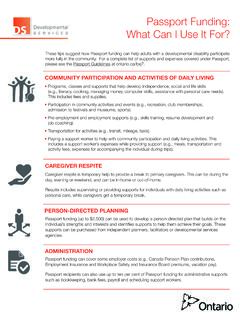
9 The Directive may be viewed Planning Passport funding can be used to purchase supports to develop a person-directed plan that builds on the individual s strengths and interests and identifies the supports needed to achieve their goals. Person-directed planning services and supports may be purchased from independent planners and facilitators or developmental services agencies. Passport recipients can use up to $2,500 of their annual funding to purchase person- directed planning services and Expenses The following types of services and supports are examples of what Passport funding may be used to purchase: Community Participation Supports and Activities of Daily Living Programs, classes, camps, and supports that foster and develop independence, social, communication and life skills ( , literacy, cooking, banking and managing money, using public transportation, computer skills, decision-making, self- advocacy, assistance with self-care).
10 This includes associated fees and supplies Recreation, leisure, social, cultural and athletic activities that enable opportunities to participate and join in community events and activities ( , club memberships and fees, admission to festivals, museums and sporting events, fitness and sport/activity- specific lessons) Pre-employment and employment supports ( , skills, task and routine training, job coaching) Transportation to/from activities ( , local transit, mileage, taxis)* Hiring a support worker to provide assistance with community participation and activities of daily living10 Examples of caregiver respite services and supports include: Help for the person with a developmental disability with activities of daily living such as personal care needs. Supervision of the person with a developmental respite services and supports may last from a few hours to overnight.