Transcription of PATENT REGULATIONS 1986
1 Page 1 of 37 (A) 327/86 PATENTS REGULATIONS 1986 (Incorporated the changes made up to 15 February 2011) Preamble IN exercise of the powers conferred by section 87 of the Patents Act 1983, the Minister makes the following REGULATIONS : Regulation 1. Citation and commencement. These REGULATIONS may be cited as the Patents REGULATIONS 1986 and shall come into force on the 1st October 1986. Regulation 2. Fees. (1) The fees to be paid in respect of all matters arising under the Act and these REGULATIONS shall be as specified in Schedule I. (2) The fees shall be paid to the PATENT Registration Office by such means and in such manner as the Registrar may direct. Regulation 3. Forms. The forms referred to in these REGULATIONS are those set out in Schedule II. Regulation 4. Interpretation. In this Part, unless the context otherwise requires, "application" means an application for the grant of a PATENT and "applicant" shall be construed accordingly.
2 Regulation 5. Application for Grant of PATENT . (1) An application shall contain Page 2 of 37 (a) a request for the grant of a PATENT ; (b) a description; (c) a claim or claims; (d) a drawing or drawings, where required; and (e) an abstract. (2) The application shall be filed at the PATENT Registration Office. Regulation 5A. Filing of an international application. (1) An international application shall be filed in three copies. (2) Where an international application is filed in less than three copies, the PATENT Registration Office shall prepare the additional copies required and the applicant shall pay to the PATENT Registration Office the prescribed fees for preparing such additional copies. Regulation 6. Name and declaration of inventor. (1) The application shall contain the name and address of the inventor. (2) An inventor who does not wish to be named in a PATENT may, by declaration in writing signed by him and submitted to the Registrar, indicate that he does not wish to be so named.
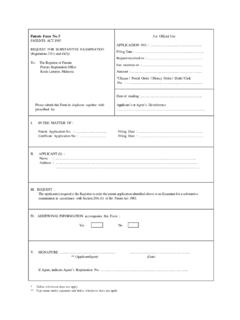
3 Regulation 7. Request for the grant of a PATENT . (1) A request for the grant of a PATENT shall be made to the Registrar on Form 1 together with the payment of the prescribed fee. (2) The title of the invention shall indicate clearly and concisely the subject matter to which the invention relates. Regulation 8. Names and addresses. Names and addresses given in the application shall in all cases be the full names and addresses. Page 3 of 37 Regulation 9. Nationality and residence. (1) The applicant's nationality shall be indicated by the name of the State of which he is a national or, if the applicant is not a natural person, the name of the State under whose laws it is constituted. (2) The applicant's residence shall be indicated by the name of the State of which he is a resident. Regulation 10. Applicant's right to PATENT . (1) Where the applicant is the inventor, the request shall state that fact. (2) Where the applicant is not the inventor, the request shall be accompanied by a statement justifying the applicant's right to the PATENT .
4 (3) For the purposes of subregulations (1) and (2), the request shall be made in Form 22 and shall be submitted together with Form 1 and Form 17. Regulation 11. Common representative. If an application is submitted by more than one applicant and the applicants have not appointed a PATENT agent to represent all of them (a) the request shall designate one of the applicants as their common representative; or (b) if the request does not designate one of the applicants as their common representative, the applicant first named in the request shall be considered the common representative. Regulation 12. Description. (1) The description shall first state the title of the invention as appearing in the request and shall (a) specify the technical field to which the invention relates; (b) indicate the background art which, as far as is known to the applicant, can be regarded as useful for the understanding, searching and examination of the invention, and, wherever possible, cite the documents reflecting such art; Page 4 of 37 (c) disclose the invention in such terms that it can be understood and in a manner sufficiently clear and complete for the invention to be evaluated and to be carried out by a person having ordinary skill in the art, and state any advantageous effects of the invention with reference to the background art; (d) briefly describe figures in the drawings, if any.
5 (e) describe the best mode contemplated by the applicant for carrying out the invention, using examples where appropriate and referring to the drawings, if any; and (f) indicate explicitly, when it is not obvious from the description or nature of the invention, the way in which the invention is industrially applicable and the way in which it can be made and used or, if it can only be used, the way in which it can be used. (2) The description shall be presented in the manner and order specified in sub regulation(1) unless, because of the nature of the invention, a different manner or a different order would result in a better understanding and a more economical presentation. (3) The description shall not contain drawings. Regulation 13. Claims. (1) The claims shall be clear and concise and fully supported by the description; and the number of the claims shall be reasonable taking into consideration the nature of the invention.
6 (2) If there are several claims they shall be numbered consecutively in arabic numerals. (3) Claims shall not contain drawings and shall not, unless necessary, rely, in respect of the technical features of the invention, on references to the description or drawings. (4) Where the application contains drawings, the technical features mentioned in the claims shall, wherever possible be followed by reference signs relating to such features and placed between parentheses, subject to the following: (a) reference signs which do not particularly facilitate quicker understanding of a claim, should not be included; (b) the same features, when denoted by reference signs, shall, throughout the application, be denoted by the same signs. (5) The claims shall define the invention in terms of the technical features of the invention. Page 5 of 37 (6) Whenever appropriate, claims shall contain (a) statement indicating those technical features of the invention which are necessary for the definition of the claimed subject matter but which, in combination, are part of the prior art; (b) a characterizing portion, preceded by the words "characterized in that", "characterized by", "wherein the improvement comprises", or any other words to the same effect stating concisely the technical features which, in combination with the features stated under paragraph (a), it is desired to protect.
7 Regulation 14. Dependent claims. (1) Any claim which includes all the features of one or more other claims ("dependent claim") shall contain, if possible at the beginning, a reference to the other claim or claims and shall then state the additional features claimed. (2) [Deleted by (A) 262/95] (3) A dependent claim shall be construed as including all the limitations contained in the claims to which it refers or, if the dependent claim is a multiple dependent claim, all the limitations contained in the particular claim in relation to which it is considered. (4) All dependent claims referring back to a single previous claim, and all dependent claims referring back to several previous claims, shall be grouped together to the extent and in the most practical way possible. Regulation 15. Drawings. (1) Subject to sub regulation (2), drawings shall be required when they are necessary for the understanding of the invention. (2) Notwithstanding sub regulation (1), where the nature of the invention admits of illustration by drawings the applicant may include drawings in the application when filed.
8 (3) Flow sheets and diagrams shall be considered drawings for the purposes of these REGULATIONS . Page 6 of 37 Regulation 16. Abstract. (1) The abstract shall commence with a title for the invention. (2) The abstract shall contain (a) a summary of the disclosure as contained in the description and the claims and drawings, if any; and (b) where applicable, the chemical formula which, among all the formulae contained in the application, best characterizes the invention. (3) The summary mentioned in sub regulation (2)(a) shall indicate the technical field to which the invention pertains and shall be drafted in a way which allows the clear understanding of the technical problem, the gist of the solution of that problem through the invention, and the principal use or uses of the invention. (4) The abstract shall be as concise as the disclosure permits and shall preferably not contain more than one hundred and fifty words.
9 (5) The abstract shall not contain statements on the alleged merits or value of the invention or on its speculative application. (6) Each main technical feature mentioned in the abstract and illustrated by a drawing in the application shall be followed by the reference sign used in that drawing placed between parentheses. (7) The abstract shall not contain drawings but shall be accompanied by the most illustrative of any drawings furnished by the applicant. (8) The abstract shall be so drafted that it constitutes an efficient instrument for the purposes of searching in the particular technical field, in particular by making it possible to assess whether there is a need to consult the description, the claims or the drawings. Regulation 17. Measures, terminology and signs. (1) Units of weights and measures shall be expressed in terms of the metric system. (2) Temperatures shall be expressed in degrees Celsius. (3) Densities shall be expressed in metric units.
10 (4) For heat, energy, light, sound, and magnetism, as well as for mathematical formulae and electrical units, the rules of international practice shall be observed. Page 7 of 37 (5) For chemical formulae, the symbols, atomic weights, and molecular formulae in general use shall be employed. (6) In general, only such technical terms, signs and symbols as are generally accepted in the field in question should be used. (7) The terminology and the signs shall be consistent throughout the application. Regulation 18. Physical requirements. (1) Unless provided otherwise, the application and any accompanying statements or documents shall be filed in duplicate, but the Registrar may require that they be filed in more than two copies. (2) All documents of the application shall be so presented as to admit of direct reproduction by photography, electrostatic processes, photo offset and microfilming. (3) All sheets shall be free from cracks, creases and folds and only one side of each sheet contained in the application shall be used.