Transcription of PCOR Fees - Reporting and Preparation Process
1 PCOR Fees - Reporting and Preparation Process Forward Trouble viewing this email? Click here. Contact Us: 877-861-3220. June 6, 2013. PCOR Fees - Reporting and Preparation Process Recently released guidance addresses the new Patient-Centered Outcomes Research (PCOR). Trust Fund fee that group health plan sponsors will soon face. The total fee liability will depend on how many arrangements the sponsor offers that will trigger the fee and the method used to count covered lives. The fee applies to both fully-insured and self-insured plans. Carriers will pay the fee for insured plans so there is nothing additional for a insured plan sponsor to do (other than pay a higher premium). Self-insured group health plan sponsors are liable for Reporting and paying the PCOR fee. The following focuses on key aspects of the new guidance applicable to a self- insured plan sponsor.
2 What is the PCOR Fee? The PCOR fee is a fee on issuers of specified health insurance policies and plan sponsors of applicable self-insured health plans that helps to fund the PCOR Institute. The Institute will assist, through research, patients, clinicians, purchasers and policy-makers, in making informed health decisions by advancing the quality and relevance of evidence-based medicine. The Institute will compile and distribute comparative clinical effectiveness research findings. Effective Date. The PCOR fee applies to self-insured health plans with plan years ending after September 30, 2012 and before October 1, 2019. Amount of Fee. The amount of the fee is equal to the average number of lives covered during the plan year multiplied by the applicable dollar amount for the year. For plan years ending after September 30, 2012 and before October 1, 2013, the applicable dollar amount is $1.
3 For plan years ending after September 30, 2013 and before October1, 2014, the applicable dollar amount is $2. For plan years beginning on or after October 1, 2014 and before October 1, 2019, the applicable dollar amount is further adjusted to reflect inflation in National Health Expenditures, as determined by the Secretary of Health and Human Services. Plans Subject to Fee. The fee applies to both fully-insured and self-insured group health plans. See the Table of Common Types of Plans for more information on plans that will trigger the fee. The PCOR fee does not apply to exempt governmental programs, including Medicare, Medicaid, Children's Health Insurance Program (CHIP) and generally any program established by federal law for providing medical care to members of the Armed Forces, veterans and members of certain Indian tribes.
4 Unless a self-insured health plan is an exempt governmental program described above, the plan is an applicable self-insured health plan subject to the fee. Thus, the plan sponsor [6/10/2014 4:08:04 PM]. PCOR Fees - Reporting and Preparation Process of a tax-exempt organization or governmental entity self-insured health plan (not otherwise exempt as described above) is responsible for the PCOR fee. Also, self-insured plans that provide only excepted benefits, such as plans that offer benefits limited to vision or dental benefits and most FSAs, are not subject to the PCOR fee. Further, self- insured plans that are limited to employee assistance programs, disease management programs or wellness programs are not subject to the PCOR fee if these programs do not provide significant benefits in the nature of medical care or treatment.
5 The PCOR fee also does not apply to policies and plans that are designed specifically to cover employees who are working and residing outside the United States. Determining Average Number of Lives. The fee is imposed on an applicable self-insured health plan based on the average number of lives covered under the plan for the plan year. Generally, all individuals who are covered during the plan year must be counted in computing the average number of lives covered for that year. Thus, for example, generally an applicable self-insured health plan must count an employee and his dependent child as two separate covered lives. COBRA beneficiaries and retirees or other former employees count as lives covered' for the purpose of calculating the PCOR fee. Plan sponsors of self-insured plans must use one of three alternative methods (1) the actual count method, (2) the snapshot method or (3) the Form 5500 method to determine the average number of lives covered for a plan year.
6 Plan sponsors may only apply a single method in determining the average number of lives covered under the plan for the entire plan year. However, a sponsor is not required to use the same method from one plan year to the next. Actual Count Method. Determine the average number of lives covered under the plan for the plan year by calculating the sum of the lives covered for each day of the plan year and dividing that sum by the number of days in the plan year. Snapshot Method. Determine the average number of lives covered under the plan for the plan year by adding the totals of lives covered on a date during the first, second, or third month in each quarter, or an equal number of dates for each quarter, and dividing the total by the number of dates on which a count was made. The rules do not require that a specific date be used for each month or quarter, but do provide specific rules to ensure that similar dates are used each month.
7 In addition, there are two methods within the snapshot method to count family members (count the actual number of lives covered on the designated date, or count the number of participants with self-only coverage on the designated date, plus the number of participants with coverage other than self-only coverage on the designated date multiplied by ). Form 5500 Method. Determine the average number of lives covered under a health plan filing for the plan year based on a formula that includes the number of participants actually reported on the Form 5500 for the plan year (and only if the Form 5500 is filed no later than the due date for the fee imposed for that plan year). Under this method, the total number of lives is determined by simply adding the total participant counts at the beginning and end of the year and dividing by 2 for a plan that only offers single coverage.
8 If a plan offers single coverage along with other coverage ( , family coverage), the total number of lives is determined by adding the total participant counts at the beginning and end of the year (without dividing by 2). Treatment of Multiple Arrangements. Where an individual is covered by both an insured policy [6/10/2014 4:08:04 PM]. PCOR Fees - Reporting and Preparation Process and applicable self-insured health plan, that individual's life may be counted twice the rule does not provide a way to allocate the fee between these separate arrangements. However, the rules allow the sponsor of a self-insured plan that includes both fully insured and self-insured options to disregard the lives covered solely by the fully insured option. If the same plan sponsor maintains more than one arrangement that provides self-insured coverage , if the sponsor maintains an HRA or health FSA in addition to major medical coverage the arrangements can be treated as a single self-insured health plan if the arrangements have the same plan year for purposes of calculating the fee.
9 Similarly, if the sponsor maintains self-insured medical coverage and a separate self-insured arrangement with the same plan year providing prescription drug benefits, the two arrangements may be treated as one applicable self-insured health plan so that the same life covered under each arrangement would count as only one covered life under the plan. Who Pays Fee? The fee for an insured plan is paid by the carrier. The fee for a self-insured plan is paid by the plan sponsor, which in most cases means the employer or employee organization that established or maintains the plan. The DOL has indicated that these fees generally are not permissible plan expenses under ERISA, since they are imposed on the plan sponsor and not the plan. This means that plan assets ( , trust assets or participant contributions) should not be used to pay the fee since ERISA's prohibited transaction rules prohibit plan assets from being used to offset employer obligations.
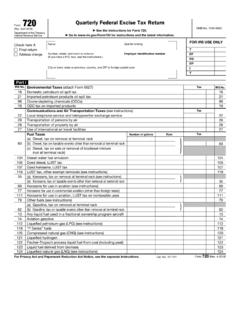
10 However, multiemployer plan assets may be used to pay the PCOR fees since the plan sponsor liable for a multiemployer plan's fee is generally an independent joint board of trustees with no source of funding other than plan assets. Form 720 Reporting . Plan sponsors of applicable self-insured health plans are responsible for Reporting and paying the PCOR annual fee by filing the Form 720, Quarterly Federal Excise Tax Return. The Form 720 will be due on July 31 of the year following the last day of the plan year. Electronic filing is available but not required. Payment will be due at the time the Form 720 is due. Deposits are not required for the PCORI fee. Plan sponsors who are required to pay the PCOR. fee but are not required to report any other liabilities on a Form 720 will be required to file a Form 720 only once a year.