Example: bachelor of science
(PDF) Key Stage 1, Learning Through Play
Play at Key Stage 1 should build on the active, hands–on learning that has taken place in the Foundation Stage. It is usually linked to the topic being explored and allows children to engage in a variety of focused play activities AND independent play based games/activities, for example, construction, role play, art/ design and table top games.
Tags:
Information
Domain:
Source:
Link to this page:
Documents from same domain
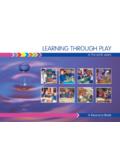
LEARNING THROUGH PLAY - nicurriculum.org.uk
www.nicurriculum.org.ukLEARNING THROUGH PLAY – INTRODUCTION 5 ACKNOWLEDGEMENTS This resource was designed and compiled by members of the Early Years Interboard Panel.
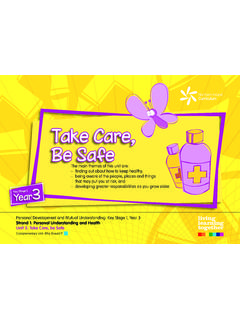
Take Care, Be Safe - Curriculum
www.nicurriculum.org.ukin familiar and unfamiliar environments: - being aware of how to care for their body in order to keep it healthy and well; - recognising and practicing basic hygiene skills;

(PDF) Gifted and talented children in (and out) of …
www.nicurriculum.org.ukGifted and talented children in (and out) of the classroom 1 A report for the Council of Curriculum, Examinations and Assessment (CCEA) 1 Feb 28th 2006What does it mean to be Gifted/Talented? 1

Jump Distance folder2 - CCEA
www.nicurriculum.org.ukexample, drawings to show ‘me jumping on the trampoline’. • Describe movements using art media for example, drawings/ mono-printing to show ways of jumping.
(PDF) Thinking Skills in the Early Years - Curriculum …
www.nicurriculum.org.ukThinking Skills in the Early Years: A Guide for Practitioners 2 EXECUTIVE SUMMARY Thinking Skills and Personal Capabil ities is an integral feature of the Foundation

(PDF) Foundation Stage, Learning Outdoors - …
www.nicurriculum.org.ukin Early Years settings for guidelines on provision and progression in learning outdoors. ... Stage as recommended ... • Outdoor play is central to young children ...
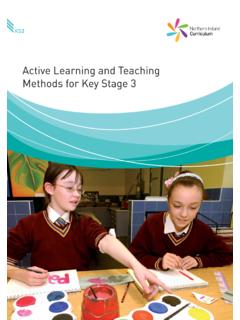
(PDF) Active Learning and Teaching Methods for …
www.nicurriculum.org.ukActive Learning and Teaching Methods 1 Active Learning and Teaching Methods Rationale The Revised Curriculum aims to empower our young people to …
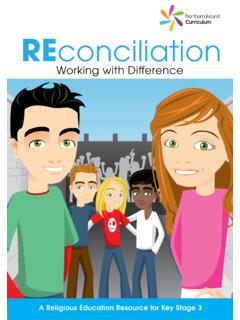
(PDF) Key Stage 3 Religious Education …
www.nicurriculum.org.ukREconciliation Working with Difference A Religious Education Resource for Key Stage 3
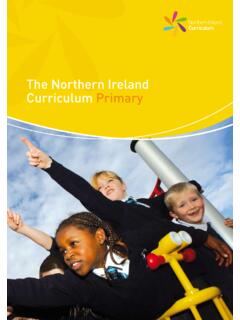
(PDF) The Northern Ireland Curriculum: Primary
www.nicurriculum.org.ukThe Northern Ireland Curriculum Primary_Introduction Introduction 1.0 4 Individuals Contributors to Society Contributors to the Economy and Environment
Guidance on Assessment in the Primary School
www.nicurriculum.org.ukparticularly where the assessment results are used for high stakes purposes. The nature and content of the assessments could determine the nature of teaching and learning and may limit the use of more innovative
Related documents

Music programmes of study: key stages 1 and 2
assets.publishing.service.gov.ukkey stages 1 and 2 National curriculum in England . Purpose of study . Music is a universal language that embodies one of the highest forms of creativity. A high-quality music education should engage and inspire pupils to develop a love of music and their talent as musicians, and so increase their self-confidence, creativity and sense of ...
Mathematics programmes of study: key stages 1 and 2
assets.publishing.service.gov.ukThe programmes of study for mathematics are set out year-by-year for key stages 1 and 2. Schools are, however, only required to teach the relevant programme of study by the end of the key stage. Within each key stage, schools therefore have the flexibility to introduce content earlier or later than set out in the programme of study.
English programmes of study: key stages 1 and 2
assets.publishing.service.gov.ukEnglish – key stages 1 and 2 4 . misconceptions. Pupils should also be taught to understand and use the conventions for discussion and debate. All pupils should be enabled to participate in and gain knowledge, skills and understanding associated with the artistic practice of drama. Pupils should be able to adopt, create and
Mathematics glossary for teachers in Key Stages 1 to 3
www.ncetm.org.ukpublication Mathematics glossary for teachers in key stages 1 to 4 published by the Qualifications and Curriculum Authority in 2003. It is intended to be used alongside the 2014 National Curriculum for teachers to check the meaning of the terms. This glossary is part of a wider suite of support of materials from the

(PDF) Active Learning and Teaching Methods for Key …
nicurriculum.org.ukKey Stages 1&2 How to get the most out of using the resource It is hoped that Active Learning and Teaching Methods will be dipped into and referred to regularly rather than simply read and shelved, so as to provide you with innovative ideas and strategies to integrate into your teaching. [Section 1] Getting started – a checklist

Puzzles and Problems for Year 1 and Year 2
www.mathematicshed.comYou roll a 1 to 6 dice. After two moves you land on 16. Find all the different ways you can do it. Now think of other questions you could ask. Mathematical challenges for able pupils in Key Stages 1 & 2 – DfEE 0083/2000 P/LL/SI/KS/MATHS CHALLENGES/PBR326 4 Teaching objectives Solve mathematical problems or puzzles. Count on from any small number.
A collaborative sorting activity for Key stages 2 & 3 ...
www.sgsts.org.ukA collaborative sorting activity for Key stages 2 & 3 Teachers’ notes Contents Animal Cards: 8 Pictures per card (54 +2 blanks) Alphabetical list of pictured animals Group cards: VERTEBRATE/INVERTEBRATE Group cards: FISH, AMPHIBIA, REPTILES, BIRDS, MAMMALS Features. Instruction sheet – one per group Vertebrate Key.
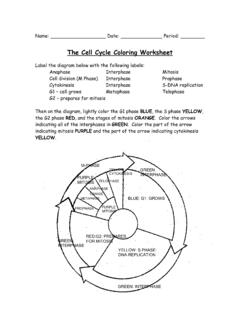
The Cell Cycle Coloring Worksheet - WPMU DEV
cpb-us-e1.wpmucdn.comJul 10, 2017 · 1. What is a series of events that cells go through as they grow and divide? 2. What is the longest stage of the cell cycle called? 3. During what stage does the G1, S, and G2 phases happen? 4. During what phase of the cell cycle does mitosis and cytokinesis occur? 5. During what phase of the cell cycle does cell division occur? 6.