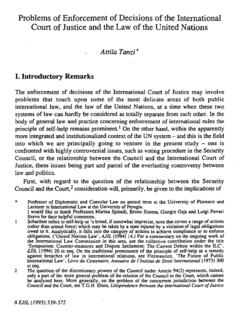
Transcription of Peace and Security Achievements and Failures
1 Peace and Security Achievements and Failures Rosalyn Higgins *. The history of the United Nations, 1945-1995, in the field of Peace and Security , would be a scholarly enterprise of several volumes. One is struck first of all by the sheer magnitude of all that has happened relating to the UN's role in Peace and Security during these years. The texts, the problems, the events, the attempts, the developments, the successes, the Failures , the new problems - come teeming upon each other. But, looking back over the last fifty years, it seems to me that certain trends and patterns are clearly discernible. We cannot understand where we are now, and what problems the United Nations faces today in the field of Peace and Security , without understanding what was intended, and what has actually occurred in the intervening period time.
2 And only then can we explore what is happening today - and the implications for tomorrow. I. The First Phase: What was Intended To look at the text of the Charter, and to remind ourselves of what was originally intended, is to see how far we have come from the original ideas of the founding fathers. The United Nations Charter was intended to provide a comprehensive set of prescriptions on conflict resolution and the use of force. On the one hand there were the provisions for settling disputes between States, and the prescriptions as to when force could or could not be used. On the other was the intended capability of the United Nations itself to provide collective Security , if necessary by enforcing the Peace .
3 Chapter VI of the Charter indicates the appropriate methods of settling international disputes and gives the Security Council certain powers in relation to these. Whether decisions taken by the Security Council under Chapter VI can be binding has been the subject of some controversy . But it is agreed that generally Professor of Law, The London School of Economics & Political Science till July 1995; Judge of the International Court of Justice. 6 EJIL (1995) 445-460. Rosalyn Higgins speaking, resolutions under Chapter VI will be recommendatory, rather than decisions which bind the membership at large by reference to Article 25.
4 The International Court of Justice in the Namibia case made the extremely important observation (which has implications for other chapters of the Charter as well) that resolutions may in any event have operative effect - that is to say, the findings of fact, or applications of law within an organ's own competence, are determinative.'. As for the entitlement of States to use force, the matter was meant to be resolved by the combined application of Article 2(4) and Article 51. All use of force save in self-defence was prohibited under Article 2(4) (as the International Court in the Corfu Channel case was to affirm in its judgment in 1949).
5 Article 51 did not entirely 'match' Article 2(4), in that under the former a State could use force 'if an armed attack occurs', but the latter provision prohibited the threat or use of force. (Years later, in the Nicaragua v. United States case (Merits), the International Court was further to underline that Articles 2(4) and 51 were not fully obverse sides of the same coin, by its finding that not all illegal uses of force constituted an armed attack, and that the right to self-defence was available only in regard to the latter).2. The Charter envisaged that States could reasonably be required to abstain from the use of force save in self-defence through the provision of collective Security by the Security Council.
6 Article 39 empowers the Security Council to determine the existence of a threat to or breach of international Peace , and to recommend or decide on measures to maintain or restore international Peace . Article 40 provides for provisional measures. Article 41 refers to non-forcible sanctions, including diplomatic and economic sanctions. Article 42 provides for military enforcement measures, to be carried out by forces made available to the Security Council under the special agreements envisaged in Article 43. The Security Council would thus be able to order economic and diplomatic sanctions, and also - directly, if it so chose, without first imposing sanctions under Article 41 - military sanctions.
7 The forces would be available, the decision to use diem in particular circumstances binding on all concerned. The Military Staff Committee was to be established to deal with the military planning and logistical aspects of such measures, as well as advising on a number of other military matters contained in Articles 45-47 of the Charter. EL The Second Phase: What Happened - Developments up to 1990. The failure of the United Nations to put in place the envisaged collective Security system has had several major consequences, each of which characterize the second phase in the last half century. The first is that States have in fact relied, as much as they have been able to, legally, militarily and politically speaking, on the unilateral 1 ICJ Reports (1971) at para.
8 105. 2 ICJ Reports (1986) at paras. 193-5 and 210-211. 446. Peace and Security . Achievements and Failures use of force. Unilateral military action was engaged in by various of the major powers, invoking an 'invitation' from the State concerned (USSR in Hungary;. USSR in Afghanistan); the protection of one's nationals (USA in Suez; USA in the Dominican Republic; USA in Grenada); or an extended notion of self-defence including, inter alia, the protection of one's nationals abroad (USA in Libya). The period 1956-1990 was characterised by a long list of unilateral uses of force, albeit that some effort was made to articulate the justifications by reference to Articles 2(4) and 51.
9 During this period the General Assembly also passed its celebrated series of 'law making' resolutions on issues related to the use of force. Important among these have been the 1970 Declaration on Principles of International Law concerning Friendly Relations and Cooperation among States in Accordance with the Charter of the United Nations (General Assembly Resolution 2625) and the 1974 Definition of Aggression (General Assembly Resolution 3314). These Declarations reflected a determination by the Assembly to act, notwithstanding the freeze in the Security Council - but other factors also, including notably the tension between the apparent general prohibition of the use of force in Article 2(4) and a widely perceived need to supply military aid to those fighting against colonialism.
10 The Declarations - similar, it may be thought, to many of the 'law making' pronouncements of the General Assembly in other fields have provisions within them to suit diverse shades of opinion and political conviction: these elements are sometimes contradictory. But they have come to be widely cited - including, from time to time, by the International Court of Justice itself. There is always a paragraph that can be invoked to fit a particular occasion and legal counsel before the Court ignore them at their peril. Paramilitary groups, not officially under the control of the State, emerged early in this period with the operations of the Fedayeen across the Egyptian-Israeli borders in the early 1950s.