Transcription of PERCUTANEOUS ENDOSCOPIC GASTROSTOMY (PEG)
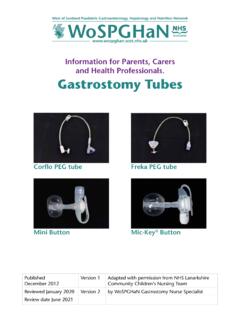
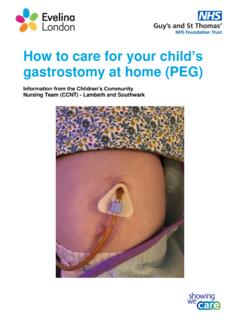
1 PERCUTANEOUS ENDOSCOPIC GASTROSTOMY (PEG). Patient Information This information leaflet has been written to explain what happens when you have a PERCUTANEOUS ENDOSCOPIC GASTROSTOMY (PEG). feeding tube placed. What is a PEG feeding tube? A PEG feeding tube allows liquid feed, water and medication to go directly into the stomach A PEG tube can be for short-term or long-term use; it is often used for patients who are experiencing swallowing difficulties due to illness or medical treatment Picture: by kind permission Fresenius Kabi PERCUTANEOUS ENDOSCOPIC GASTROSTOMY (PEG). One week before the procedure If you are taking any of the blood thinning medication listed below, please phone our Endoscopy Nursing Team on 01225 821425 or 01225 821788, (Monday - Friday, 8am-5pm), and ask to speak to a registered nurse. Warfarin Edoxaban Phenindione Enoxaparin Clopidogrel Fondaparinux Dabigatran Apixaban Rivaroxaban Prasugrel If you are taking medications for diabetes you should also contact the Endoscopy Nursing Team on 01225 821425 one week before your procedure if you have not received our Guidance for a diabetic person having an OGD' booklet.
2 Before the procedure Contact the nutrition nurses at the RUH on 01225 821954 if you have been told that: 1. You are at risk of CJD or vCJD for public health purposes or 2. You have any problems with your breathing. A blood sample will have been taken to check the clotting level of your blood (FBC and INR). The doctor performing the procedure must have these results to check they are within normal limits in order for the procedure to take place You must not have anything to eat or drink for six hours before the procedure If you have a nasogastric feed this must be stopped six hours before the procedure. On the day of the procedure If medications are necessary they can only be taken with sips of water prior to the procedure. Otherwise you must be nil by mouth' for six hours before the procedure. Please bring your prescription and list of drug allergies with you.
3 Date of publication May 2020 Ref: RUH GAS/025. Royal United Hospitals Bath NHS Foundation Trust Page 2 of 10. PERCUTANEOUS ENDOSCOPIC GASTROSTOMY (PEG). Consent A form will need to be signed by you to give consent to have the procedure. This form is usually completed in advance with the Nutrition Nurse Specialist or doctor looking after you in the clinic or on the ward. You can discuss questions with the Endoscopy Nursing Team or endoscopist undertaking the procedure. The procedure will be explained to you and you will be given the opportunity to discuss any aspects of the procedure, including potential risks, before you sign the consent form. Risks There are risks which will be explained to you prior to signing the consent form. The risk of major complications during or following the procedure is around 3%. The risk of mortality is up to 2%.
4 Around 17% of people have a minor complication. Aspiration Aspiration refers to the inhalation of saliva and stomach contents into the lungs. This can happen during the procedure especially for those people who are experiencing problems with their swallowing, have pre-existing respiratory (lung). disease, or haven't been six hours nil by mouth'. The risk of aspiration is around 1%. Bleeding Minor bleeding may occur which does not usually require additional treatment. The risk of this is 1 - 3%. Infection Infection can occur at the tube insertion site. Antibiotic therapy is given at the time of insertion to minimise this risk, with antibiotics the risk of wound infection is around 7%. Leakage This may occur around the PEG site, early on or develop later. Tube dislodgement Very occasionally the PEG tube can become dislodged or fall out and will need replacing.
5 If this happens you should place a dry dressing over the site and contact one of the emergency numbers in the back of this booklet. Trained professionals can replace a tube through the existing hole. This needs to be done very soon (within hours) after an accidental displacement. For this reason you should seek help as soon as possible if your tube falls out. Rare complications There could be serious damage or perforation to the bowel or internal organs; this is a rare complication. This may lead to peritonitis (severe internal infection) which Date of publication May 2020 Ref: RUH GAS/025. Royal United Hospitals Bath NHS Foundation Trust Page 3 of 10. PERCUTANEOUS ENDOSCOPIC GASTROSTOMY (PEG). will require urgent medical treatment, and rarely surgical treatment. Signs of perforation include a temperature and severe pain. The risk of peritonitis is 2%.
6 The procedure The procedure takes place in the Endoscopy Department (Grace Penwarden Gastroenterology and Surgical Unit), department B57. It is performed with sedation and local anaesthetic will be used around the site where the PEG tube will be placed. Sedation A small needle will be placed in the back of your hand and the medication will be injected through it. Sedation may make you drowsy and you may not remember the procedure taking place. Sedation is not a general anaesthetic; you will not be unconscious. Conscious sedation is a technique used here and in all other endoscopy units. The use of medication produces a state of relaxation enabling treatment to be carried out, but during which verbal contact with you is maintained throughout, you will be awake. Each person reacts differently to sedation, your thinking and movements may be slower than usual; therefore you cannot drive or be alone for 24 hours afterwards.
7 The endoscope is a slim flexible tube with a bright light at the end. It is passed through your mouth, to allow views of your stomach. Antiseptic solution will be used to clean your skin and a small cut will be made on the skin above your stomach which has been identified by the endoscope. The PEG tube will be pulled into position through this small hole. What to expect following the procedure It is common to feel bloated after the procedure because air in the stomach is passing through the bowel, but this should settle. The site of the tube may be sore for two or three days. A dressing is rarely required, any dressing covering the site will be removed the day after the procedure. The feeding tube will be tested with a flush of sterile water six hours after the procedure. If the test flush of water is satisfactory, you will then be allowed to eat and drink or the tube will be used to give feed and fluid.
8 Any pain and discomfort should subside a few days after the procedure; you may have medication to ease any pain. Date of publication May 2020 Ref: RUH GAS/025. Royal United Hospitals Bath NHS Foundation Trust Page 4 of 10. PERCUTANEOUS ENDOSCOPIC GASTROSTOMY (PEG). The triangular fixation plate on the PEG should be sitting against the skin and should stay in this position for two weeks. It should not be undone or moved at all during these first two weeks. General advice following the PEG insertion The dietitian will undertake an assessment of what you are currently eating, to determine how much feed needs to be given through the tube. If feeding via the tube does not need to be started immediately because you are able to eat and drink to meet your nutritional requirements, you will be taught how to manage and care for the feeding tube.
9 You will need to flush the tube at least once a day with water to maintain tube patency. If feeding does need to start immediately the dietitian will prescribe a feeding plan and you will need to stay in hospital for a few days. This will enable feeding to be established; you will be taught how to manage and care for the tube and feeding equipment. The dietitian will also explain how the feed and equipment will be delivered to you at home after discharge. Medication can be given through your tube and wherever possible will be in a liquid or dispersible form a pharmacist can advise you further. You will need to seek immediate advice if any of the following occur: Fever Pain on feeding through the tube or any increasing level of pain following the tube insertion Fresh bleeding around the stoma (hole). Leaking of feed or stomach contents around the tube The tube becomes blocked or difficult to flush The tube falls out If any of the above occur stop feeding and seek advice immediately (see relevant contacts at the end of the booklet).
10 Initial care It is particularly important to clean your hands thoroughly before any contact with the feeding tube or feeding equipment. This will minimise the risk of infection. In the first week following the tube placement, clean the site around the tube with sterile gauze and saline. This will be supplied by the hospital. You may take Date of publication May 2020 Ref: RUH GAS/025. Royal United Hospitals Bath NHS Foundation Trust Page 5 of 10. PERCUTANEOUS ENDOSCOPIC GASTROSTOMY (PEG). showers during this first week, but avoid baths. If in any doubt about care of the skin around the tube please contact the community nutrition nurse or your district nurse. Ongoing care Flushing the PEG tube and preventing blockage Always flush the tube before and after administration of feed and medication Use 30 - 50ml of freshly drawn tap drinking water unless you have been advised to use an alternative If you are unable to flush the tube due to resistance gently massage the tube around the area where any blockage may be visible Try flushing with warm water or carbonated water.