Transcription of PERSON-CENTERED AND TRAUMA-INFORMED PRACTICE
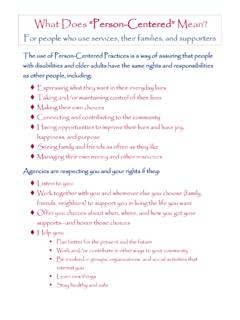
1 The National Center on Addiction and Substance Abuse 2016 Foundational Concepts & Elements of TransformationPERSON-CENTERED AND TRAUMA-INFORMED PRACTICECore Elements The individual is the expert on his/her life Focuses on natural supports Maximizes self-determination and choice Maximizes community connections Identifies an individual s hopes, capacities, interests, preferences, needs, and abilities2 PERSON-CENTERED PRACTICE This is a philosophy, not a specific technique The beliefs of PERSON-CENTERED PRACTICE , when adopted, will come to infuse all aspects of an organization s functioning The centrality of the person as the locus of control in a web of services and supports/resources defines the essence of PERSON-CENTERED PRACTICE PRACTICE is a collaborative process. The professional brings their experience and expertise. The individual brings their personal expertise. 3 What Does A PERSON-CENTERED Organization Look Like Individual choice is evident Client s voice is used in treatment plans goals are in his/her own words Treatment decisions are made collaboratively Clinical and administrative processes that affect clients are transparent to all Families and natural supports are actively incorporated in treatment4 What Does A PERSON-CENTERED Organization Look Like The structure of the organization is person driven not program driven A menu of services promotes choice and customization Nothing about us without us transparency Efforts are made to retain and gain natural supports, connections, and integrations 5 TRAUMA-INFORMED Care Many of the features of PERSON-CENTERED practices are essential elements of an organization delivering care in a TRAUMA-INFORMED way.
2 Safety, collaboration, trustworthiness/transparency, choice, and control and empowerment are shared elements between the two As part of the transformation process, organizations will integrate PERSON-CENTERED , TRAUMA-INFORMED , strength-based, recovery-oriented principles6 TRAUMA-INFORMED vs. Non Trauma-InformedTrauma-Informed Recognition of high prevalence of trauma Recognition of primary and co-occurring trauma diagnoses Assess for traumatic histories & symptoms Recognition of culture and practices that are re-traumatizingNon TRAUMA-INFORMED Lack of education on trauma prevalence & universal precautions Over-diagnosis of serious mental illness Cursory or no trauma assessment Tradition of Toughness valued as best care approach7 TRAUMA-INFORMED vs. Non Trauma-InformedTrauma-Informed Caregivers/supporters collaboration constant attention to culture Address training needs of staff to improve knowledge & sensitivityNon TRAUMA-INFORMED Rule enforcers compliance emphasis on power and control Patient-blaming as fallback position without training8 TRAUMA-INFORMED vs.
3 Non Trauma-InformedTrauma-Informed Staff understand function of behavior (rage, repetition-compulsion, self-injury) Objective, neutral language Transparent systems open to outside supportNon TRAUMA-INFORMED Behavior seen as intentionally provocative Labeling language: manipulative, needy, attention seeking Closed system outside support discouraged9(adapted from Fallot & Harris, 2002; Cook et al., 2002, Ford, 2003, Cusack et al., Jennings, 1998, Prescott, 2000)