Transcription of PHYSICS EDUCATION RESEARCH SECTION - AAPT.org
1 The challenge of changing deeply held student beliefs about the relativityof simultaneityRachel E. Scherr,a)Peter S. Shaffer, and Stamatis VokosDepartment of PHYSICS , University of Washington, Seattle, Washington 98195~Received 17 August 2001; accepted 17 February 2002!Previous RESEARCH indicates that after standard instruction, students at all levels often construct aconceptual framework in which the ideas of absolute simultaneity and the relativity of simultaneityco-exist. We describe the development and assessment of instructional materials intended toimprove student understanding of the concept of time in special relativity, the relativity ofsimultaneity, and the role of observers in inertial reference frames. Results from pretests andpost-tests are presented to demonstrate the effect of the curriculum in helping students deepen theirunderstanding of these topics.
2 Excerpts from taped interviews and classroom interactions helpillustrate the intense cognitive conflict that students encounter as they are led to confront theincompatibility of their deeply held beliefs about simultaneity with the results of specialrelativity. 2002 American Association of PHYSICS Teachers.@DOI: #I. INTRODUCTIONThe PHYSICS EDUCATION Group at the University of Wash-ington is conducting an ongoing study of student understand-ing of basic ideas in special ,2A previous articledescribed a detailed investigation into student conceptions oftime, reference frames, and simultaneity after found that students often finish a standardintroductory course or an advanced undergraduate course onrelativity with some fundamentally incorrect beliefs aboutthe definition of the time of an event and the construction ofa reference ,4 Many seem to believe that the time of adistant event is the time at which a signal from the event isreceived by an observer.
3 Thus, they treat the time ordering oftwo events as dependent on the location of an observer. Yet,many of these same students also have a deeply held under-lying belief that simultaneity is absolute and that when signaltravel time is accounted for, all observers~in all referenceframes!agree on the time order of any two thus fail to recognize one of the profound implica-tions of special relativity for our understanding of the natureof report here on the development and assessment of cur-riculum designed to help students construct a meaningfulunderstanding of the relativity of simultaneity. The initialdevelopment was guided by earlier 4 The use ofmaterials in the classroom revealed ways of student thinkingthat we had not encountered previously. These insights led tomodifications that increased the effectiveness of the instruc-tion.
4 The current versions are the product of an iterative pro-cess, part of which is previous articles describe conceptual change in thelarger context of special articles outline thegeneral circumstances under which conceptual change islikely to occur, and suggest broad instructional strategiesto encourage such change. This paper focuses on the effecton student learning of a particular instructional interventionand illustrates some aspects of the conceptual conflict CONTEXT FOR RESEARCH AND CURRICULUMDEVELOPMENTThe development and testing of the instructional materialson special relativity have primarily been conducted at theUniversity of Washington~UW!. The populations have in-cluded students in the introductory calculus-based honorscourse~for PHYSICS majors and others with strong sciencePHYSICS EDUCATION RESEARCH SECTIONE dward F.
5 Redish,EditorDepartment of PHYSICS , University of Maryland, College Park, Maryland 20742 This SECTION of AJP includes PHYSICS EDUCATION RESEARCH ~PER!articles. It continues the editorialprocess that begun with the green PER Supplementary Issues to AJP published in July of 1999 2001. ThePER SECTION ~PERS!is a response to the tension between the long-standing policy of AJP not to publishresearch articles and the growing interest within the AAPT community in PER. Articles in the regularsection focus on the PHYSICS that students have difficulty understanding and on pedagogical strategies forhelping them learn. Articles in PERS are expected to focus on these issues as well, but to pay moreattention to questions of how we know and why we believe what we think we know about studentlearning.
6 Articles in PERS can be expected to address a wide range of topics from theoretical frameworksfor analyzing student thinking, to developments of RESEARCH instruments for the assessment of the effec-tiveness of instruction, to the development and comparison of different teaching methods. Manuscriptssubmitted for publication in the PER SECTION should be sent directly to Edward F. Redish,PER more information, see J. ~12!, December 2002 2002 American Association of PHYSICS Teachersand mathematics background!and students in advanced un-dergraduate courses~for example, the junior-level course onelectricity and magnetism and a course on relativity andgravitation!. All together, this study has involved the classesof six instructors, and about 350 students from 12 sections ofvarious courses have setting for most of the work described in this articlehas been an extension of the tutorial system in the introduc-tory calculus-based course.
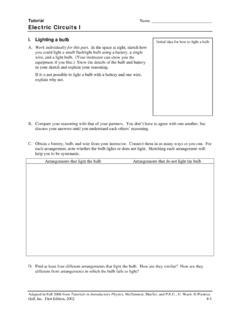
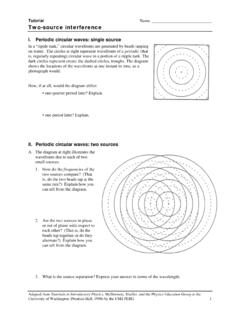
7 The core of the system is pro-vided by a set of tutorials collectively entitledTutorials inIntroductory are designed to supplement thelectures and textbook of a traditional lecture-based emphasis is on constructing concepts, developing rea-soning skills, and relating the formalism of PHYSICS to thereal world, not on transmitting information or solving end-of-chapter problems. The tutorials are described in other ar-ticles by our few key elements are described tutorial sequence begins with a short pretest that isdesigned to elicit student ideas. The pretests consist of quali-tative questions that require explanations of reasoning. Theyare typically administered after relevant lecture and textbookinstruction. During the subsequent tutorial session, studentswork collaboratively in small groups on tutorial consist of a series of carefully sequenced questionsintended to guide students through the reasoning necessaryto develop and apply a given concept.
8 Tutorial homeworkhelps students apply, extend, and generalize what they havelearned. Post-testing on course examinations is a crucial partof the tutorial sequence. Comparisons of student perfor-mance on the pretests and post-tests provide assessment ofstudent learning and guide modifications to the OVERVIEW OF THE INSTRUCTIONALAPPROACHAn understanding of the relativity of simultaneity is inex-tricably linked to the concept of reference frame and theoperational definition of the time of a distant event. In ourinvestigation we have observed that students often fail tointerpret properly the time of an event and the notion of reference frame. Many do not come to an understandingof these basic ideas, let alone the classic paradoxes that aretypically used in instruction in special relativity.
9 Therefore,we focus the tutorial instruction on helping students developthe requisite concepts and apply the reasoning required forresolving one of the standard paradoxes: the trainparadox. 9In this paper, we describe a set of two tutorials , entitledEvents and reference framesandSimultaneity. The first is inthe context of a single reference frame. Students are guidedto develop the basic procedures that allow an observer tomeasure the time of a single distant event. These proceduresform the basis for defining a reference frame as a system ofintelligent observers. The tutorial then helps students extendthe intuitive notion of whether or not twolocalevents aresimultaneous by having them develop a definition of simul-taneity for events that have a spatial ,11In thesecond tutorial, students examine the consequences of theinvariance of the speed of light through an analysis of thetrain paradox.
10 They are led to recognize that the resolution ofthe paradox requires the relativity of simultaneity as a meansof preserving causality. This tutorial reinforces the equiva-lence of observers in a given frame in determining the timeorder of events. The tutorial concludes by helping studentsapply the relativity of simultaneity to other contexts. Stu-dents take about2htowork through the pair of tutorials are not intended as a stand-alone assumption is that students have been introduced to cer-tain basic ideas, for example, the invariance of the speed oflight, events, and synchronization of clocks, in other parts ofthe course. The content of the tutorials does not differ sig-nificantly from what is typically taught in a course on specialrelativity. The approach taken, however, is to help studentsgo through the reasoning required to develop a functionalunderstanding of the relativity of tutorials described in this paper use a variety of in-structional strategies.