Transcription of Research as a guide for improving student learning …
1 Research as a guide for improving student learning !Lillian C. McDermott!Peter S. Shaffer!University of Washington!New physics and Astronomy Faculty Workshop!June 2013 ! physics Education Group at the University of Washington!2! physics Graduates 23 (1979-2013) ! physics students !Paul Emigh!Ryan Hazelton!Alexis Olsho!Brian Stephanik!Stella Stylianidou!Faculty!Lillian C. McDermott!Paula Heron!!Peter Shaffer!!Lecturers & Post-docs!Donna Messina (K-12 teacher)!Gina Passante!Ximena Cid! Research and Teacher Education Coordinator!Nina Tosti!Our coordinated program of Research , curriculum development, and instruction is supported, in part, by grants from the National Science Foundation.
2 !Evolution of UW physics Education Group!Early 1970 s:!K-12 teacher preparation!!Mid 1970 s:! physics Education Research (PER) and program in Department of physics !!1980 s:! Research -based development of curriculum for K-12 teachers!!1990 s onward:! Research -based development of curriculum for! K-12 teachers Undergraduates!!!! Research -based professional development of TAs as instructors in undergraduate physics !3!Discipline-based Research on learning and teaching! focuses on student understanding of science content! is an important field for scholarly inquiry by science faculty in science departments!can be an effective approach for improving student learning (K 20+)!
3 Differs from traditional education Research (in which emphasis is on educational theory and methodology)!4!5!Perspective on teaching as a science (as well as an art)"indicate: ! many students encounter same conceptual and reasoning difficulties! same instructional strategies are effective for many students !Results from documented Research ! !constitute:! a rich resource for improving instruction !are: ! generalizable beyond a particular course, instructor, or institution! reproducible!!become:! publicly shared knowledge that provides a basis for acquisition of new knowledge and for cumulative improvement of instruction!Criteria for effectiveness of instruction!
4 Motivational effect of personal qualities and style of instructor! Instructor s subjective assessment of student learning ! student enthusiasm and self-assessment of learning ! student evaluations of the course or instructor!!Criteria are not tightly linked to student learning .!Teaching as a science" Assessment of student learning by specified intellectual outcomes!Criterion is student learning .!Teaching as an art"6! physics Education Group!Goal: ongoing cumulative improvement in! Research base on student understanding of physics ! undergraduate instruction ( introductory and beyond)! K-12 teacher preparation (preservice and inservice)!
5 Professional development (grad. students , post-docs, faculty)!within culture and constraints of Research -oriented physics department!Perspective: ! Research in physics education is a science. !7! physics Education Group!Procedures:! conduct systematic investigations! apply results ( , develop instructional strategies)! assess effectiveness ( , through pre- and post-testing)! document methods and results so that they can be replicated! report results at meetings and in papers!8!The procedures are characteristic of an empirical applied science."Systematic investigations of student learning (at the beginning, during, and after instruction)!
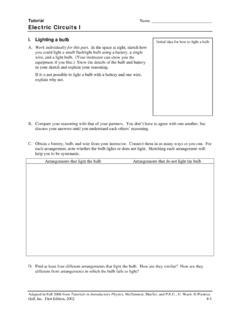
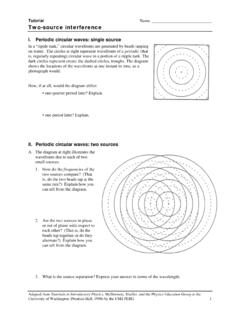
6 Individual demonstration interviews! for probing student understanding in depth! written questions with explanations (pretests and post-tests)! for ascertaining prevalence of specific difficulties ! for assessing effectiveness of instruction! descriptive studies during instruction! for providing insights to guide curriculum development!9!10!Curriculum!Development! Research !Instruction!at UW!Instruction!at pilot sites!Application of Research to development of curriculum! Research -based curriculum development!Preparing precollege teachers to teach physics and physical science !! physics by Inquiry "!(John Wiley & Sons, Inc., 1996)!!!
7 Self-contained, laboratory-based, no lectures! improving student learning in introductory physics !" tutorials in introductory physics "!!(Prentice Hall, 2002)!!!!Supplementary to lecture-based course!11!Examples in two different contexts! Electric circuits! Mechanics!12!Investigation of student understanding: an example from electric circuits! Research as a guide for curriculum development: An example from introductory electricity. Part I: Investigation of student understanding, McDermott and Shaffer, Am. J. Phys. 60 (1992) ! Research as a guide for curriculum development: an example from introductory electricity, Part II: Design of instructional strategies, Shaffer and McDermott, Am.
8 J. Phys. 60 (1992)! Preparing teachers to teach physics and physical science by inquiry, McDermott, Shaffer, and Constantinou, Phys. Educ. 35 (2000)! New insights into student understanding of complete circuits and the conservation of current, Stetzer, P. van Kampen, Shaffer, and McDermott, Am. J. Phys. 81 (2013)!13!What students could do!Solve many end-of-chapter circuit problems by applying Kirchhoff s rules!14!15!What students could not do!The bulbs are identical. The batteries are identical and ideal.!!Rank the bulbs from brightest to dimmest. Explain.!Results independent of whether administered "before or after instruction in standard lecture courses"Correct response !
9 Given by ~ 15%!! students in calculus-based physics (N > 1000)!Answer: A = D = E > B = C!!given by ~ 70%! graduate TA s and postdocs in physics (N ~ 100)! high school physics teachers! university faculty in other sciences and mathematics!ADEBCG eneralizations on learning and teaching"inferred and validated!!by Research and development of!! physics by Inquiry and ! tutorials in introductory physics !serve as a practical guide in ongoing iterative process!of curriculum development !16!17! !Facility in solving standard quantitative problems is not an adequate criterion for functional understanding.*!!Questions that require qualitative reasoning and verbal explanations are essential for assessing student learning .
10 !* Ability to apply concepts and reasoning to situations not explicitly memorized!Such questions are an effective strategy for helping students learn."18!SWhen the switch is closed, do the following increase, decrease, or stay the same? intensities ! ibat! voltage drops! student performance substantially worse on conceptual problem."Similar situation at other universities ( , Harvard University; Eric Mazur) !Calculate current in 2- resistor and potential difference between P and Q.!8V2 4 12 VPQ8 Paired examination questions! !Certain conceptual difficulties are not overcome by traditional instruction. (Advanced study may not increase student understanding of basic concepts.)