Transcription of Physics - SEAB
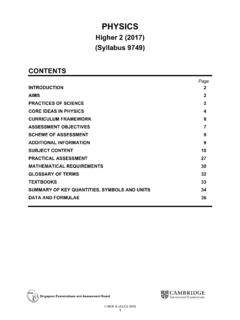
1 Common Last Topic (CLT) highlighted in yellow on pages 25- 26 will not be examined in 2021. Questions assessing CLT will be removed from all papers and candidates will be informed at the start of the examinations. For Physics (9749), the removal of CLT will result in candidates having no question option in Section B of Paper 3. Please see details on page 8. The durations of all papers remain unchanged. We would like to assure candidates that a lack of options in Paper 3 will be taken into account during grading to ensure fair Singapore-Cambridge General Certificate of Education Advanced Level Higher 2 (2021) (Syllabus 9749) MOE & UCLES 20191 Singapore Examinations and Assessment Board Physics Singapore-Cambridge General Certificate of Education Advanced Level Higher 2 (2021) (Syllabus 9749) CONTENTS Page INTRODUCTION2 AIMS 2 PRACTICES OF SCIENCE 2 CORE IDEAS IN Physics 4 CURRICULUM FRAMEWORK 6 ASSESSMENT OBJECTIVES 7 SCHEME OF ASSESSMENT 8 ADDITIONAL INFORMATION 9 SUBJECT CONTENT 10 PRACTICAL ASSESSMENT 27 MATHEMATICAL REQUIREMENTS 30 GLOSSARY OF TERMS 32 TEXTBOOKS AND REFERENCES 33 SUMMARY OF KEY QUANTITIES, SYMBOLS AND UNITS 34 DATA AND FORMULAE 36 9749 Physics GCE ADVANCED LEVEL H2 SYLLABUS (2021)
2 2 INTRODUCTION The syllabus has been designed to build on and extend the content coverage at O-Level. Candidates will be assumed to have knowledge and understanding of Physics at O-Level, either as a single subject or as part of a balanced science course. AIMS The aims of a course based on this syllabus should be to: students with an experience that develops their interest in Physics and builds the knowledge,skills and attitudes necessary for further studies in related students to become scientifically literate citizens who are well-prepared for the challenges of the21st in students the understanding, skills, ethics and attitudes relevant to the Practices of Science,including the understanding the nature of scientific demonstrating science inquiry relating science and in students an understanding that a small number of basic principles and core ideas can beapplied to explain, analyse and solve problems in a variety of systems in the physical OF SCIENCE Science as a discipline is more than the acquisition of a body of knowledge ( scientific facts, concepts, laws, and theories) it is a way of knowing and doing.
3 It includes an understanding of the nature of scientific knowledge and how this knowledge is generated, established and communicated. Scientists rely on a set of established procedures and practices associated with scientific inquiry to gather evidence and test their ideas on how the natural world works. However, there is no single method and the real process of science is often complex and iterative, following many different paths. While science is powerful, generating knowledge that forms the basis for many technological feats and innovations, it has limitations. The Practices of Science are explicitly articulated in the syllabus to allow teachers to embed them as learning objectives in their lessons. The students understanding of the nature and the limitations of science and scientific inquiry are developed effectively when the practices are taught in the context of relevant science content.
4 Attitudes relevant to science such as inquisitiveness, concern for accuracy and precision, objectivity, integrity and perseverance should be emphasised in the teaching of these practices where appropriate. For example, students learning science should be introduced to the use of technology as an aid in practical work or as a tool for the interpretation of experimental and theoretical results. 9749 Physics GCE ADVANCED LEVEL H2 SYLLABUS (2021) 3 The Practices of Science comprise three components: the Nature of Scientific Understand that science is an evidence-based, model-building enterprise concerned with thenatural world Understand that the use of both logic and creativity is required in the generation of scientific knowledge Recognise that scientific knowledge is generated from consensus within the community of scientists through a process of critical debate and peer review Understand that scientific knowledge is reliable and durable, yet subject to revision in the light of new evidence Science Inquiry Identify scientific problems, observe phenomena and pose scientific Plan and conduct investigations by selecting appropriate experimental procedures, apparatus andmaterials, with due regard for accuracy, precision and Obtain.
5 Organise and represent data in an appropriate Analyse and interpret Construct explanations based on evidence and justify these explanations through reasoning andlogical Use appropriate models1 to explain concepts, solve problems and make Make decisions based on evaluation of evidence, processes, claims and Communicate scientific findings and information using appropriate language and Science and Recognise that the application of scientific knowledge to problem solving could be influenced byother considerations such as economic, social, environmental and ethical factors Demonstrate an understanding of the benefits and risks associated with the application of science to society Use scientific principles and reasoning to understand, analyse and evaluate real-world systems as well as to generate solutions for problem solving 1 A model is a representation of an idea, an object, a process or a system that is used to describe and explain phenomena that cannot be experienced directly.
6 Models exist in different forms from the concrete, such as physical, scale models to abstract representations, such as diagrams or mathematical expressions. The use of models involves the understanding that all models contain approximations and assumptions limiting their validity and predictive power. 9749 Physics GCE ADVANCED LEVEL H2 SYLLABUS (2021) 4 CORE IDEAS IN Physics Physics encompasses the study of systems spanning a wide range of distances and times: from 10 15 m( sub-atomic particles) to larger than 1030 m ( galaxies); from near-instantaneous events, such asthe current flow with a flick of a switch, to slow-evolving phenomenon, such as the birth and death of astar. A small number of basic principles and laws can be applied in the study and interpretation of this widevariety of simple and complex systems. Similarly, a few core ideas that cut across traditional contentboundaries can be introduced in the curriculum to provide students with a broader way of thinking aboutthe physical world.
7 These Core Ideas are fundamental in the study of Physics and help students integrate knowledge andlink concepts across different topics. They provide powerful analytical tools which can explainphenomena and solve and Defining the systems under study (by specifying their boundaries and making explicit models of thesystems) provides tools for understanding and testing ideas that are applicable throughout Physics . Objects can be treated as having no internal structure or an internal structure that can be ignored. A system, on the other hand, is a collection of objects with an internal structure which may need to be taken into account. Physical events and phenomena can be understood by studying the interactions between objects in a system and with the environment. Students should be able to identify causal relationships when analysing interactions and changes in a system. Interactions between objects in a system can be modelled using forces ( a system of forces applied to move a mass; a system of two masses colliding; a system of the moon orbiting around the Earth; a system of electrical charges; a system of current in a straight wire placed in a magnetic field).
8 Fields existing in space are used to explain interactions between objects that are not in contact. Forces at a distance are explained by fields that can transfer energy and can be described in terms of the arrangement and properties of the interacting objects. These forces can be used to describe the relationship between electrical and magnetic fields. Equilibrium is a unique state where the relevant physical properties of a system are balanced ( the attainment of constant temperature at thermal equilibrium when objects of different temperatures interact, or an object returning to its equilibrium position after undergoing damped oscillatory motion). Simplified microscopic models can be used to explain macroscopic properties observed in systems with complex and random interactions between a large number of objects: Microscopic models are applied in the study of electricity, thermodynamics and waves.
9 Macroscopic properties ( current, temperature and wave speed) are used to investigate interactions and changes in these systems. These macroscopic properties can be linked to complex interactions at the microscopic level, for example: the motion of electrons giving rise to current in a circuit, the random motion of atoms and molecules of an object giving rise to its thermal energy and the oscillatory motion of many particles giving rise to a wave motion. Such complex systems may also be better characterised by statistical averages ( drift velocity, temperature) as these quantities may be more meaningful than the properties and behaviours of individual components ( electron movement in a wire resulting in current). 9749 Physics GCE ADVANCED LEVEL H2 SYLLABUS (2021) 5 and Models use reasonable approximations to simplify real-world phenomena in order to arrive atuseful ways to explain or analyse systems.
10 The awareness of the approximations used in a proposed model allows one to estimate the validity and reliability of that model. Models are tested through observations and experiments and should be consistent with available evidence. Models can evolve and be refined in the light of new evidence. The assumptions made in defining a system will determine how interactions are described and analysed. Understanding the limits of these assumptions is a fundamental aspect of modelling. The use of representations is inherent in the process of constructing a model. Examples of representations are pictures, motion diagrams, graphs, energy bar charts and mathematical equations. Mathematics is an important tool in Physics . It is used as a language to describe the relationships between different physical quantities and to solve numerical problems. Representations and models help in analysing phenomena, solving problems, making predictions and communicating ideas.