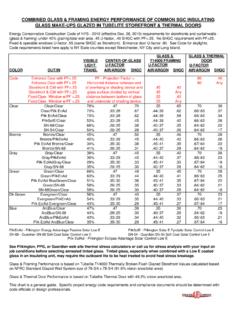
Transcription of Pilkington Product Guide Technical Data - …
1 Pilkington Product Guide Technical Data493/32 Clear1 Blue-Green TintOptifloatHeavy Clear, Energy AdvantageLow-E or Solar-ESolar Control Low-E GlassOptiwhite Low Iron Float GlassPilkington Monolithic Annealed glass SizesQuality Levels1 Nominal AdvantageReflective Low-E glass or Mirropane Transparent MirrorOptifloat Heavy Grey Tint or Bronze Tint1 glass (all products except as noted below) glass StandardsOptifloatClear, Activ, OptiView, EnergyAdvantage Low-E, Solar-E Solar Control Low-E GlassOptifloat Grey Tint or Bronze TintOptifloatBlue-Green Tint, Evergreen High-Performance Tint or SuperGrey High-Performance TintReeded (Texture glass )Austral & Morisco (Texture glass )Rayado, Sparkel and Yacare (Texture glass )Arctic Blue High-Performance ASTM C 1036; with exception of Texture and Optiwhite listed may, in some cases, be too large to meet applicable static load requirements.
2 Other thicknesses and sizes may be available upon on the mean of the thickness range. Note glass density = 158 Typical production nominal glass thickness in bold typeface* Pilkington Optifloat Blue-Green glass : 1/8" and 5mm are not standard products* Subject to AvailabilityMaximum Available Sizes 2,350 OptifloatGrey TintOptifloatClear OptifloatBronze TintOptifloatBlue-Green TintEverGreenHigh-Performance TintSuperGreyHigh-Performance TintArctic BlueHigh-Performance Tint Heat GainCoeffi-cient7 Shading Coeffi-cient8 European6 NominalGlassThicknessVisible Light2 Trans-mittance3% Reflectance4%Solar Energy2 Reflect-ance4%UVTrans-mittance2% WinterOutsideInsideTrans-mittance3% 3 glass data 1.
3 10 Pilkington OptiwhiteTMLow Iron Glass1 IronPilkington Mirropane mmGlassSubstrateVisible2 ReflectanceOn The Coated Side%Visible2 Transmittance%RecommendedLight RatioProperGlazingVisible2 ReflectanceGlass Side%8:1 Subject-side:Observer-sideGreyMirror coatingtoward subject-sideProduct1/46116816 Pilkington Uncoated Float GlassOptifloatGrey TintOptifloatClear OptifloatBronze TintOptifloatBlue-Green TintEverGreenHigh-Performance TintSuperGreyHigh-Performance TintArctic BlueHigh-Performance Tint Heat GainCoeffi-cient7 Shading Coeffi-cient8 European6 NominalGlassThicknessVisible Light2 Trans-mittance3% Reflectance4%Solar Energy2 Reflect-ance4%UVTrans-mittance2% WinterOutsideInsideTrans-mittance3% 3 glass data 1.
4 10 Pilkington OptiwhiteTMLow Iron Glass1 IronPilkington Mirropane mmGlassSubstrateVisible2 ReflectanceOn The Coated Side%Visible2 Transmittance%RecommendedLight RatioProperGlazingVisible2 ReflectanceGlass Side%8:1 Subject-side:Observer-sideGreyMirror coatingtoward subject-sideProduct1/46116816 Pilkington Uncoated Float Glass513 AdvantageLow-EPilkington Energy AdvantageTMLow-E glass (#2 Surface) Heat GainCoeffi-cient7 Shading Coeffi-cient8 European6 NominalGlassThicknessVisible Light2 Trans-mittance3% Reflectance4%Solar Energy2 Reflect-ance4%UVTrans-mittance2% WinterOutsideInsideTrans-mittance3% Single glass Performance data 1,10 1 Eclipse AdvantageTMReflective Low-E glass (#2 Surface) Pilkington Solar-ETMS olar Control Low-E glass (#2 Surface)
5 9 Solar-ESolar Control Low-E Eclipse AdvantageClear1 Advantage Grey1 Advantage Bronze1 AdvantageBlue-Green1 AdvantageEverGreen1 AdvantageArctic Blue1 AdvantageGold1 < < OptiViewTMAnti-Reflective GlassOptiViewAnti-Reflective GlassClear Float GlassOptiViewAnti-Reflective GlassClear Float GlassNotes: Contact Pilkington for other OptiView thickness and laminated glass OptiView Anti-Reflective glass performance based on: 6mm (1/4") laminated glass : 3mm (1/8") OptiView (#1) + ( ") clear pvb + 3mm (1/8") OptiView (#4) 12mm (1/2") laminated glass : 6mm (1/4") OptiView (#1) + ( ") clear pvb + 6mm (1/4") OptiView (#4)Clear float glass performance based on non-laminated ActivTM Self-cleaning glass (#1 Surface)91 Control Low-EPilkington Solar-ETMS olar Control Low-E glass Outer Lite (#2 Surface) and Clear Float glass Inner Lite3 Tint3 Tint3 Tint1 Tint3 BlueHigh-Performance Tint1 Tint3 units constructed of equal glass thicknesses and 1/2 ( ) airspace3 AdvantageLow-E3 Uncoated Float glass Outer Lite and Energy AdvantageTMLow-E glass Inner Lite (#3 Surface) Pilkington Eclipse AdvantageTMReflective Low-E glass Outer Lite (#2 Surface) and Energy AdvantageTMLow-E glass Inner Lite (#3 Surface)
6 Pilkington Energy AdvantageTMLow-E glass Outer Lite (#2 Surface) and Clear Float glass Inner Lite Heat GainCoeffi-cient7 Shading Coeffi-cient8 European6 AirArgonAirAirArgonArgonNominalGlassThic knessVisible Light2 Trans-mittance3% Reflectance4%Solar Energy2 Reflect-ance4%UVTrans-mittance2% WinterOutsideInsideTrans-mittance3% Double glass Performance data 1,10 Eclipse AdvantageClear1 AdvantageGrey1 AdvantageBronze1 AdvantageBlue-Green1 AdvantageEverGreen1 AdvantageArctic Blue1 AdvantageGold1 Tint3 Tint3 Tint1 Tint3 BlueHigh-Performance Tint1 Tint3 Eclipse AdvantageTMReflective Low-E glass Outer Lite (#2 Surface)
7 And Clear Float glass Inner LitePilkington Uncoated Float glass Outer Lite and Clear Float glass Inner LiteInsulating units constructed of equal glass thicknesses and 1/2 ( ) airspace Eclipse AdvantageClear1 AdvantageGrey1 AdvantageBronze1 AdvantageBlue-Green1 AdvantageEverGreen1 AdvantageArctic Blue1 Heat GainCoeffi-cient7 Shading Coeffi-cient8 European6 AirArgonAirAirArgonArgonNominalGlassThic knessVisible Light2 Trans-mittance3% Reflectance4%Total Solar Energy2 Reflect-ance4%UVTrans-mittance2% WinterOutsideInsideTrans-mittance3% 3 ActivTMSelf-Cleaning glass Outer Lite (#1 Surface) andOptifloatTMClear glass Inner Lite1 ActivTMSelf-Cleaning glass Outer Lite (#1 Surface) and Solar-ETMS olar Control Low-E glass Inner Lite (#3 Surface)*Double glass Performance data 1,10 Pilkington ActivTMSelf-Cleaning glass Outer Lite (#1 Surface) andEnergy AdvantageTMLow-E glass Inner Lite (#3 Surface)3 AdvantageGold1 OptiViewTM Anti-Reflective glass Outer Lite and Inner Lite *OptiView Anti-Reflective1/4 25 84 54 5 <1 Pilkington OptiViewTM Anti-Reflective glass - Insulating glass fabricated with two layers of Laminated glass ** 2 lites of Laminates glass - each 1/8 OptiViewTM + pvb layer + 1/8 OptiViewTM (coating on all 4 glass to air surfaces)
8 Insulating units constructed of equal glass thicknesses and 1/2 ( ) airspace531. Some combinations or installations may require heat treating to prevent glass breakage from thermal stress. 2. Visible, Solar and UV data are based on laboratory spectrophotometric measurements weighted by an appropriate weighting function(s) using LBNL Window software. Wave length ranges of the sun s energy used to calculate properties: Visible from to microns, Solar from to microns and UV from to microns. 3. Transmittance Percentage of normally incident visible light or solar energy passing directly through the glazing. 4. Reflectance Percentage of normally incident visible light or solar energy reflected away from the glazing.
9 5. U-Factor ( ft. F) Measure of the heat gain or loss through glazing due to environmental differences between the outdoor and indoor air. U-Factors given are center-of- glass values calculated using LBNL Windows Winter U-Factors are based on an outdoor temperature of 0 F (-18 C), an indoor temperature of 70 F (21 C) and a ( ) wind velocity with no sun. Summer U-Factors are based on an outdoor temperature of 90 F (32 C), an indoor temperature of 75 F (24 C), a solar intensity of 248 ft. F (783 W/sq m) and a ( ) wind. To obtain metric U-Factor (W/sq m. C), multiply by U-Factor is identical to the previously known term of U-Value . 6. European U-Factor (W/sq ) is based on EN 410/673 (CEN) standard.
10 7. Solar Heat Gain Coefficient or SHGC The ratio of the total solar heat gain through the glass relative to the incident solar radiation. The solar heat gain includes both the solar energy directly transmitted through the glass , plus the solar energy absorbed by the glass and subsequently convected and thermally radiated data Notes8. Shading Coefficient or SC The ratio of solar heat gain through the glass relative to that through 1/8 (3mm) clear glass at normal incidence. Note that Relative Heat Gain or RHG ( ft.), which is the amount of heat gained through the glass at assumed summer conditions, can be calculated using the following equation: RHG = SC x 200 + Us x 14.