Example: bankruptcy
Pilot Proficiency Program User's Guide - FAASafety.gov
WINGS Pilot Proficiency Program User's Guide November 1, 2011 TC11-0007 Administration Federal Aviation
Tags:
Information
Domain:
Source:
Link to this page:
Documents from same domain

Density Altitude - FAA
www.faasafety.govtakeoff or landing to become an accident in less time than it takes to tell about it. Density Altitude Defined Types of Altitude Pilots sometimes confuse the term “density altitude” with other definitions of altitude. To review, here are some types of altitude: • Indicated Altitude is the altitude shown on the altimeter.

On Landings Part I - FAA - FAASTeam
www.faasafety.govOn Landings Part I Federal Aviation Administration. On Landings Part I ... Landing phase accidents are responsible for nearly half of all general aviation accidents. By fortifying your knowledge of the “whys” and “wherefores” of approach and landing accidents, you can become a safer pilot.

Federal Aviation Administration - FAASafety.gov
www.faasafety.govThis course offers a practical framework to help you develop this vital pilot skill and use it to stay safe in all of your flying activities. After completing the course, you will be able to explain the 3-P model and apply it to flight scenarios that appear in Chapter7. At the end of the course is a short quiz drawn primarily from these scenarios.

VFR Weather Minimums - FAA - FAASTeam - …
www.faasafety.govVFR Weather Minimums The basic VFR weather minimums (14 CFR 91.155) are specific to types of airspace and altitudes. Understanding the rationale behind the different

On Landings Part III - FAA - FAASTeam
www.faasafety.govOn Landings Part III Landing on Wet, Icy, or Snow-Covered Runways Where runway friction is low or nil, aerodynamic braking becomes much more important. Use aerodynamic drag to your advantage on land-ing—especially when the runway is wet or icy. Simply hold the nosewheel

Failure to Follow Procedures Landing Gear Failure Course
www.faasafety.govcorrect and prevent failure in certain components of the nose landing gear, lack of cleanliness of the nose landing gear due to inadequate maintenance, or lack of lubricant in the nose landing gear or its components.

Operations Specifications required to file various ...
www.faasafety.govOperations Specifications required to file various Capabilities Requirements associated with each Ops Spec are documented in FAA Order 8900.1, Volume 3, Chapter

AIRSPACE, SPECIAL USE AIRSPACE, and TEMPORARY FLIGHT ...
www.faasafety.govremains outside Class A, B, or C airspace; and below the altitude of the ceiling of a Class B or Class C airspace area designated for an airport or 10,000 feet MSL, whichever is lower.

Spatial Disorientation - FAASafety.gov
www.faasafety.govOtolith organs The otolith organs are small sacs at the base of the semicircular canals. They are embedded with sensory hairs and contain a gelatinous membrane with chalk-like crystals – called otoliths. As the head or body moves, the movement of the membrane against the sensory hairs registers gravity.

Light Gun Signals - FAASafety.gov
www.faasafety.govApr 03, 2013 · Light Gun Signals Color and Type of Signal Aircraft on the Ground Aircraft in Flight Steady Green Cleared for takeoff Cleared to land Flashing Green Cleared for taxi Return for landing Steady Red STOP Give way and continue circling Flashing Red Taxi clear of runway in use Airport unsafe, do not land Flashing White Return to starting point on airport
Related documents

AC 150/5210-20A, Ground Vehicle Operations to include ...
www.faa.govprovided to an employee or airport user every twelve Consecutive Calendar Months (CCM) to enable that person to maintain a satisfactory level of proficiency. An example of twelve CCM is when training occurs on July 1, 2014 and the training remains valid through July 31, 2015. The training would expire on August 1, 2015.

First Day of School Scripts - Effective Teaching
www.effectiveteaching.comHelps seniors with alternative assessment to show proficiency for graduation Click here to see Sacha’s script as a PowerPoint presentation. John Schmidt High School Teacher John teaches in Illinois and began his first year receiving expert advice from his school district’s three-year new teacher induction program.
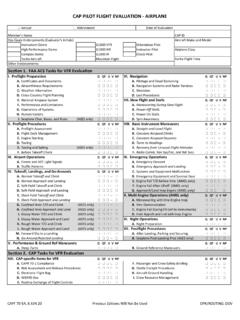
CAP PILOT FLIGHT EVALUATION - AIRPLANE
www.gocivilairpatrol.comannotated on this form. The member has demonstrated the proficiency required to fly the make/model used for the evaluation and to hold the indicated endorsements. In addition, renewal of the member's existing qualifications in the additional aircraft makes/models listed below is …

Advantages and Disadvantages of Various Assessment Methods
www.clark.edu• Embedding the test as part of a course’s requirements may improve student motivation. 2. Locally Developed Exams Advantages • Can be tailored to match program and institutional objectives. • Specific criteria for performance can be established in relation to the curriculum. • Can be used to develop locally meaningful norms.

End to End Hiring Initiative - United States Office of ...
www.opm.govto the agency’s Strategic and Operational Plan. The goal states, “Collaborate with one or more pilot agencies to design an end-to-end hiring model by April 1, 2008; implement and evaluate the model by July 1, 2008; and issue a Governmentwide standard by September 1, 2008.”