Transcription of Pipe Joint Restraint per NFPA 24 - ebaa.com
1 Wats: (800) 633-9190 Phone: (254) 629-1737 Fax: (254) 629-2910 January 13, 2000 Subject: Joint Restraint per NFPA 24 This paper is an explanation of the sections of the National Fire Protection Association NFPA Standard 24, Installation of Private Fire Service Mains and Their Appurtenances, pertaining to the anchoring of fire service mains. The need for some clarification of various parts of this standard has become apparent through the inquiries received by the EBAA Engineering Office. The format to be used in this discussion will be to quote a section of the standard (in italics) followed by an explanation of that section. 8-6 Anchoring Fire Mains. Except for the case of welded joints and approved special restrained joints, such as provided by approved mechanical Joint retainer glands or locked mechanical and push-on joints, the usual joints for underground pipe and fittings are expected to be held in place by the soil in which the pipe is buried.
2 Gasketed push-on and mechanical joints without special locking devices have limited ability to resist separation due to movement of the pipe. All tees, plugs, caps, bends, and hydrant branches on pipe installed underground shall be restrained against movement. This section defines the need for anchorage or Restraint of fittings. To put it quite simply, a Joint that is not provided with a means of Restraint , is an unrestrained Joint and will separate due to the movement caused by the pressure in the pipe. This section also introduces the reader to the concept of restrained joints by the mention of welded joints, approved retainer glands, and locked joints. Methods of Anchoring Fire Mains. Pipe clamps and tie-rods, thrust blocks, locked mechanical or push-on joints, mechanical joints utilizing set screw retainer glands, or other approved methods or device shall be used.
3 The type of pipe, soil, conditions, and available space determine the method. This section is basically a list of available options which satisfy the requirements set forth in the previous section. It may sound humorous but a common misconception is the interpretation that all of the methods must be used at each fitting. Obviously this is incorrect. One only needs to select a single method to satisfy the anchorage requirement. If thrust blocks are used, then rodding and retainer glands are not necessary. Likewise, ifEBAA IRON, INC. Box 877 Eastland, Texas 76448 mechanical joints using retainer glands or other approved devices are used then thrust blocking or rodding is not necessary to fulfill the requirement unless otherwise stated in the specifications. By now we ve seen the word approved used several times so we need to return to earlier sections of the standard for definitions.
4 1-3 Definitions Approved. Means acceptable to the authority having jurisdiction. A note under the above definition points out the fact that NFPA does not approve, inspect or certify any installations, procedures, equipment, or materials nor does it approve or evaluate testing laboratories. This clearly states that NFPA is not in the business of testing, listing, or inspecting. In short, NFPA is not an approval body. This raises the question: If NFPA doesn t approve products or installations, then who does? The answer lies in the next definitions. Authority Having Jurisdiction. The authority having jurisdiction is the organization, office, or individual responsible for approving equipment, an installation or a procedure. This is to say that someone must be given the task of deciding what products and methods, will be used in the installation.
5 Notes below this definition suggest that this may be a government agency, a representative from the local fire authority, an inspector, or even an insurance agency among others. In any event, the owner of the facility must either assume the role of authority having jurisdiction or assign or defer that role to some other entity. Thus far, by following the definitions, we have established that approved products or procedures must be chosen by someone acting as the authority having jurisdiction. So how does one choose products for use in fire protection systems? The most common, though not the only method, is to select products that have been tested for use in fire protection systems. This testing is typically done by organizations writing and organizations that perform this function are Underwriters Laboratories (UL) and Factory Mutual Research (FM).
6 Products that meet the testing and other requirements of the respective testing agencies are then listed in publications issued by the agency. Additionally, a manufacturer has the privilege of marking the product to signify that it has met the testing requirements and is thus listed as acceptable for use in fire protection systems. It is important to note that just because a product is listed as meeting testing requirements of either UL or FM it is not automatically approved for use on a particular installation. The approval of products or methods of Restraint for any particular job must come from the authority having jurisdiction, who will often specify products listed by one of the above mentioned organizations but is not obligated to do so nor is the authority limited to such listed products. EBAA IRON, INC. Box 877 Eastland, Texas 76448 To summarize the anchoring of fire mains per NFPA 24, we find that: 1.
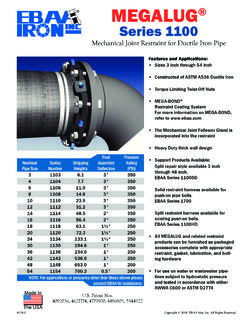
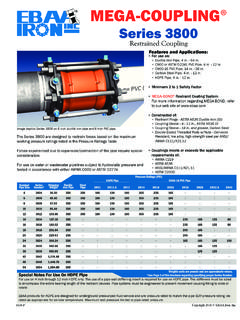
7 All fittings and hydrants branches must be restrained. 2. A method of Restraint must be chosen from the options provided. 3. An authority having jurisdiction must be identified. 4. Products and or methods of Restraint must be approved by the authority. 5. The authority has the option but not the obligation to approve UL or FM listed products. This leads us to the Joint Restraint products produced by EBAA Iron, Inc. A number of our Restraint products have been tested to meet fire protection service standards and are listed as such by UL and FM. This testing was conducted using the representative products as the sole Restraint without assistance from external rodding or blocking and are therefore offered as options available to the authority having jurisdiction, as devices that can be used to meet the requirements for anchoring of fire mains per NFPA 24.
8 The full text of NFPA 24 contains additional information concerning many other aspects of installing fire service mains and the reader is encouraged to consult this and related standards for a more comprehensive understanding of this topic. The Engineering Department EBAA Iron, Inc. EBAA IRON, INC. Box 877 Eastland, Texas 76448