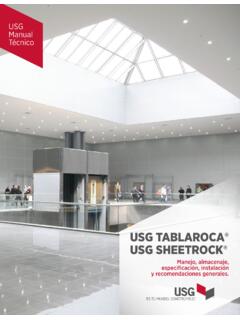
Transcription of Plaster Systems Brochure (English) - SA920
1 Fire performance, beauty and durability for interior residential and commercial spacesPlaste r Systems Plaster Systems offer a number of practical and aesthetic advantages over gypsum panels and other interior finishes. Plaster permits a great deal of design flexibility, combined with fire performance, strength and durability. These factors improve lifecycle economy when compared to drywall. Because Plaster Systems are truly monolithic, they provide surfaces that minimize or eliminate irregularities associated with standard drywall construction (ridging, boarding, nail pops, etc.)
2 Beauty and Strength 3 USG Plaster SystemsUser s Guide This Brochure explains: The components of a Plaster system The difference between conventional Plaster Systems and one- or two-coat veneer Plaster Systems The attributes of conventional and veneer Plaster systemsPagesUnderstand Your system 4 Overview Applications Components Select Your system 19 Product Data Performance Testing
3 Performance SelectorDesign Your system 42 Design Details Good Design PracticesSpecify Your system 54 Application Guide SpecificationsFor More Information Technical Service 800 WebSite Plaster Systems provide improved fire and abuse resistance over conventional drywall Systems .
4 In addition, they allow for a variety of aesthetic applications and better acoustic performance. Depending on the application, either conventional or veneer Plaster Systems can be used. Conventional Plaster Systems use a thicker Plaster coat over a metal lath and provide increased fire and wear resistance, while one- or two-coat veneer Systems are faster and less expensive to apply. Plaster Systems typically consist of a substrate, a basecoat Plaster and a finish Substrates can be either metal lath, unit masonry, monolithic concrete, or a recommended gypsum base, cement board or gypsum fiber Plasters Basecoat plasters provide strength and rigidity, compensating for substrate imperfections and resulting in even, straight walls and ceilings.
5 In conventional Plaster Systems , basecoat plasters are generally applied 1/29 to 19 thick, in one or two separate applications, depending on the substrate. In veneer Plaster Systems , basecoat plasters are applied approximately 1/169 thick. Basecoat plasters are supplied in two forms: mill aggregated (which requires only mixing with water), and neat (which requires the addition of aggregate at the job site).Finish Plasters In conventional Plaster Systems , finish plasters are applied to properly prepared gypsum basecoat plasters to form the wearing surface of walls and ceilings.
6 In veneer finish applications, finish plasters can be applied to any properly prepared basecoat or directly to a gypsum base. Finishes are approximately 1/169 to 3/329 thick, and can be smooth troweled, floated or textured. Finish plasters are supplied in two forms: factory-prepared finishes require only the addition of water, while gauging plasters require the addition of lime putty. Plaster Systems provide improved fire and abuse resistance over conventional drywall Systems . In addition, they allow for a variety of aesthetic applications and better acoustic performance.
7 Depending on the application, either conventional or veneer Plaster Systems can be used. Conventional Plaster Systems use a thicker Plaster coat over a metal lath and provide increased fire and wear resistance, while one- or two-coat veneer Systems are faster and less expensive to apply. Plaster Systems typically consist of a substrate, a basecoat Plaster and a finish Substrates can be either metal lath, unit masonry, monolithic concrete, or a recommended gypsum base, cement board or fiber-reinforced gypsum Plasters Basecoat plasters provide strength and rigidity, compensating for substrate imperfections and resulting in even, straight walls and ceilings.
8 In conventional Plaster Systems , basecoat plasters are generally applied 1/29 to 19 thick, in one or two separate applications, depending on the substrate. In veneer Plaster Systems , basecoat plasters are applied approximately 1/169 thick. Basecoat plasters are supplied in two forms: mill aggregated (which requires only mixing with water), and neat (which requires the addition of aggregate at the job site).Finish Plasters In conventional Plaster Systems , finish plasters are applied to properly prepared gypsum basecoat plasters to form the wearing surface of walls and ceilings.
9 In veneer finish applications, finish plasters can be applied to any properly prepared basecoat or directly to a gypsum base. Finishes are approximately 1/169 to 3/329 thick, and can be smooth troweled, floated or textured. Finish plasters are supplied in two forms: factory-prepared finishes require only the addition of water, while gauging plasters require the addition of lime putty. 4 USG Plaster SystemsOverview 5 USG Plaster SystemsConventional Three-CoatPlaster Systems Conventional Plaster Systems are the best choice to attain a uniform, monolithic, blemish-free, smooth surface with good to excellent wear resistance based on the type of finish Plaster .
10 These Systems make intricate architectural details and ornamental shapes possible. Conventional Plaster Systems offer excellent acoustical performance, proven fire resistance, increased abuse resistance, design flexibility for curves and compound surfaces, and lifecycle cost reduction due to lower maintenance costs. A three-coat conventional Plaster system consists of a thicker Plaster coat (from 5/89 to 19) over a substrate, two base coats (a scratch coat and a brown coat) and a finish Plaster . Two-Coat A two-coat conventional Plaster system uses Rocklath Plaster Base instead of metal lath, one thickness of basecoat Plaster , and a finish that replaces the scratch coat and brown coat.