Transcription of POLYMERS - Btech College in Tirupati
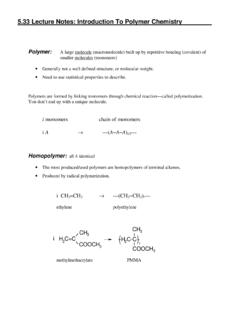
1 1 POLYMERS POLYMERS are the high molecular weight compounds obtained by repeated union of simple molecules. (Monomers). Ex: Starch, Polyvinyl chloride, Polyethylene, N ylon 6, 6 and etc. The word polymer is coined from two Greek words: poly means many and mer means unit or part. The term polymer is defined as very large molecules having high molecular mass. These are also referred to as macromolecules, which are formed by joining of repeating structural units on a large scale. The repeating structural units are derived from some simple and reactive molecules known as monomers and are linked to each other by covalent bonds. This process of formation of POLYMERS from respective monomers is called polymerization.
2 The transformation of ethene to polythene and interaction of hexamethylene diamine and adipic acid leading to the formation of N ylon 6, 6 are examples of two different types of polymerisation reactions. Monomers Monomer is a simple repetitive unit which when joined together in large numbers which give rise to a polymer . These are the building blocks of polymer Ex: Vinyl chloride, ethene, propylene etc. The number of repeating units (n) in the chain so formed is called the Degree of polymerization(DP=n). POLYMERS with ahigh degree of polymerization are called High polyme rs and those with low degree of polymerization are called Oligopolyme rs Degree of polemerization (DP).
3 Degree of polymerization is a number, which indicates the number of repetitive units (monomers) present in the polymer . By knowing the value of DP, the molecular weight of the polymer can be calculated. [Molecular wt of the polymer ] = DP x Molecular wt of each monomer. DP is represented as n . Ex: (CH2 CH2) n Polythene Here n is the DP. i) Calculate the molecular weight of the polythene polymer given DP is 100. Molecular weight of the polythene = DP X Molecular weight of Polethene = 100 X 28=2800. Basic Concepts: 2 The functionality of a monomer is the number of sites it has for bonding to other monomers under the given conditions of the polymerization reaction.
4 Thus, a bifunctional monomer, , monomer with functionality two, can link to two other molecules under suitable conditions. A polyfunctional monomer is one that can react with more than two molecules under the conditions of the polymerization reactions. Definition: The number of bonding sites (or) reactive sites or functional groups present in the molecule. Ex: The double bond in vinyl monomers (CH2 = CHX) can be considered as a site for two free valencies. When the double bond is broken, two single bonds become available for combination. H2C=CHX --- CH2 CHX ------ A). When the functionality of monomer is two bifunctional linear (or) straight chain polymer is formed.
5 Ex: (a)vinyl monomers (b)adipic acid (c)hexamethylene diamine Example for polymer : HDPE (high density polythene) -M-M-M-M-M-M-M- B). When the functionality of monomer is three (tri-functional), three-dimensional net work polymer is formed. Ex: phenol, glycerol Examples for POLYMERS : Urea formaldehyde, phenol formaldehyde. -M-M-M-M-M-M-M- -M-M-M-M-M-M-M- -M-M-M-M-M-M-M- C). when a trifunctional monomer is mixed in small amounts with a bifunctional monomer, a branched chain polymer is formed. Ex: LDPE (LOW density polyethene) -M-N-M-N-M-N-M-N- M N N M M N N M M N 2.
6 Nomenclature of POLYMERS POLYMERS are classified in to four types a) Homo POLYMERS b) Hetero POLYMERS c) Homo chain POLYMERS d) Hetero chain POLYMERS a) Homo POLYMERS : POLYMERS made up of with same type of monomers are called homo POLYMERS eg: Poly ethylene, PVC b) Hetero POLYMERS : POLYMERS made up of with different type of monomers are called hetero POLYMERS eg: buna-s rubber Graft copolymers: If main chain consists of one momomer and branched chain consists of another monomers are called Graft copolymers -M-M-M-M-M-M-M-M N N 3 N N N N N N N N c) Homo chain POLYMERS : If the main chain consists of only one type of atoms called Homo chain POLYMERS eg.
7 Polyethylene. C-C-C-C-C-C-C-C- d) Hetero chain POLYMERS : If the main chain consists of different type of atoms called Hetero chain POLYMERS eg: Polyester, N ylon-6. C-O-C-O-C-O-C-O- Copolymers Homopolymer from a single monomer, copolymer from two (or more) monomers chain copolymerization (different monomers incorporated during the growth of the polymer chain) can lead to: alternating copolymer ABABABABABABABABABABABA block copolymer - AAAAAAAABBBBBBBBBBBBAAA random copolymer - BAABBAABABBABABBBAABBAB graft copolymer - branches of a different polymer are attached to a polymer chain AAAAAAAAAAAAAAAAAAAAAAAAABBBBBBBBBBBBBBB BBBB (generate reactive site on existing polymer chain, grow new chain) 3.
8 Tacticity The difference in configuration due to the orientation of different functional groups with respect to the main chain is called tacticity. It is of three types a). Isotactic If all the functional groups are arranged on the same side of main chain is called isotactic b) .Syndiotactic - If all the functional groups are arranged in the alternative fashion of main chain is called Syndiotactic c). Atactic - If all the functional groups are arranged in random of main chain is called atactic 4 There are several ways of classification of POLYMERS based on some special considerations. The following are some of the common classifications of POLYMERS : [1] by Source [2] by Backbone of the chain [3] by Structure [4] by Compostion [5] by Mode of Polymerization [6] by Molecular force Classification Based on Source: [1] Natural POLYMERS : These POLYMERS are found in plants and animals.
9 Examples are proteins, cellulose, starch, resins and rubber. [2] Semi-synthetic POLYMERS : Cellulose derivatives as cellulose acetate (rayon) and cellulose nitrate, etc. are the usual examples of this sub category. [3] Synthetic POLYMERS : A variety of synthetic POLYMERS as plastic (polythene), synthetic fibres (nylon 6,6) and synthetic rubbers (Buna - S) are examples of man-made POLYMERS . Classification Based on Backbone of the polyme r chain: Organic and Inorganic POLYMERS : A polymer whose backbone chain is essentially made of carbon atoms is termed as organic polyme r. The atoms attached to the side valencies of the backbone carbon atoms are, however, usually those of hydrogen, oxygen, nitrogen, etc.
10 The majority of synthetic POLYMERS are organic. O n the other hand, generally chain backbone contains no carbon atom is called inorganic polyme rs. Glass and silicone rubber are examples of it. Classification Based on Structure of Polyme rs: [1] Linear POLYMERS : These POLYMERS consist of long and straight chains. The examples are high density polythen, PVC, etc. [2] Branched POLYMERS : These POLYMERS contain linear chains having some branches, , low density polythene. [3] Cross-linked POLYMERS : These are usually formed from bi-functional and tri-functional monomers and contain strong covalent bonds between various linear polymer chains, vulcanized rubber, urea-formaldehyde resins, etc.