Transcription of Polymorphism of phosphatidyletbanolamine ...
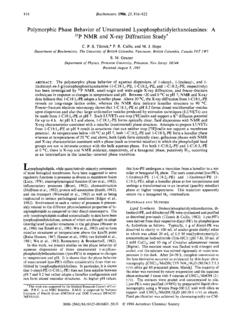
1 I, . II -! ! (346 Polymorphism of phosphatidyletbanolamine -phosphatidylser ine model systems: influence of cholesterol and Mg2+ on Ca2+-triggered bilayer tohexagonal (Hn) transitionsBALLY, C. P. S. TBLCOCK, M. J. HOPE, AND P. R. CULLISD epartment of Biochemistry,University ofBritish Columbia, Vancouver, , Canada V6T 1 W5 Receiwd December 1, 1982 Bally, M. B., Tilcock, C. P. S.,ope, M. J. & Cullis, P. R. (1983) Polymorphism of phosphatidylethanolamine-phosphatidyl-se rine model systems: influence of cholesterol andon Ca2+-triggered bilayer to hexagonal (HI*) transitions. Can. Cell Biol. 61, 344-352 Previous work has shown that Ca2+can trigger bilayer to hexagonal (HI,) polymorphic phase transitions in (unsaturated) phosphatidylserine (PS) - phosphatidylethanolamine (PE) model systems.)
2 In this work we examine the influence of cholesteroland Mg2+on the phase preferences of PS-PE systems. Subsequently, the influence of cholesterol and Mg2+ on the levels ofCa2+ required to trigger bilayer-HII transitions in these mixed systems is studied. It is shown that at 30 C the presence ofequimolar (with respect to phospholipid) levels of cholesterol engenders formation of the Hu phase for PE-PS systemscontaining 15 and 30 mol% PS, whereas bilayer structure is maintained for PE-PS-cholesterol (1: 1:2) dispersions. However, thepolymorphic phase preferences of the latter system are much more sensitive to the presence of monovalent and divalent the absence of cholesterol, Mg2 and high salt concentrations do not affect the polymorphic phase preferences of PE-PS (1: 1)systems.
3 In contrast, 8 mA4 or higher Mg + levels or salt concentrations greater than 1 .O M induce HII-phase formation in,PE-PS-cholesterol (1: 1:2) systems. Further, lower Mg2 concentrations (2 mM) act as a powerful adjunct to CaZt triggeringof HII-phase structure in such systems, reducing the Ca2+concentration required from 4 to mM. These results are discussedin terms of Ca + concentrations required for fusion events and the influence of cholesterol on the structural preferences of theinner monolayer lipids of the erytkrocyte , M. B.,Tilcock, , S. s Hope, M. J. & Cullis, !P. R. (1983) Polymorphism of phosphatidylethanolamine-phosphatidyl-se rine model systems: influence of cholesterol and Mg2+on Ca2+-triggered bilayer to hexagonal (Hn) transitions.
4 Can. Cell Biol. 61, 346-352 Des travaux antCrieurs ont montrC que le Ca2+ peut provoquer des passages de la phase bilamellaire B une phase hexagonale(HI,) polymorphe dans les systkmes mod&les (insatur&) phosphatidylsCrine (PS) - phosphatidylCthanolamine (PE). Nousexaminons ici l influence du choIestCro1 et du Mg2+sur les choix de phase par les syst&mes PS-PE. Par la suite, nous ttudionsl influence du cholestkrol et du Mg2+ sur les taux de Ca*+requis pour dtclencher 11-s passages de bicouche g Hn dans cessystkmes mixtes. Nous dCmontrons qu & 3O C, la prtsence de quantitCs Cquimolaires (quant aux phospholipides) de cholestCro1engendre la formation de la phase HII dans les systCmes PE-PSI contenant 15 et 30 mol% de PS alors que la structure bilamellaireest maintenue dans les dispersions PE-PS-cholestCrol (1:1:2).
5 &pendant, les choix de la phase polymorphe dans ce demiersystt?me sont beaucoup plus sensibles & la prCsence de cations monovalents et divalents. IEn absence de cholestkrol, le Mgzt et lesconcentrations salines tSlevkes n affectent pas Res choix de phase polymorphe des systbmes PE-PS (1~1). Par con ke, desconcentrations de Mg* 8 mM ou plus ClevCes ou des cioncentrations salines plus grandes que 1,O M induisent la formation de laphase Htt dans les systkmes PE-PS-cholestCro1 (1:1:2). De plus, des concentrations plus faibles (2 mA4) de Mg2+ agissentcomme de puissants auxiliaires du Caztpour provoquer la phase Hn dans de tels systkmes, rkduisant la quantitt de Ca*+ requisede 4 & 0,25 mM.
6 Nous discutons de ces r&&tats en fonction des concentrations de Ca*+requises pour les phknomtnes defusion et de l influence du cRoRestCro1 sur les pr&f&ences structurales des lipides de monocouche inteme de la work has shown that unsaturated PE s ofnatural and synthetic origin preferentially adopt ~the HI1configuration at physioloI temperatures ( 1) o Alter-natively, an acidic (~e~a~~~~~y charged) phospholipidABBREVIATIONS: HII, hexagonal; PS, phosphatidylserine ;PE, phosphatidylethanolamine; PC, phosphatidykholine;NMR, nuclear magnetic resonance; HEPES, 2-(IV-Zhydroxy-ethylpiperazin-iV -yl)ethanesulfonic acid; TLC, +raduit par la revue]such as PS can stabilize a bilayer organization for mixedPE - acidic phospholipid systems (2-5).
7 Such systemsare of interest not o nly because they can mimic the lipidcomposition of certain membranes (such as the innermonolayer of the human erythrocyte membrane (6)), butalso because their structural preferences (bilayer ++nonbilayer) can be Imodulated or reulated by physiolog-ically relevant factors such as pH and divalent cations(2--T), Given evid ence that nonbilayer lipid structuresplay intermediate roles in membrane fusion processes(7, 8) and their pos#sible involvement in lipid flip-flop and other forms of transbilayer transport (9), an under-standing of such regulation could provide potentiallyimportant information regarding the functional roles oflipids and the methods by which those functions this regard it has been shown that bilayer to Hntransitions in multilamellar (soya) PE-PS (4: 1) systemscan be triggered by 2 mM or higher concentrations ofCa2+ (5).
8 Fusion between sonicated unilamellar ver-sions of these systems requires similar levels of Ca*+(10). Such Ca*+concentrations are rather high andwould not be expected to occur in most biologicalsystems, particularly in the cytoplasm where the freeCa2+ concentrations are less than 100 PM (11). In thiscommunication we therefore examine the influence oftwo factors which may be expected to act as adjuncts tothe Ca2+ effect, namely Mg2+ and cholesterol. Mg2+does not induce bilayer to Hn transitions in PE-PSsystems, but does induce aggregation, a step which isvital to obtaining the close apposition between bilayersapparently required before Hn-phase formation canproceed (9).
9 In (unsaturated) bilayer PE-PC systems,on the other hand, cholesterol can induce formation ofthe hexagonal phase (12, 13) and thus may also beconsidered to facilitate Hu-phase formation. We showhere that cholesterol can induce HII-phase structure inDprevious bilayer PE-PS systems and that, in combina-tion, the presence of (2mM) Mg2+ and equimolarcholesterol can reduce the Ca2+ concentrations requiredto induce such transitions by more than an order and methodsSoya PE and soya PS were obtained from soya bean PCemploying the head-group-exchange capacity of phospholip-ase D (14). The PS was purified using carboxymethyl-cellulose column chromatography and subsequently convertedto the sodium salt as described previously (15).
10 PE waspurified employing silicic acid preparative liquid chromatog-raphy. All lipids were shown to be greater than 99% pure asindicated by two-dimensional thin-layer was obtained from Sigma (St. Louis, MO).Phospholipase D was partially purified from the inner leaves ofsavoy cabbage employing established procedures (16).Samples for3 P-NMR studies were prepared from anappropriate mixture of the lipids in chloroform in a lo-mmNMR tube. Chloroform was evaporated under nitrogen and thesample was then kept under high vacuum for approximately2 h. The dry lipid mixtures were hydrated with mL ofbuffer (100mM NaCl, 10% (v/v) *HzO, and 10 mM HEPES(pH )) by vortex mixing at 4 C in the presence of a glassagitator to facilitate lipid dispersal.





![INDEX [www.ballyrefboxes.com]](/cache/preview/3/2/a/a/7/f/f/4/thumb-32aa7ff45cca59bcf1b3f12bf9df3096.jpg)

