Transcription of Polynomials - Multiplying Polynomials - CCfaculty.org
1 Polynomials - Multiplying Polynomials Objective: Multiply Polynomials . Multiplying Polynomials can take several different forms based on what we are Multiplying . We will first look at Multiplying monomials, then monomials by Polynomials and finish with Polynomials by Polynomials . Multiplying monomials is done by Multiplying the numbers or coefficients and then adding the exponents on like factors. This is shown in the next example. Example 1. (4x3 y 4z)(2x2 y 6z 3) Multiply numbers and add exponents for x, y, and z 8x5 y 10z 4 Our Solution In the previous example it is important to remember that the z has an exponent of 1 when no exponent is written. Thus for our answer the z has an exponent of 1 + 3 = 4. Be very careful with exponents in Polynomials . If we are adding or sub- tracting the exponnets will stay the same, but when we multiply (or divide) the exponents will be changing.
2 Next we consider Multiplying a monomial by a polynomial. We have seen this operation before with distributing through parenthesis. Here we will see the exact same process. Example 2. 4x3(5x2 2x + 5) Distribute the 4x3, Multiplying numbers, adding exponents 20x5 8x4 + 20x3 Our Solution Following is another example with more variables. When distributing the expo- nents on a are added and the exponents on b are added. Example 3. 2a3b(3ab2 4a) Distribute, Multiplying numbers and adding exponents 6a4b3 8a4b Our Solution There are several different methods for Multiplying Polynomials . All of which work, often students prefer the method they are first taught. Here three methods will be discussed. All three methods will be used to solve the same two multipli- cation problems. Multiply by Distributing 1. Just as we distribute a monomial through parenthesis we can distribute an entire polynomial.
3 As we do this we take each term of the second polynomial and put it in front of the first polynomial. Example 4. (4x + 7y)(3x 2y) Distribute (4x + 7y) through parenthesis 3x(4x + 7y) 2y(4x + 7y) Distribute the 3x and 2y 12x2 + 21xy 8xy 14y 2 Combine like terms 21xy 8xy 12x2 + 13xy 14y 2 Our Solution This example illustrates an important point, the negative/subtraction sign stays with the 2y. Which means on the second step the negative is also distributed through the last set of parenthesis. Multiplying by distributing can easily be extended to problems with more terms. First distribute the front parenthesis onto each term, then distribute again! Example 5. (2x 5)(4x2 7x + 3) Distribute (2x 5) through parenthesis 4x2(2x 5) 7x(2x 5) + 3(2x 5) Distribute again through each parenthesis 8x3 20x2 14x2 + 35x + 6x 15 Combine like terms 8x3 34x2 + 41x 15 Our Solution This process of Multiplying by distributing can easily be reversed to do an impor- tant procedure known as factoring.
4 Factoring will be addressed in a future lesson. Multiply by FOIL. Another form of Multiplying is known as FOIL. Using the FOIL method we mul- tiply each term in the first binomial by each term in the second binomial. The letters of FOIL help us remember every combination. F stands for First, we mul- tiply the first term of each binomial. O stand for Outside, we multiply the outside two terms. I stands for Inside, we multiply the inside two terms. L stands for Last, we multiply the last term of each binomial. This is shown in the next example: Example 6. (4x + 7y)(3x 2y) Use FOIL to multiply (4x)(3x) = 12x2 F First terms (4x)(3x). (4x)( 2y) = 8xy O Outside terms (4x)( 2y). (7y)(3x) = 21xy I Inside terms (7y)(3x). (7y)( 2y) = 14y 2 L Last terms (7y)( 2y). 12x2 8xy + 21xy 14y 2 Combine like terms 8xy + 21xy 12x2 + 13xy 14y 2 Our Solution 2.
5 Some students like to think of the FOIL method as distributing the first term 4x through the (3x 2y) and distributing the second term 7y through the (3x 2y). Thinking about FOIL in this way makes it possible to extend this method to problems with more terms. Example 7. (2x 5)(4x2 7x + 3) Distribute 2x and 5. (2x)(4x2) + (2x)( 7x) + (2x)(3) 5(4x2) 5( 7x) 5(3) Multiply out each term 8x3 14x2 + 6x 20x2 + 35x 15 Combine like terms 8x3 34x2 + 41x 15 Our Solution The second step of the FOIL method is often not written, for example, consider the previous example, a student will often go from the problem (4x + 7y)(3x 2y). and do the multiplication mentally to come up with 12x2 8xy + 21xy 14y 2 and then combine like terms to come up with the final solution. Multiplying in rows A third method for Multiplying Polynomials looks very similar to Multiplying numbers.
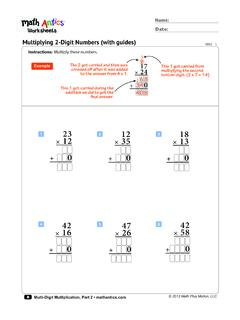
6 Consider the problem: 35. 27. 245 Multiply 7 by 5 then 3. 700 Use 0 for placeholder, multiply 2 by 5 then 3. 945 Add to get Our Solution World View Note: The first known system that used place values comes from Chinese mathematics, dating back to 190 AD or earlier. The same process can be done with Polynomials . Multiply each term on the bottom with each term on the top. Example 8. (4x + 7y)(3x 2y) Rewrite as vertical problem 4x + 7y 3x 2y 8xy 14y 2 Multiply 2y by 7y then 4x 12x2 + 21xy Multiply 3x by 7y then 4x. Line up like terms 12x2 + 13xy 14y 2 Add like terms to get Our Solution This same process is easily expanded to a problem with more terms. 3. Example 9. (2x 5)(4x2 7x + 3) Rewrite as vertical problem 4x3 7x + 3 Put polynomial with most terms on top 2x 5. 2. 20x + 35x 15 Multiply 5 by each term 8x 14x2 + 6x 3.
7 Multiply 2x by each term. Line up like terms 8x3 34x2 + 41x 15 Add like terms to get our solution This method of Multiplying in rows also works with Multiplying a monomial by a polynomial! Any of the three described methods work to multiply Polynomials . It is suggested that you are very comfortable with at least one of these methods as you work through the practice problems. All three methods are shown side by side in the example. Example 10. (2x y)(4x 5y). Distribute FOIL Rows 4x(2x y) 5y(2x y) 2x(4x) + 2x( 5y) y(4x) y( 5y) 2x y 8x2 4xy 10xy 5y 2 8x2 10xy 4xy + 5y 2 4x 5y 8x2 14xy 5y 2 8x2 14xy + 5y 2 10xy + 5y 2. 8x2 4xy 8x2 14xy + 5y 2. When we are Multiplying a monomial by a polynomial by a polynomial we can solve by first Multiplying the Polynomials then distributing the coefficient last. This is shown in the last example.
8 Example 11. 3(2x 4)(x + 5) Multiply the binomials, we will use FOIL. 3(2x2 + 10x 4x 20) Combine like terms 3(2x2 + 6x 20) Distribute the 3. 6x2 + 18x 60 Our Solution A common error students do is distribute the three at the start into both paren- thesis. While we can distribute the 3 into the (2x 4) factor, distributing into both would be wrong. Be careful of this error. This is why it is suggested to mul- tiply the binomials first, then distribute the coeffienct last. Beginning and Intermediate Algebra by Tyler Wallace is licensed under a Creative Commons Attribution Unported License. ( ). 4. Practice - Multiply Polynomials Find each product. 1) 6(p 7) 2) 4k(8k + 4). 3) 2(6x + 3) 4) 3n2(6n + 7). 5) 5m4(4m + 4) 6) 3(4r 7). 7) (4n + 6)(8n + 8) 8) (2x + 1)(x 4). 9) (8b + 3)(7b 5) 10) (r + 8)(4r + 8). 11) (4x + 5)(2x + 3) 12) (7n 6)(n + 7).
9 13) (3v 4)(5v 2) 14) (6a + 4)(a 8). 15) (6x 7)(4x + 1) 16) (5x 6)(4x 1). 17) (5x + y)(6x 4y) 18) (2u + 3v)(8u 7v). 19) (x + 3y)(3x + 4y) 20) (8u + 6v)(5u 8v). 21) (7x + 5y)(8x + 3y) 22) (5a + 8b)(a 3b). 23) (r 7)(6r 2 r + 5) 24) (4x + 8)(4x2 + 3x + 5). 25) (6n 4)(2n2 2n + 5) 26) (2b 3)(4b2 + 4b + 4). 27) (6x + 3y)(6x2 7xy + 4y 2) 28) (3m 2n)(7m2 + 6mn + 4n2). 29) (8n2 + 4n + 6)(6n2 5n + 6) 30) (2a2 + 6a + 3)(7a2 6a + 1). 31) (5k 2 + 3k + 3)(3k 2 + 3k + 6) 32) (7u2 + 8uv 6v 2)(6u2 + 4uv + 3v 2). 33) 3(3x 4)(2x + 1) 34) 5(x 4)(2x 3). 35) 3(2x + 1)(4x 5) 36) 2(4x + 1)(2x 6). 37) 7(x 5)(x 2) 38) 5(2x 1)(4x + 1). 39) 6(4x 1)(4x + 1) 40) 3(2x + 3)(6x + 9). Beginning and Intermediate Algebra by Tyler Wallace is licensed under a Creative Commons Attribution Unported License. ( ). 5. Answers to Multiply Polynomials 1) 6p 42 21) 56x2 + 61xy + 15y 2.
10 2) 32k 2 + 16k 22) 5a2 7ab 24b2. 3) 12x + 6 23) 6r 3 43r 2 + 12r 35. 4) 18n3 + 21n2 24) 16x3 + 44x2 + 44x + 40. 5) 20m5 + 20m4 25) 12n3 20n2 + 38n 20. 6) 12r 21 26) 8b3 4b2 4b 12. 7) 32n2 + 80n + 48 27) 36x3 24x2 y + 3xy 2 + 12y 3. 8) 2x2 7x 4 28) 21m3 + 4m2n 8n3. 9) 56b2 19b 15 29) 48n4 16n3 + 64n2 6n + 36. 10) 4r 2 + 40r+64 30) 14a4 + 30a3 13a2 12a + 3. 11) 8x2 + 22x + 15 31) 15k 4 + 24k 3 + 48k 2 + 27k + 18. 12) 7n2 + 43n 42 32) 42u4 + 76u3v + 17u2v 2 18v 4. 13) 15v 2 26v + 8 33) 18x2 15x 12. 14) 6a2 44a 32 34) 10x2 55x + 60. 15) 24x2 22x 7 35) 24x2 18x 15. 16) 20x2 29x + 6 36) 16x2 44x 12. 17) 30x2 14xy 4y 2 37) 7x2 49x + 70. 18) 16u2 + 10uv 21v 2 38) 40x2 10x 5. 19) 3x2 + 13xy + 12y 2 39) 96x2 6. 20) 40u2 34uv 48v 2 40) 36x2 + 108x + 81. Beginning and Intermediate Algebra by Tyler Wallace is licensed under a Creative Commons Attribution Unported License.