Transcription of Position Statement - American Nephrology Nurses Association
1 vascular access for Hemodialysis Patients who have reached Stage 5 of Chronic Kidney Disease (CKD) or end stage renal disease (ESRD) require dialysis or transplant for survival. Patients who require hemodialysis therapy must have a permanent means of access to their bloodstream in order to achieve this life sustaining therapy. It is the Position of the American Nephrology Nurses Association (ANNA) that: CKD education related to creation and maintenance of the hemodialysis vascular access should be made available to CKD patients and their families beginning in Stage 4. Ideally, as soon as the diagnosis of impending progression into Stage 5 is made and need for kidney replacement therapy has been determined, permanent vascular access should be placed.
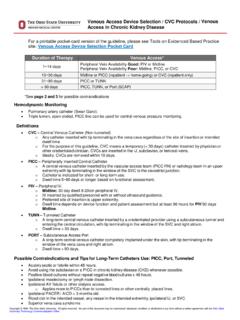
2 Vein preservation of both peripheral and central vessels should be incorporated into patient teaching and care. Blood draws and IV placement should be from/in the dorsum of the hands whenever possible, regardless of arm dominance. Forearm and upper-arm veins suitable for future vascular access should not be used for venipuncture or for placement of intravenous catheters. Subclavian catheters or peripherally inserted central catheter lines (PICCs) should be avoided due to the risks of central vein stenosis and occlusion. Optimally all patients requiring maintenance hemodialysis therapy should have a functioning permanent vascular access in place prior to the initiation of hemodialysis. ANNA endorses the recommendations of the National Kidney Foundation (NKF) Kidney Disease Outcomes Quality Initiative (KDOQI) vascular access Guidelines regarding the order of preference for the placement of vascular access , with fistulae as the preferred choice.
3 An acceptable choice when an arteriovenous (AV) fistula is not possible or viable is an AV graft of synthetic or biological material. The use of hemodialysis catheters greater than 90 days should be avoided if possible. Peritoneal dialysis should be considered as a bridge to AVF maturation in appropriate patients to avoid HD catheter usage. Detailed, focused history and physical examination as well as vessel mapping is the expected standard of care and should be performed for each new CKD patient to determine the most suitable type of vascular access . Vessel mapping is also indicated when a vascular access failure or impending failure occurs to determine if the patient is a candidate for an A-V fistula. ANNA endorses the recommendations of the NKF KDOQI vascular access Guidelines regarding assessment, access placement, and maintenance.
4 ANNA endorses the Centers for Medicare & Medicaid Services Fistula First Catheter Last (FFCL) Workgroup Coalition s Change Concepts. Several recent studies show data supporting increased patient survival with AV Fistula and increased morbidity and mortality in patients with HD catheters as vascular access . Position Statement Page 2 vascular access for Hemodialysis A routine access Surveillance Program should be employed in each dialysis facility to identify and intervene for vascular access dysfunction, to enhance long-term access function and reduce the costs associated with maintenance of access patency. access surveillance and management is an interdisciplinary team function. The patient, nephrologist, Nephrology nurse, technician, interventional radiologist/nephrologist, surgeon, and primary care physician should all be participants of the team.
5 The social worker and dietitian can also participate in this sustained effort. The interdisciplinary team should assure each patient and family has factual information related to all types of vascular access and respect the patient s right to self-determination in choice of vascular access . Staff and patient education should include information on infection control measures applicable to hemodialysis access sites. Staff education should include principles and hands-on cannulation training for vascular access to assure optimal care of the patient s access . Staff education programs should include satisfactory demonstration of knowledge and skills prior to the staff member being allowed to independently perform cannulation. Facilities should adopt FF/CL best practice models to develop vascular access management plans.
6 Education in self-cannulation should be offered to patients with the ability and access placement location to enable them to take on this responsibility. Cannulation of vascular access should be considered as an integral part of successful hemodialysis and an important factor in access outcomes. Background and Rationale vascular access for hemodialysis has long been a formidable challenge to those involved in caring for ESRD patients. In the early 1960s, vascular access for chronic hemodialysis was established using an external device known as the Scribner shunt. This access device consisted of Teflon tubes surgically implanted into the patient s artery and vein and connected externally by silastic tubing. This method of vascular access was plagued by infection, clotting, and the potential risk of exsanguination should the device become disconnected or dislodged.
7 In 1966 the internal AV fistula was developed by Drs. Brescia and Cimino. The native AV fistula was a significant breakthrough at the time and is still considered to be the gold standard for hemodialysis vascular access . In the 1970s biologic and synthetic grafts became available. In the 1980s central venous catheters for hemodialysis were developed. Grafts and catheters are associated with a higher incidence of infection and thrombosis; therefore, the native AV fistula is the preferred means of hemodialysis vascular access . In 1997 the NKF published the Dialysis Outcome Quality Initiative (DOQI) Clinical Practice Guidelines including vascular access Guidelines. These guidelines, revised and expanded in 2000 to include earlier stages of chronic kidney disease, endorse the use of the native AV fistula as the preferred vascular access for hemodialysis.
8 The NKF re-named the project Kidney Disease Outcome Quality Initiative (KDOQI) and the vascular access Guidelines were updated in 2006. These guidelines stipulate that when the creation of a native AV fistula is not possible, a graft or central venous catheter may be used for hemodialysis vascular access . These guidelines also stipulate that peritoneal dialysis may serve as a bridge to AVF maturation to avoid HD catheter placement. Page 3 vascular access for Hemodialysis In 2003, CMS collaborated with ESRD networks and key provider representatives for the purpose of advancing the KDOQI vascular access guideline. The recommendation from this group increased the goal for AV fistulas to 50% for incident patients and 40% for prevalent patients.
9 In 2005 CMS recognized the work of this group as having a significant impact on the management of vascular access in patients with CKD. The group was renamed the Fistula First Breakthrough Initiative (FFBI) and the AV fistula goal in prevalent patients was increased to 66%. In 2013 this initiative was renamed the Fistula First Catheter Last (FFCL) Workgroup Coalition. Nephrology Nurses have the primary responsibility to assure the highest quality cannulation to preserve access integrity and prevent access complications. This responsibility includes use of the extensive resources available from FF/CL to incorporate best practices for access cannulation by promotion of expert cannulators and formal cannulation protocols and offering patients the opportunity to self cannulate.
10 The following steps may lead to a reduction in morbidity and mortality in the CKD patient population: increasing the use of native AV fistulas as the primary option for vascular access ; access surveillance efforts to identify access dysfunction; initiation of timely, appropriate interventional procedures; and preserving central and peripheral vessels to assure future access . Implementation of these steps will not only improve the quality of life enjoyed by our patients, but will also serve to reduce the ever-increasing cost of providing hemodialysis care to the CKD patient population. Glossary access Surveillance Program A program developed and implemented by an interdisciplinary group in the dialysis setting to assure that access dysfunction is detected early, so appropriate and timely interventions can be executed.