Transcription of Postnatal care planning - RCM
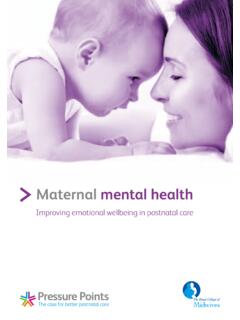
1 Postnatal care planning23 Postnatal care planning The message we are getting from our members is clear. We must do something to address the state of Postnatal care. That s what our campaign Pressure Points is all about. Presenting the evidence and making a case for better provision of Postnatal care enabling midwives, maternity support workers and student midwives to give women and their families the care that they deserve. This report continues our study by focusing on Postnatal care planning and demonstrating how the situation could be improved through the funding of more midwives.
2 One thing is certain our members cannot continue to paper over the cracks in an underfunded and under-resourced Postnatal environment, without there being detrimental effects on the health of women, children and the over-stretched maternity teams who are crying out to be given the tools to support of women s views of maternity care repeatedly inform us of their unhappiness with the current provision of Postnatal care which is not able to provide them with the support they need. Despite policy rhetoric that supports women s choice and their involvement in decision making, the findings in this report evidence the fact that the NICE recommendation for individualised care planning that could improve continuity of care and ensure women and their babies receive the number of Postnatal contacts appropriate to their needs, is not being implemented.
3 The role of the maternity team in supporting women and recognising the onset of complications is vital. However, there has been a decrease in the length of Postnatal stay in hospital and the number of home visits and there appears to be little recognition of the value of continuity of care. This has led to a situation where the current content and timing of Postnatal care is not meeting women s health Point 4 Postnatal care planning The backgroundChief Executive, Royal College of MidwivesThe impact that good Postnatal care could have on women s experiences and their long-term health in the context of the increasing complexity of the health of women who become pregnant, more intervention in labour, the high rate of caesarean sections and widespread morbidity should not be care planning What should women be receiving?
4 Between September and November 2013 the RCM surveyed our midwife, maternity support workers and student midwife members across the UK. We then asked the mothers at for their experiences within the Postnatal care period. These are the results. The survey results Midwives MSWs Student Midwives MothersWe know that women are asking for Postnatal care that is able to be supportive and listening and where possible in their own home. These aspirations are reflected in the NICE quality standard on Postnatal care. What NICE guidance says Postnatal care should be a continuation of the care the woman received during her pregnancy, labour and birth and involve planning and regularly reviewing the content and timing of care, for individual women and their babies.
5 Each Postnatal contact should be provided in accordance with the principles of individualised NICE quality standard recommends that: A documented, individualised Postnatal care plan should be developed with the woman ideally in the antenatal period or as soon as possible after birth. This should include: relevant factors from the antenatal, intrapartum and immediate Postnatal period details of the healthcare professionals involved in her care and that of her baby, including roles and contact details plans for the Postnatal period including:> details about adjustment to motherhood, emotional wellbeing and family support structures> plans for feeding, including specific advice about either breastfeeding support or formula feeding.
6 The plan should be reviewed at each Postnatal contact. planning and regularly reviewing the content and timing of care for individual women and their babies, and communicating this (to the woman, her family and other relevant Postnatal care team members) through a documented care plan can improve continuity of care. Women and their babies should receive the number of Postnatal contacts appropriate to their care care is key to providing important information at the appropriate time, recognising when additional support is needed and offering targeted interventions through the appropriate multiple agency care care planning Postnatal services must be commissioned and provided in a way that is consistent with NICE quality standard recommendations It is unacceptable that women are not currently provided with an individualised Postnatal care plan and equally unacceptable that there are not enough midwives to ensure women receive the number of Postnatal visits that are appropriate to their factorsWe asked midwives - What
7 Is the most significant factor influencing the decision about the number of Postnatal visits a woman receives?Organisational pressures65%Traditional service provision3%Women s needs23%Commissioners directives9%Overwhelmingly, two-thirds of midwives said the most important factor influencing the number of Postnatal visits a woman receives was not the woman s needs, but was the pressure on the service from, for example, the midwife shortage. That only one midwife in four told us that it was women s needs which determined the number of visits received, is deeply care should always be based on women s needs and not on how underfunded and overstretched local maternity services ability to plan care with women will reflect the directives from managers and commissioners.
8 It is clear that our members feel it is this which is seen to be prescribing and limiting the number of visits. Recommendation 89 Postnatal care planning Opportunities for developing and reviewing the care she didn t tell me44% Yes but only in general terms37% I don t remember if we discussed this or not9% Yes she told me exactly when and how often she would visit10% We asked mothers - Did the midwife tell you before you had the baby what sort of care you would receive after birth? Nearly half of women did not remember discussing a Postnatal care plan before the birth.
9 Although an explanation for this may be that most women are unlikely to receive Postnatal care from the midwife they met while they were pregnant, it is worrying that mothers are not made aware of the level of service and support that they can expect in the Postnatal asked mothers - Did you discuss your Postnatal plan with a member of the maternity team after the birth?Ye s21%No64%Don t remember15%It is perhaps even more worrying that nearly two-thirds of mothers had not discussed the Postnatal care plan after the birth these conversations between women and midwives are not happening because resources are stretched, it is no wonder that both are left disappointed with the Postnatal care being offered.
10 1011 Postnatal care planning Home safety (eg room temperature, smoking) 59% 60%Hand hygiene and general cleanliness 51% 45%Changing the nappy 50% 64%Cord care 68% 74%Bathing the baby demonstration 20% 46%Breastfeeding latching 71% 76%Breastfeeding position 70% 71%Artificial feeding sterilisation of equipment 33% 45%Artificial feeding preparation of feeds 34% 46%Safer infant sleeping 74% 62%Normal infant behavior 35% 39%Maternal physical wellbeing 67% 55%Maternal emotional wellbeing 41% 40%Contraception 44% 33%Reviewing the Postnatal care plan 35% 35%We asked midwives and MSWs - Can you identify in