Transcription of Practice Note – Deciding on the appropriate JCT contract
1 Practice Note Deciding on the appropriate JCT contract This Practice Note is intended to provide assistance in Deciding the appropriate form of contract but it is not a substitute for professional advice. Published September 2011 by Sweet & Maxwell, 100 Avenue Road, London NW3 3PF part of Thomson Reuters (Professional) UK Limited (Registered in England and Wales, Company No 1679046. Registered Office and address for service: Aldgate House, 33 Aldgate High Street, London EC3N 1DL) All rights reserved. No part of this publication may be reproduced, stored in a retrieval system, or transmitted, in any form or by any means, electronic, mechanical, photocopying, recording or otherwise, except in accordance with the provisions of the Copyright, Designs and Patents Act 1988, without the prior written permission of the publisher.
2 Thomson Reuters and the Thomson Reuters Logo are trademarks of Thomson Reuters. Sweet & Maxwell is a registered trademark of Thomson Reuters (Professional) UK Limited. The Joint Contracts Tribunal Limited 2011 The Joint Contracts Tribunal Limited 2011 Practice Note Deciding on the appropriate JCT contract 2011 Page i Introduction Page 1 Part 1: Project Strategy 2 Procurement methods 2 Types of contract 4 Matters which might influence choice 5 Consequences of the choice of main contract 6 Watchpoints for choice and use 8 Part 2: Range of JCT Main Contracts 9 Traditional or conventional : Lump sum 9 Traditional or conventional: Measurement 14 Traditional or conventional.
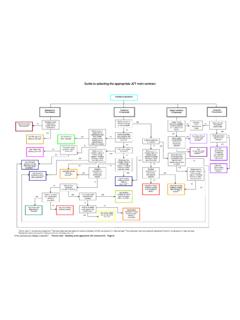
3 Cost reimbursement or cost plus 15 Design and build 16 Management 17 Partnering 19 Pre-Construction Services Agreement 20 Consultancy Agreement 21 Part 3: Range of JCT Sub-Contracts and Sub-subcontract 22 Sub-Contracts 22 Sub-subcontract 26 Pre-Construction Services Agreement 27 Part 4: Comparison of contract Provisions 29 Guide to selecting the appropriate JCT main contract 33 Guide to selecting the appropriate JCT sub- contract 34 JCT Construction Contracts 38 Part 5: JCT Publications 39 Contents The Joint Contracts Tribunal Limited 2011 Practice Note Deciding on the appropriate JCT contract 2011 Page 1 1 This Practice Note has five Parts: Part 1 covers the project strategy and although this mainly is concerned with the top level of contracting it also has relevance to the sub- contract level; Parts 2 and 3 respectively identify the available main and sub-contracts; Part 4 provides a tabulated comparison of provisions of some of the most used contracts and a flow chart to assist users in making their choice; and Part 5 a list of JCT publications.
4 2 When approaching the question of the appropriate JCT construction contract , the first decisions to be made are those concerning the choice of procurement and the type of contractual arrangement. Only when these two decisions have been made can the choice of a form of contract be decided. 3 JCT provides a wide range of forms of contract to meet the various and diverse needs of the UK construction industry. 4 The Scottish Building contract Committee (SBCC), a member of JCT, has in the past prepared and published Scottish Supplements to many JCT forms of contract , for use where Scots law is to apply.
5 SBCC now publishes integrated documents, that is a JCT contract which has been amended formally for use where Scots law is to apply. Additionally, the Royal Society of Ulster Architects continues to publish Adaptation Schedules for certain JCT contracts for use in Northern Ireland. 5 The concept of partnering plays an important part in procurement strategy and may impact upon the choice of contract . A discrete section on partnering is included in this Practice Note. Introduction The Joint Contracts Tribunal Limited 2011 Practice Note Deciding on the appropriate JCT contract 2011 Page 2 6 Procurement is a generic term embracing all those activities undertaken by a client seeking to bring about the construction or refurbishment of a building.
6 Variously referred to as a method, path or system, procurement is initiated by devising a project strategy, which entails weighing up the benefits, risks and financial constraints which attend the project and which eventually will be reflected in the choice of contractual arrangements. In every project the concerns of the client will focus on time, cost, and performance or quality, in relation both to design and to construction of the building. 7 The project strategy will necessitate making an analysis of the situation, making a choice from the procurement options and then devising a method of implementing that choice, using well established rules and procedures.
7 The client s policies, available resources, organisational structure and preferred contractual arrangements will need to be taken into account. There are inherent risks associated with using any particular procurement strategy but equally important is the need for all parties to comply with their respective obligations; this is particularly important where responsibility for design and construction are separated. Identifying and dealing appropriately with risk at the outset is an integral part of any project strategy. Procurement methods 8 There are three main procurement options, and the essential features of each are as follows: Traditional procurement (sometimes termed conventional procurement) 9 A method which became standard Practice in the building industry for 150 years following the emergence of the general contracting firm and the establishment of independent client consultants.
8 The main feature is that the design process is separate from construction, and full documentation is required before the contractor can be invited to tender for carrying out the work. Appointment of a contractor is commonly by competitive tender, but less usually by negotiation. Full documentation is necessary for tendering purposes, including that from specialist sub-contractors, and adequate time is needed for the preparation of this. The client has control over design, specified quality and standards etc through his appointed consultants. Generally there is no design responsibility on the contractor.
9 Because design and construction are separate sequential processes, the overall programme for the project tends to be relatively long. There is for the client reasonable certainty on construction costs, because a contract figure is usually known at the outset, although this may need to be adjusted later, as provided for in the contract . The terms of many traditional contracts require the client to appoint a professional consultant to act as an independent contract administrator. Although making design decisions before work has commenced may appear to bring a measure of inflexibility, changes or variations are possible during construction of the work, usually at a price in terms of direct and related costs and extra time.
10 Administrative matters relating to valuations and payments are in the hands of the client s consultants. Completion within the contract period is an obligation, although the contract administrator may need to revise the date for completion to take account of delays due to reasons listed in the contract . Speculative risks are balanced as between the parties, more in the client s favour on a lump sum contract , but less so with a measurement contract . The traditional lump sum approach in terms of cost, design and quality is a relatively low risk procurement option for the client, but the time needed for the project overall is likely to be relatively longer than that of other procurement methods.





![CLAIMS THE KEY ESSENTIALS [ PART 1 ] - kpkqs.com](/cache/preview/5/b/7/9/c/5/e/1/thumb-5b79c5e12cfb7d73ac152a7099f25fbc.jpg)