Transcription of Predators as Prey - Oceana
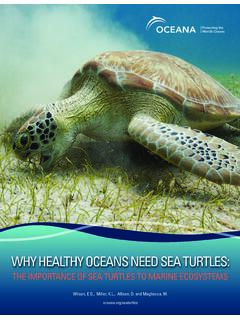
1 Why Healthy Oceans Need Rob Stewart/ SharkwaterPredators as prey : Why Healthy Oceans Need SharksGriffin, E., Miller, , Freitas, B. and Hirshfield, M. July Connecticut Ave. NW, 5th Floor | Washington, DC 20036 USAT + | F + | have been swimming the world s oceans for more than 400 million years 100 million years before the first dinosaurs appeared on land. But today, shark populations are being decimated by commercial fishing, putting some species in danger of have unfortunately fallen victim to the man-hungry stereotype society has created for them. However, what the world should really fear is a world without sharks.
2 Each year, humans kill more than 100 million sharks worldwide. This includes the tens of millions of sharks that are caught annually for their fins, which are one of the world s most expensive seafood products. As top Predators , sharks help to manage healthy ocean ecosystems. And as the number of large sharks declines, the oceans will suffer unpredictable and devastating consequences. Sharks help maintain the health of ocean ecosystems, including seagrass beds and coral reefs. Healthy oceans undoubtedly depend on sharks. The Importance of Apex Predators to Healthy Ecosystems.
3 1 The Hawaiian Islands, An Example of a Balanced Marine Ecosystem .. 2 Sharks: Jinxed by Jaws .. 3 The Loss of the Great Sharks in the North Atlantic .. 5 Tiger Sharks in Shark Bay, Australia .. 7 The Caribbean Coral Reef Ecosystem .. 9 Sleeper Sharks in Prince William Sound, Alaska ..10 Conclusions and Recommendations ..11 References ..13 1 Sharks are often the apex or top Predators in their ecosystems because they have few natural Predators . As apex Predators , sharks feed on the animals below them in the food web, helping to regulate and maintain the balance of marine ecosystems.
4 Apex Predators directly limit the populations of their prey , which in turn affects the prey species of those animals, and so The diets of most top Predators are quite varied. This allows top Predators to switch prey species when certain populations are low, thereby allowing prey species to ,3 Apex Predators not only affect population dynamics by consuming prey , but they also can control the spatial distribution of potential prey through intimidation. Fear of shark predation causes some species to alter their habitat use and activity level, leading to shifts in abundance in lower trophic Top Predators affect other animals in a cascade effect throughout the ecosystem, ultimately influencing community By preventing one species from monopolizing a limited resource, Predators increase the species diversity of the ecosystem.
5 To put it simply, more Predators lead to greater Comparisons of areas with and without apex Predators show that apex Predators provide greater biodiversity and higher densities of individuals, while areas without apex Predators experience species Without apex Predators there is the potential for unchecked predation by other lower predatory species, overeating of vegetation by herbivorous prey species and increased competition that ultimately affects the species richness and abundance within the Apex Predators , including many shark species, are a necessary component to maintaining a complex ecosystem full of diversity and life.
6 In addition to regulating species abundance, distribution and diversity, top Predators provide essential food sources for scavengers9 and remove the sick and weak individuals from prey Photo Rob Stewart/ SharkwaterThere are very few, if any, pristine locations left in the ocean that are untouched by human activities, especially by the impacts of fishing. Even the most remote locations of the world, such as the Northwestern Hawaiian Islands (NWHI), are not free from human interference. However, studying these locations may yield the best possible insight into the structure and natural functioning of unaltered ecosystems.
7 Recent surveys conducted in the central Pacific off the coasts of the NWHI and Palmyra have provided comparisons to the ecosystems of the nearby inhabited Christmas and Fanning Islands and the heavily populated main Hawaiian Islands (MHI).11,12 In these surveys, researchers observed a larger number of fish surrounding the uninhabited islands, with a drastically different composition of species. Most surprising was the fact that apex Predators accounted for over half the fish biomass surrounding Palmyra and the NWHI, while the apex Predators at Christmas, Fanning and the MHI were less than 10 percent of the fish ,14 In addition, the apex Predators , such as sharks, were larger in the waters surrounding the uninhabited Locations with greater apex predator biomass also had a higher biomass of herbivorous fish, which support the general hypothesis that a coral reef ecosystem with many apex Predators also will have many herbivorous Notably.
8 Most of the dominant Predators found in the NWHI were rare or absent in the These studies illustrate that a typical trophic pyramid for an unfished coral reef is actually inverted, meaning that most of the fish biomass is at the top levels. It also shows that typical overfished ecosystems are lacking apex PredatorsHerbivoresLow-LevelCarnivoresAp ex PredatorsNorthwestern Hawaiian IslandsMain Hawaiian Islands 2 Figure 1: Comparison of Trophic Structure Between the Northwestern Hawaiian Islands and the Main Hawaiian Islands Based on Biomass19 Sharks have unfortunately fallen victim to the man-hungry stereotype society has created for them.
9 We consider this the Jaws image. However in reality, sharks are some of the world s most misunderstood animals. There are more than 350 distinct species of sharks that vary in size, diet and habitat, but the vast majority are harmless to humans. In fact, nearly two-thirds of all shark attacks involve just three species white, tiger and bull. The reality is that humans are the true top Predators of the sea, killing more than 100 million sharks each year in fisheries,20 while sharks mistakenly kill between five and 15 people during that same Scientists estimate that fishing has reduced large predatory fish populations worldwide by 90 percent over the past 50 to 100 Sharks now represent the largest group of threatened marine species on the World Conservation Union s (IUCN)
10 Red List of threatened Yet only three of the 350 shark species basking, whale and white are protected from the pressures of international trade. The remaining species are ignored or seen as low priorities despite their vulnerability to overfishing24 and their important role in their ecosystems. 3 Photo Oceana /LXShark FinningThe practice of shark finning kills 26 to 73 million sharks each year for their Once reserved as a delicacy and a sign of prestige in Asian cultures, shark fin soup consumption is on the rise. Because a bowl of soup can cost up to $100, the fins are the most economically valuable part of a shark.