Transcription of Preferred reporting items for systematic review and …
1 Preferredreportingitemsfor systematicreviewandmeta-analysisprotocol s(PRISMA-P)2015:elaborationand explanationLarissaShamseer1, DavidMoher1, MikeClarke2, DavinaGhersi3, AlessandroLiberati(deceased)4,MarkPettic rew5, Paul Shekelle6, LesleyA Stewart7, the PRISMA-PGroup1 OttawaHospitalResearchInstituteand Universityof Ottawa,Canada;2 Queen sUniversityBelfast,Ireland;3 NationalHealthand MedicalResearchCouncil,Australia;4 Universityof Modena,Italy;5 LondonSchoolof Hygieneand TropicalMedicine,UK;6 SouthernCaliforniaEvidence-basedPractice Center,USA;7 Centrefor Reviewsand Dissemination,Universityof York,UKDedication:The PRISMA-P2015initiativeis dedicatedto our colleagueAlessandroLiberati(1954 2012),who passedawaywhilePRISMA-P2015was underdevelopmentand whosecontributionsto this work systematicreviewsand meta-analysesallowfor planningand documentationof reviewmethods,act as a guardagainstarbitrarydecisionmakingdurin greviewconduct,enablereadersto assessforthe presenceof selectivereportingagainstcompletedreview s,and,whenmadepubliclyavailable,reducedu plicationof effortsand existenceof selectivereportingand excessiveduplicationof reviewson the sameor similartopicsis accumulatingand manycalls havebeenmadein supportofthe documentationand publicavailabilityof recentyearsto rectifytheseproblems,includingdevelopmen tof an internationalregisterfor prospectivereviews(PROSPERO)
2 And launchof the first openaccessjournaldedicatedtothe exclusivepublicationof systematicreviewproducts,includingprotoc ols(BioMedCentral sSystematicReviews). Furtheringtheseeffortsand buildingon the PRISMA(PreferredReportingItemsforSystema ticReviewsand Meta-analyses)guidelines,an internationalgroupof expertshas createda guidelineto improvethe transparency,accuracy,completeness,and frequencyof documentedsystematicreviewand meta-analysisprotocols PRISMA-P(for protocols) PRISMA-Pchecklistcontains17 itemsconsideredto be essentialand minimumcomponentsof a systematicreviewor PRISMA-P2015 Explanationand Elaborationpaperprovidesreaderswith a full understandingof and evidenceaboutthe necessityof eachitem as well as a modelexamplefrom an papershouldbe read togetherwith the assessorsare stronglyencouragedto makeuse of PRISMA-Pwhendraftingand a uniqueplacein helpform the basis for developingpracticeguidelinesand theyprovideinformationon gaps in knowledge,thus informationis relevantto stakeholdersacrossthe rigourand trustworthinessofsystematicreviewsis, in large part.
3 Basedon the a prioriplanningand documentationof a methodicalapproachtoconduct(that is, a protocol).A systematicreviewprotocolis importantfor severalreasons:(1) it allowssystematicreviewersto plan carefullyand therebyanticipatepotentialproblems;(2) it allowsreviewersto explicitlydocumentwhat is plannedbeforethey start their review ,enablingothersto comparethe protocoland the completedreview(that is, to identifyselectivereporting),to replicatereviewmethodsif desired,and to judgethe validityof plannedmethods;(3) it preventsarbitrarydecisionmakingwith respectto inclusioncriteriaand extractionof data; and (4) it may reduceduplicationof effortsand enhancecollaboration, as the CochraneandCampbellCollaborationsand the Agencyfor HealthcareResearchand Quality(AHRQ)regularlyrequireand ,outsideof such organizations,few protocolsare publishedin traditionaljournalsand most reportsofcompletedreviews(89%)do not mentionworkingfrom aprotocol1(2014updateunderway).
4 Manyexpertshave calledfor improveddocumentationand availabilityof response,experts(someof whomare authorson thisdocument)launchedan international,prospectiveregisterforsyst ematicreviewprotocols(PROSPERO, ) throughthe Centrefor Reviewsand Disseminationat the Universityof York (UK)in February2011,in whichmorethan 5000 systematicreviewprotocolsfrom 69 countrieshavebeen registeredas of February2012,theCorrespondence to: L Shamseer personal use only: See rights and reprints : ;349:g7647doi: (Published2 January2015)Page1 of 25 ResearchMethods& ReportingRESEARCHMETHODS& reporting first open accessjournalto exclusivelypublishsystematicreviewproduc tsincludingprotocols(BioMedCentral sSystematicReviews) was launched,in which142 protocolshave beenpublished(June2014).
5 Outsideof selectsystematicrevieworganizations,litt le to no generalguidanceexistsfor of the most importantfunctionsof systematicreviewprotocolsis their role as a documentationof plannedreviewmethods,outcomes,and analysesthat can be comparedwith completedreviewsto detectwhetherunintendedandundocumentedch angeswere relatedto selectivereportingof outcomes(that is, whenreportingis relatedto thestatisticalsignificanceor directionof effectestimate)is aproblemin is a well documentedphenomenonin clinicaltrials,2-7and similarfindingsare startingto emergefor systematicreviews(see item 13 for fulldiscussion).8-10 Whenreviewersselectivelychoosewhichinfor mationto includein a reportbasedon the directionandsignificanceof findings,they risk biasingthe evidencebase onwhichhealthcaredecisionsand policiesare recenteffortsto increasethe documentationandavailabilityof reviewprotocols,the next logicalstep is thedevelopmentof a set of standardsthat shouldbe includedin well describedprotocolmay facilitateandenhancethe detectionof undocumentedchangesto reviewmethodology.
6 It also may allowreadersto gaugethe potentialimpactof such changesas well as selectivereportingofinformationon that end, a reportingguidelinefor systematicreviewprotocols,an extensionof the PRISMA(PreferredItemsforReportingSystema ticReviewsand Meta-analyses)statementhas been developedfor protocols(PRISMA-P)and is describedin detailin this PRISMA-PPRISMA-Pis intendedto guidethe developmentof protocolsof systematicreviewsand systematicreviewsthat are not evaluatingefficacy,authorsare encouragedto use PRISMA-Pbecauseofthe lack of the purposeof this guidance,we definea protocol,broadly,as a documentwrittenbeforethe start of a systematicreviewdescribingtherationalean d intendedpurposeof the review ,and the plannedmethodologicaland analyticalapproach(see box 1 forcomprehensivedefinitions).
7 PRISMA-Pis meantto be used primarilyby authorspreparingsystematicreviewprotocol sfor publication,publicconsumption,or is also intendedfor thosecommissioningandpotentiallyfundingr eviewsas a guidefor applicantson whatshouldthey shouldincludein their reviewprotocols,and as atool for peer reviewersto gaugewhethera also be helpfulfor journaleditorsand peer reviewersgaugingthe adequacyof reviewprotocolsfor list of stakeholdersto whomwebelievePRISMA-Pwill be usefulalongwith proposedbenefitsfor each groupis providedin table 1 .Developmentof PRISMA-PThe PRISMA-Pchecklistis basedon elementsfrom thePROSPERO register,11the PRISMA checklist,12 SPIRIT(StandardProtocolItems:Recommendat ionsfor InterventionalTrials)checklistitems,13an d from the InstituteofMedicine sStandardsfor detaileddescriptionof the steps undertakenduringPRISMA-Pdevelopmentcan be foundin the processfollowsgeneralrecommendationsof theEQUATOR(Enhancingthe Qualityand Transparencyof healthResearch)Networkon how to developa reportingguideline,ofwhichone fundamentalpart is a internationalexpertswas heldin June 2011 in Rockville,MD, USA,to developand relatedguidancedocumentshave undergoneiterativerevisionwithinthe PRISMA-PGrouplistedat the end of this document.
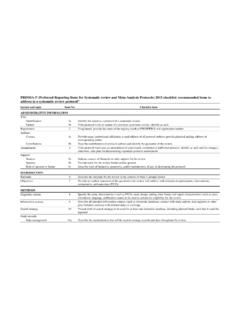
8 Membersof the PRISMA-PGroupcontributedto the writingand identifyingrelevantexamplesin this final PRISMA-Pchecklistcontains17 numbereditems(26sub- items )that shouldbe described,at minimum,in protocolsof systematicreviewsand meta-analyses(table2 ). Thechecklistis dividedinto three main sections:administrativeinformation,intro duction,and observethat wordingof the PRISMA-Pchecklistshas, wherepossible,been harmonizedwith PRISMA checklistitems,at least 13 of whichare overlappingwith anticipatethis will aid authorsin transitioningtheirsystematicreviewprotoc olspreparedin accordancewithPRISMA-Pinto full text, PRISMA-compliant, ExplanationThe formatof this documentfollowsthat of previouslyestablishedreportingguidelines such as the PRISMAE xplanationand Elaborationdocument17.
9 It aims to providereaderswith comprehensiveexplanationsand evidencebasedrationalesfor each good reportingfor each checklistitem have been identifiedfrom existingsystematicreviewand meta-analysisprotocolsand are providedthroughoutthis documentto a minimallist of itemstoconsiderwhenpreparinga systematicreviewprotocol,we haveindicatedinstanceswhereadditionalinf ormationmay bedesirableto improvetransparencyof the recommendationswithinPRISMA-Pmay requiremorewordsor spacethan authorsare accustomedto. Providingdetaileddescriptionsfor someprotocolelements(suchas item8, eligibilitycriteria;item 13, outcomesand prioritisation)willfacilitatetransparenc yand futurereproducibility,and allowauthorsto shortentheir methodssectionin a completedsystematicreviewreport,if desired,by providinga briefsummaryof the methodsand referringreadersto the completedprotocolor believethat providingindepthdescriptionsof plannedmethodologicaldetailsforsystemati creviewsis in line with emergingjournalpoliciesaimedat numberedas we envisionthem appearingin a protocol,and reportingthem in this sequentialorderis asuggestionthat may orderof appearanceof checklistitemsif theydeemit to be importantis that authorsdescribeeach PRISMA-Pitem somewherein their personal use only.
10 See rights and reprints : ;349:g7647doi: (Published2 January2015)Page2 of 25 RESEARCHMETHODS& REPORTINGBox 1: PRISMA-PterminologySystematicreview A systematicreviewattemptsto collateall relevantevidencethat fits pre-specifiedeligibilitycriteriato usesexplicit,systematicmethodsto minimizebias in the identification,selection,synthesis,and summaryof , this providesreliablefindingsfrom whichconclusionscan be drawnand 180 The keycharacteristicsof a systematicrevieware: (a) a clearlystatedset of objectiveswith an explicit,reproduciblemethodology;(b) a systematicsearchthat attemptsto identifyall studiesthat wouldmeetthe eligibilitycriteria;(c) an assessmentof the validityof the findingsof theincludedstudies(suchas assessmentof risk of bias and confidencein cumulativeestimates);and (d) systematicpresentation,andsynthesis,of the characteristicsand findingsof the Meta-analysisis the use of statisticaltechniquesto combineand summarizethe resultsof multiplestudies;they mayor may not be containedwithina combiningdata from severalstudies,meta-analysescan providemorepreciseestimates