Transcription of Preterite vs Imperfect: Part I
1 1. St. Aloysius School Spanish III. Preterite vs Imperfect: Part I. Spanish has two past tenses : Preterite and imperfect. Most verbs can be put into either tense, depending upon the meaning. In this lesson, you will learn to conjugate regular ar verbs in the Preterite and the imperfect. You will also learn the basic difference between the Preterite and the imperfect, so that you can begin using them correctly. To conjugate regular -ar verbs in the Preterite , simply drop the ending (-ar) and add one of the following: - . -aste - . -amos -aron -aron To conjugate regular -ar verbs in the imperfect, simply drop the ending (-ar) and add one of the following endings: -aba -abas -aba - bamos -aban -aban Compare the verb hablar conjugated in the Preterite and the imperfect.
2 Preterite IMPERFECT. habl hablaba hablaste hablabas habl hablaba hablamos habl bamos hablasteis hablabais hablaron hablaban 2. Generally speaking, the Preterite is used for actions in the past that are seen as completed. Use of the Preterite tense implies that the past action had a de nite beginning and de nite end. Juan habl de la una hasta las dos. Juan spoke from one until two o'clock. (Clearly stated beginning and end). It is important to realize that the beginning and the end may not always be clearly stated. Juan habl dos horas. Juan spoke for two hours. (Implied beginning and end). Juan habl con la estudiante.
3 Fr. Clint sayz: For the sake of Juan spoke with the student. simplicity at this point, (Implied beginning and end). translate the Preterite as the Generally speaking, the imperfect is used for simple past: eg. I ate, drank, actions in the past that are not seen as completed. Use of the imperfect tense looked, etc. Translate the implies that the past action did not have a imperfect with used to or de nite beginning or a de nite end. was / were : eg. I used to Las chicas hablaban en ingl s. eat, I was drinking, we were The girls used to speak in English. looking, etc. (No de nite beginning or end) And sometimes you just have to eat some chocolate!
4 You have now learned the basic difference between the Preterite and the imperfect: The Preterite tells us speci cally when an action took place. The imperfect tells us in general when an action took place. NOTE: Although this difference may appear simple, this is actually a complex topic, and you will learn the ner points in later lessons. Do Exercise A & B in the back of this packet. 3. ER and IR verbs in the Preterite Tense In the last lesson, you learned that the Preterite is used for past actions that are seen as completed. You also learned how to conjugate regular -ar verbs. In this lesson, you will learn how to conjugate -er and -ir verbs, and become more familiar with the uses of the Preterite .
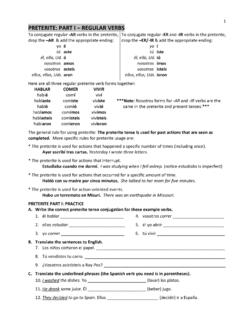
5 As we have seen, to conjugate regular -ar verbs in the Preterite , simply drop the ending (-ar) and add one of the following: - . -aste - . -amos -aron -aron Now, to conjugate regular -er and -ir verbs in the Preterite , simply drop the ending (-er or -ir). and add one of the following: - . -iste -i . -imos -ieron -ieron Here are all three regular Preterite verb forms together: hablar comer vivir habl com viv . hablaste comiste viviste habl comi vivi . hablamos comimos vivimos hablaron comieron vivieron hablaron comieron vivieron Note: the nosotros forms for -ar and -ir verbs are the same in both Preterite and present tenses : hablamos, vivimos.
6 The Preterite is used for actions that can be viewed as single events. Ella camin por el parque. Ellos llegaron a las ocho. She walked through the park. They arrived at eight o'clock. 4. The Preterite is used for actions that were repeated a specific number of times, or occurred during a specific period of time. Ayer escrib tres cartas. Vivimos all por cuatro a os. Yesterday I wrote three letters. We lived there for four years. The Preterite is used for actions that were part of a chain of events. Ella se levant , se visti , y sali de la casa. She got up, dressed, and left the house. The Preterite is used to state the beginning or the end of an action.
7 Empez a nevar a las ocho de la ma ana. It began to snow at eight in the morning. The above examples all fall within our general rule for using the Preterite : The Preterite is used for past actions that are seen as completed. ER and IR Verbs in the Imperfect Tense As we saw above, you learned that the imperfect is used for past actions that are not seen as completed. Use of the imperfect tense implies that the past action did not have a definite beginning or a definite end. You also learned how to conjugate regular -ar verbs. In this lesson, you will learn how to conjugate -er and -ir verbs, and become more familiar with the uses of the imperfect.
8 To conjugate regular -ar verbs in the imperfect, simply drop the ending (-ar) and add one of the following: -aba -abas -aba - bamos -aban -aban Now, to conjugate regular -er and -ir verbs in the imperfect, simply drop the ending (-er or -ir). and add one of the following: - a - as - a - amos - an - an 5. Here are all three regular imperfect verb forms together: hablar comer vivir hablaba com a viv a hablabas com as viv as hablaba com a viv a habl bamos com amos viv amos hablaban com an viv an hablaban com an viv an The imperfect is used for actions that were repeated habitually. Almorz bamos juntos todos los d as.
9 Las se oras siempre charlaban por las We would lunch together every day. ma anas. The ladies would always chat in the mornings. The imperfect is used for actions that "set the stage" for another action. Yo le a cuando entr mi pap . I was reading when my papa entered. (Note that "entered" is Preterite ). The imperfect is used for telling time and stating one's age. Eran las siete de la noche. La ni a ten a cinco a os. It was seven o'clock at night. The little girl was five years old. The above examples all fall within our general rule for using the imperfect: The imperfect is used for past actions that are not seen as completed.
10 Do Exercise C at the end of this packet. 6. Seeing them all lined up! Subject Translation AR verb Tranlsation ER verb Translation IR verb Translation Pronoun Hablar Comer Vivir Present Tense Yo I Hablo I talk Como I eat Vivo I live Tu You Hablas You talk Comes You eat Vives You live El, ella S/he Habla s/he talks Come s/he eats Vive s/he lives Nosotros We Hablamos We talk Comemos We eat Vivimos We live Ustedes You-all Hablan You-all talk Comen You-all eat Viven You-all live Ustedes They Hablan They talk Comen They eat Viven They live Imperfect Tense Yo I hablaba I was talking com a I was eating viv a I was living Tu You hablabas You were com as You were viv as You were talking eating living El.