Transcription of PROBABILITY AND RANDOM PROCESSES FOR ELECTRICAL …
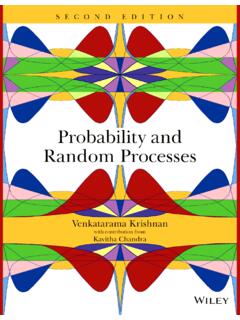
1 PROBABILITY AND RANDOM PROCESSES FORELECTRICAL AND computer ENGINEERSThe theory of PROBABILITY is a powerful tool that helps ELECTRICAL and computerengineers explain, model, analyze, and design the technology they develop. Thetext begins at the advanced undergraduate level, assuming only a modest knowledgeof PROBABILITY , and progresses through more complex topics mastered at the graduatelevel. The first five chapters cover the basics of PROBABILITY and both discrete andcontinuous RANDOM variables. The later chapters have a more specialized coverage,including RANDOM vectors, Gaussian RANDOM vectors, RANDOM PROCESSES , MarkovChains, and convergence. Describing tools and results that are used extensively inthe field, this is more than a textbook: it is also a reference for researchers workingin communications, signal processing, and computer network traffic analysis.
2 Withover 300 worked examples, some 800 homework problems, and sections for exampreparation, this is an essential companion for advanced undergraduate and resources for this title, including solutions, are available online A. Gubnerhas been on the Faculty of ELECTRICAL and ComputerEngineering at the University of Wisconsin-Madison since receiving his 1988, from the University of Maryland at College Park. His research interestsinclude ultra-wideband communications; point PROCESSES and shot noise; subspacemethods in statistical processing; and information theory. A member of the IEEE,he has authored or co-authored many papers in theIEEE Transactions, includingthose on Information Theory, Signal Processing, and in this web service Cambridge University PressCambridge University Press978-0-521-86470-1 - PROBABILITY and RANDOM PROCESSES for ELECTRICAL and computer EngineersJohn A.
3 GubnerFrontmatterMore in this web service Cambridge University PressCambridge University Press978-0-521-86470-1 - PROBABILITY and RANDOM PROCESSES for ELECTRICAL and computer EngineersJohn A. GubnerFrontmatterMore informationPROBABILITY AND RANDOMPROCESSES FOR ELECTRICAL ANDCOMPUTER ENGINEERSJOHN A. GUBNERU niversity of in this web service Cambridge University PressCambridge University Press978-0-521-86470-1 - PROBABILITY and RANDOM PROCESSES for ELECTRICAL and computer EngineersJohn A. GubnerFrontmatterMore on this title: Cambridge University Press 2006 This publication is in copyright. Subject to statutory exceptionand to the provisions of relevant collective licensing agreements,no reproduction of any part may take place withoutthe written permission of Cambridge University in the United States of America by Sheridan Books, catalog record for this publication is available from the British LibraryCambridge University Press has no responsibility for the persistence or accuracy of URLs forexternal or third-party internet websites referred to in this publication, and does not guarantee thatany content on such websites is, or will remain, accurate or published 2006 ISBN978-0-521-86470-1 HardbackUniversity Printing House.
4 Cambridgnited Kingdom Cambridge University Press is part of the University of Cambridge. It furthers the Universitys mission by disseminating knowledge in the pursuit of education, learning and research at the highest international levels of excellence. UeiCB2i8BS,i, 6th printing in this web service Cambridge University PressCambridge University Press978-0-521-86470-1 - PROBABILITY and RANDOM PROCESSES for ELECTRICAL and computer EngineersJohn A. GubnerFrontmatterMore informationTo Sue and in this web service Cambridge University PressCambridge University Press978-0-521-86470-1 - PROBABILITY and RANDOM PROCESSES for ELECTRICAL and computer EngineersJohn A. GubnerFrontmatterMore in this web service Cambridge University PressCambridge University Press978-0-521-86470-1 - PROBABILITY and RANDOM PROCESSES for ELECTRICAL and computer EngineersJohn A.
5 GubnerFrontmatterMore informationContentsChapter dependenciesxPrefacexi1 Introduction to spaces, outcomes, and of set and properties of and probability34 Notes43 Problems48 Exam preparation622 Introduction to discrete RANDOM involving RANDOM RANDOM RANDOM preparation1063 More about discrete RANDOM generating binomial RANDOM expectation127 Notes130 Problems132 Exam preparation1374 Continuous RANDOM and of a single RANDOM of multiple RANDOM bounds164 Notes167 Problems170 Exam preparation1835 Cumulative distribution functions and their RANDOM RANDOM RANDOM of RANDOM variables and their of central limit weak law of large in this web service Camb ridge Un iv ersity PressCambridge University Pres s978-0-521-86470-1 - PROBABILITY and RANDOM
6 PROCESSES for ELECTRICAL and computer EngineersJohn A. GubnerFrontmatterMore informationviiiContentsNotes219 Problems222 Exam preparation2386 estimators and their intervals for the mean known intervals for the mean unknown intervals for Gaussian tests for the and curve Carlo estimation271 Notes273 Problems276 Exam preparation2857 Bivariate RANDOM and marginal continuous RANDOM PROBABILITY and bivariate to three or more RANDOM variables314 Notes317 Problems319 Exam preparation3288 Introduction to RANDOM of matrix vectors and RANDOM of RANDOM estimation of RANDOM vectors (Wiener filters) of covariance estimation of RANDOM vectors350 Notes354 Problems354 Exam preparation3609 Gaussian RANDOM of the multivariate expectation and conditional RANDOM variables and vectors371 Notes373 Problems375 Exam preparation38210 Introduction to RANDOM Definition and Characterization of RANDOM Strict-sense and wide-sense stationary WSS PROCESSES through LTI Power spectral densities for WSS Characterization of correlation The matched The Wiener in this web service Cambridge University PressCambridge University Press978-0-521-86470-1 - PROBABILITY and RANDOM PROCESSES for ELECTRICAL and computer EngineersJohn A.
7 GubnerFrontmatterMore The Wiener Khinchin ergodic theorem for WSS spectral densities for non-WSS processes425 Notes427 Problems429 Exam preparation44011 Advanced concepts in RANDOM The Poisson Renewal The Wiener Specification of RANDOM processes459 Notes466 Problems466 Exam preparation47512 Introduction to Markov Preliminary Discrete-time Markov Recurrent and transient Limitingn-step transition Continuous-time Markov chains502 Notes507 Problems509 Exam preparation51513 Mean convergence and Convergence in mean of Normed vector spaces of RANDOM The Karhunen Lo`eve The Wiener integral (again) Projections, orthogonality principle, projection Conditional expectation and The spectral representation545 Notes549 Problems550 Exam preparation56214 Other modes of Convergence in Convergence in Almost-sure convergence572 Notes579 Problems580 Exam preparation58915 Self similarity and long-range Self similarity in continuous Self similarity in discrete Asymptotic second-order self Long-range ARMA ARIMA processes608 Problems610 Exam in this web service Cambridge University PressCambridge University Press978-0-521-86470-1 - PROBABILITY and RANDOM PROCESSES for ELECTRICAL and computer EngineersJohn A.
8 GubnerFrontmatterMore informationChapter dependencies1 Introduction to probability2 Introduction to discrete RANDOM variables3 More about discrete RANDOM variables6 Statistics7 Bivariate RANDOM variables10 Introduction to RANDOM processes13 Mean convergence and applications14 Other modes of convergence15 Self similarity and long range The Poisson Advanced concepts in RANDOM processes5 Cumulative distribution functions and their applications4 Continuous RANDOM variables8 Introduction to RANDOM vectors9 Gaussian RANDOM Discrete time Markov Continuous time Markov in this web service Cambridge University PressCambridge University Press978-0-521-86470-1 - PROBABILITY and RANDOM PROCESSES for ELECTRICAL and computer EngineersJohn A.
9 GubnerFrontmatterMore informationPrefaceIntended audienceThis book is a primary text forgraduate-level coursesin PROBABILITY and RANDOM pro-cesses that are typically offered in ELECTRICAL and computer engineering departments. Thetext starts from first principles and contains more than enough material for a two-semestersequence. Thelevel of the textvaries from advanced undergraduate to graduate as thematerial progresses. The principalprerequisiteis the usual undergraduate ELECTRICAL andcomputer engineering course on signals and systems, , Haykin and Van Veen [25] orOppenheim and Willsky [39] (see the Bibliography at the end of the book). However, laterchapters that deal with RANDOM vectors assume some familiarity with linear algebra; ,determinants and matrix to use the bookA first a course that assumes at most a modest background in PROBABILITY , thecore of the offering would include Chapters 1 5 and 7.
10 These cover the basics of probabilityand discrete and continuous RANDOM variables. As the chapter dependencies graph on thepreceding page indicates, there is considerable flexibility in the selection and ordering ofadditional material as the instructor sees second a course that assumes a solid background in the basics of prob-ability and discrete and continuous RANDOM variables, the material in Chapters 1 5 and 7can be reviewed quickly. In such a review, the instructor may want includesections andproblems marked with a , as these indicate more challenging material that might notbe appropriate in a first course. Following the review, the core of the offering wouldinclude Chapters 8, 9, 10 (Sections ), and Chapter 11.