Transcription of PRODUCT INFORMATION Anpec - Medicines
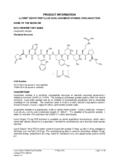
1 PRODUCT INFORMATION Anpec Verapamil hydrochloride NAME OF THE MEDICINE Active ingredient : Verapamil hydrochloride Chemical name : Benzeneacetonitrile, -[[3-[[2-(3,4-dimethoxyphenyl) ethyl]] methylamino] propyl]-3,4-dimethoxy- -(1-methylethyl) hydrochloride Structural formula : Molecular formula : C27H38N2O4,HCl Molecular weight : CAS Registry no. : 152-11-4 DESCRIPTION Verapamil hydrochloride is a calcium ion influx inhibitor (slow channel blocker or calcium ion antagonist). Verapamil hydrochloride is a white or almost white, odourless, crystalline powder. It is soluble in 20 parts of water; sparingly soluble in ethanol (96%), freely soluble in chloroform and practically insoluble in ether. Each Anpec tablet contains verapamil hydrochloride 40 mg or 80 mg as the active ingredient. The tablets also contain the following inactive ingredients: lactose, microcrystalline cellulose, pregelatinised maize starch, sodium starch glycollate, purified talc and magnesium stearate.
2 Anpec 40 also contains Opadry Yellow OY-LS-32814 and Anpec 80 contains Opadry Orange OY-LS-33113. PHARMACOLOGY Verapamil is a calcium ion influx inhibitor (slow channel blocker or calcium ion antagonist) which exerts its pharmacologic effects by modulating the influx of ionic calcium ions across cell membranes of the arterial smooth muscle cell as well as in conductile and contractile myocardial cells. Pharmacodynamics Hypertension Verapamil exerts antihypertensive effects by decreasing systemic vascular resistance, usually without orthostatic decreases in blood pressure or reflex tachycardia; bradycardia (rate less than 50 beats /min) is uncommon ( ). During isometric or dynamic exercise verapamil does not alter systolic cardiac function in patients with normal ventricular function. Anpec PRODUCT INFORMATION 2 Angina Pectoris Verapamil dilates the main coronary arteries and coronary arterioles, both in normal and ischaemic regions, and is a potent inhibitor of coronary artery spasm, whether spontaneous or ergonovine-induced.
3 This property increases myocardial oxygen delivery in patients with coronary artery spasm, and is responsible for the effectiveness of verapamil in vasospastic (Prinzmetal's or variant) as well as unstable angina at rest. Whether this effect plays any role in classical effort angina is not clear, but studies of exercise tolerance have not shown an increase in the maximum exercise rate-pressure PRODUCT , a widely accepted measure of oxygen utilisation. This suggests that, in general, relief of spasm or dilation of coronary arteries is not an important factor in classical angina. Verapamil regularly reduces the total systemic resistance (afterload) against which the heart works both at rest and at a given level of exercise by dilating peripheral arterioles. Verapamil does not alter total serum calcium levels.
4 However, one report suggested that calcium levels above the normal range may alter the therapeutic effect of verapamil. Other Pharmacological Actions Electrical activity through the AV node depends, to a significant degree, upon calcium influx through the slow channel. By decreasing the influx of calcium, verapamil prolongs the effective refractory period within the AV node and slows AV conduction in a rate-related manner. Normal sinus rhythm is usually not affected, but in patients with sick sinus syndrome, verapamil may interfere with sinus node impulse generation and may induce sinus arrest or sinoatrial block. Atrioventricular block can occur in patients without pre-existing conduction defects (see PRECAUTIONS). Verapamil does not alter the normal atrial action potential or intraventricular conduction time, but depresses amplitude, velocity of depolarisation and conduction in depressed atrial fibres.
5 Verapamil may shorten the antegrade effective refractory period of accessory bypass tracts. Acceleration of ventricular rate and/or ventricular fibrillation has been reported in patients with atrial flutter or atrial fibrillation and a co-existing accessory AV pathway following administration of verapamil (see PRECAUTIONS). Verapamil has a local anaesthetic action that is times that of procaine on an equimolar basis. It is not known whether this action is important at the doses used in humans. Pharmacokinetics Anpec is rapidly and almost completely absorbed from the gastrointestinal tract. The overall oral bioavailability ranges from 22 to 35% due to a substantial hepatic first pass effect. Peak plasma concentrations are reached between one and two hours after oral administration.
6 Chronic oral administration of 120 mg of verapamil every 6 hours resulted in plasma levels of verapamil ranging from 125 to 400 ng/mL with higher values reported occasionally. A nonlinear correlation between the verapamil dose administered and verapamil plasma levels does exist. In early dose titration with verapamil a relationship exists between verapamil plasma concentrations and the prolongation of the PR interval. However, during chronic administration this relationship may disappear. The mean elimination half-life in single dose studies ranged from to hours. In these same studies, after repetitive dosing the half-life increased to a range from to hours (after less than ten consecutive doses given 6 hours apart). Half-life of verapamil may increase during titration.
7 Aging may affect the pharmacokinetics of verapamil. Elimination half-life may be prolonged in the elderly. In healthy subjects, orally administered verapamil undergoes extensive metabolism in the liver. Twelve metabolites have been identified in plasma. Norverapamil can reach steady-state plasma concentrations approximately equal to those of verapamil itself. The cardiovascular activity of norverapamil appears to be approximately 20% that of verapamil. Approximately 70% of an administered dose is excreted as metabolites in the urine and16% or more in the faeces within five days. About 3% to 4% is excreted in the urine as unchanged drug. Approximately 90% is bound to plasma proteins. Anpec PRODUCT INFORMATION 3 In patients with hepatic insufficiency, metabolism of immediate release verapamil is delayed and elimination half-life prolonged up to 14 to 16 hours (see Precautions); the volume of distribution is increased and plasma clearance reduced to about 30% of normal.
8 Verapamil clearance values suggest that patients with liver dysfunction may attain therapeutic verapamil plasma concentrations with one-third of the oral daily dose required for patients with normal liver function. Impaired renal function has no effect on verapamil hydrochloride pharmacokinetics in patients with end-stage renal failure and subjects with healthy kidneys. After four weeks of oral dosing (120 mg four times daily), verapamil and norverapamil levels were noted in the cerebrospinal fluid. Estimated partition coefficient of for verapamil and for norverapamil. Haemodynamics and Myocardial Metabolism Verapamil reduces afterload and myocardial contractility. Improved left ventricular diastolic function in patients with hypertrophic cardiomyopathy (IHSS) and those with coronary heart disease has also been observed with verapamil therapy.
9 In most patients, including those with organic cardiac disease, the negative inotropic action of verapamil is countered by reduction of afterload and cardiac index is usually not reduced. In patients with severe left ventricular dysfunction however, ( pulmonary wedge pressure above 20 mmHg or ejection fraction lower than 30%), or in patients on beta-adrenergic blocking agents or other cardiodepressant drugs, deterioration of ventricular function may occur (see INTERACTIONS WITH OTHER Medicines ). Pulmonary Function Verapamil does not induce broncho-constriction and hence, does not impair ventilatory function. INDICATIONS Hypertension Angina of effort Angina at rest Vasospastic angina (including Prinzmetal's variant angina) Tachyarrhythmias including paroxysmal supraventricular tachycardia Atrial fibrillation and atrial flutter with rapid ventricular response.
10 CONTRAINDICATIONS Verapamil HCl is contraindicated in: Severe left ventricular dysfunction (see PRECAUTIONS) Hypotension (systolic pressure less than 90 mmHg) or cardiogenic shock Sick sinus syndrome (except in patients with a functioning artificial ventricular pacemaker) Second- or third-degree AV block (except in patients with a functioning artificial ventricular pacemaker) Patients with atrial flutter or atrial fibrillation and an accessory bypass tract ( Wolff-Parkinson-White, Lown-Ganong-Levine syndromes) (see PRECAUTIONS). These patients are at risk to develop Anpec PRODUCT INFORMATION 4 ventricular tachyarrhythmia including ventricular fibrillation if verapamil hydrochloride is administered. Heart failure with reduced ejection fraction of less than 35%, and/or pulmonary wedge pressure above 20 mg Hg.