Transcription of PRODUCT INFORMATION - Medicines
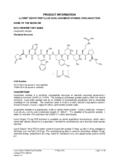
1 valdoxan (agomelatine 25 mg) PRODUCT INFORMATION 1 (17) Version 18 PRODUCT INFORMATION NAME OF THE MEDICINE valdoxan Agomelatine 25mg DESCRIPTION The active component of valdoxan is agomelatine which has the chemical name: N-[2-(7-methoxy-1-naphthyl)ethyl] acetamide. Agomelatine is practically insoluble in purified water (< mg/mL) but freely soluble (> 100 mg/mL) in various organic solvents (96% ethanol, methanol, methylene chloride). Agomelatine has no asymmetric carbon atom. CAS Registry Number: 138112-76-2 Molecular formula: C15H17NO2 (MW = ). Chemical structure: Excipients: Lactose monohydrate, maize starch, povidone, sodium starch glycollate, stearic acid, magnesium stearate, colloidal anhydrous silica, hypromellose, iron oxide yellow (CI77492), glycerol, macrogol 6000, and titanium dioxide (CI77891), shellac, indigo carmine (CI73015), propylene glycol. PHARMACOLOGY Pharmacodynamics Pharmacotherapeutic group: Other antidepressants (ATC-code: NO6AX22) Agomelatine is a melatonin receptor (MT1 and MT2) agonist and 5-HT2C receptor antagonist.
2 Agomelatine has shown an antidepressant-like effect in animal models of depression (learned helplessness test, despair test, chronic mild stress), in models with circadian rhythm desynchronisation and in models related to stress and anxiety. In vitro studies indicate that agomelatine has no effect on monoamine uptake and no affinity for or adrenergic, histaminergic, cholinergic, dopaminergic, or benzodiazepine receptors. Agomelatine has no influence on the extracellular levels of serotonin and increases dopamine and noradrenaline release specifically in the prefrontal cortex. These properties may explain why, compared with other antidepressants, it has less gastrointestinal ( vomiting, constipation) and sexual function ( libido decrease) side effects, and no cardiovascular side effects in clinical trials. valdoxan (agomelatine 25 mg) PRODUCT INFORMATION 2 (17) Version 18 In humans, agomelatine has positive phase shifting properties; it induces a phase advance of sleep, body temperature decline and melatonin onset.
3 Agomelatine resynchronises circadian rhythms in animal models of circadian rhythm disruption. In patients with depression, treatment with agomelatine 25 mg increased slow wave sleep without modification of REM (Rapid Eye Movement) sleep amount or REM latency. Agomelatine 25 mg also induced an advance of the time of sleep onset and of minimum heart rate. From the first week of treatment, onset of sleep and the quality of sleep were significantly improved without daytime clumsiness as assessed by patients. At therapeutic doses, in healthy volunteers, agomelatine preserves daytime alertness and memory, with no sedation in the morning following drug intake. Cardiovascular In clinical trials, agomelatine had no effect on QT interval and no clinically-significant effect on heart rate, blood pressure and ECG tracings Withdrawal / Discontinuation The abrupt discontinuation of agomelatine was evaluated in a specific active control trial (CL3-030) using the Discontinuation Emergent Signs and Symptoms (DESS) check-list.
4 Patients with major depression were treated under double-blind conditions with agomelatine 25 mg or paroxetine 20 mg over a 12 week period. Only those who remitted at week eight and sustained that remission until week 12 were randomised to placebo or the initial active treatment for a two-week double-blind period. Patients discontinued from agomelatine to placebo were compared to those who continued treatment on agomelatine and, likewise for the active control paroxetine. The abrupt discontinuation of agomelatine was not associated with discontinuation symptoms [p= for difference between the agomelatine and placebo groups]. The sensitivity of the trial was demonstrated by the presence of significant emergent discontinuation symptoms following the abrupt discontinuation of treatment with the active control paroxetine [p< for difference between the paroxetine and placebo groups]. Sexual function No deleterious effect on sexual function (SEX-FX total score and SEX-FX sub-scores and items) was observed during agomelatine 50 mg treatment over 12 or 24-week treatment periods in a specific sexual dysfunction comparative trial in remitted depressed patients.
5 There was a numerical trend towards less sexual emergent dysfunction on agomelatine 50 mg than venlafaxine 150 mg for SEX-FX drive arousal or orgasm scores but statistical separation was not achieved. A separate pooled analysis of trials using the Arizona Sexual Experience Scale (ASEX) showed that agomelatine was not associated with sexual dysfunction. In healthy volunteers agomelatine did not affect sexual function, in contrast to paroxetine. Pharmacokinetics Absorption Agomelatine is rapidly and well absorbed ( 80%) after oral administration. The peak plasma concentration is reached within one to two hours after administration of agomelatine. Absolute bioavailability is low (approximately 1% at the therapeutic oral dose), and is highly variable due to the first pass effect and the inter-individual differences of CYP1A2 activity. The bioavailability is valdoxan (agomelatine 25 mg) PRODUCT INFORMATION 3 (17) Version 18 increased in women compared to men.
6 Although not clinically relevant, the bioavailability is increased by intake of oral contraceptives and reduced by smoking. In the therapeutic dose-range, agomelatine exposure appears to increase proportionally with dose with saturation of the first pass effect occurring at supra-therapeutic doses (from 200 to 1200 mg). Food intake (standard meal or high fat meal) reduced the peak concentration (Cmax) by approximately 20 30% but did not modify overall absorption or bioavailability. The variability is increased with high fat food. Distribution Steady state volume of distribution is about 35 L. Plasma protein binding is 95% irrespective of concentration and is not modified with age and in patients with renal impairment but the free fraction is doubled in patients with hepatic impairment. Metabolism Following oral administration, agomelatine is rapidly oxidized mainly by the hepatic cytochromes CYP1A2 (90%) and CYP2C9/CYP2C19 (10%).
7 The major metabolites, hydroxylated and demethylated agomelatine, are not pharmacologically active and are rapidly conjugated and eliminated in the urine. Excretion Elimination is rapid. The mean plasma half-life is between one and two hours. Clearance is high (about 1100 mL/min) and essentially metabolic. Excretion is mainly urinary (80%) and corresponds to metabolites. Urinary excretion of the unchanged compound is negligible. Pharmacokinetics remained unchanged following repeated administration. Special Populations Severe renal impairment: In subjects with severe renal impairment the pharmacokinetic parameters Cmax and AUC were slightly higher than in healthy subjects. However, due to the high inter-individual variability of agomelatine pharmacokinetics, this result was not clinically relevant. Renal impairment did not affect the protein binding of agomelatine. Hepatic Impairment: Following a single oral dose of 25 mg agomelatine in patients with hepatic impairment, Cmax increased by a factor of ~60 and ~110, while AUC increased by ~70-times and ~140-times, in mild (Child-Pugh score of 5 or 6) and moderate (Child-Pugh score of 7 to 9) hepatic impairment, respectively compared to healthy subjects.
8 Both mild and moderate liver impairment increased the half-life of agomelatine by a factor of ~3. The unbound fraction of agomelatine was also increased in subjects with hepatic insufficiency. The inter-individual variability decreased with mild hepatic impairment, with a further decrease in moderate hepatic impairment, suggesting a progressive saturation of the hepatic first-pass effect. Agomelatine is therefore contraindicated in patients with hepatic impairment (see CONTRAINDICATIONS section). Gender, smoking and age: No significant difference in exposure was shown between the young and the elderly as well as between males and females. Although not clinically relevant: - a decrease in mean exposure was observed in volunteers without depression who were heavy smokers ( 15 cigarettes per day); - a decrease of 33 % of agomelatine exposure has been shown in the smoker population (healthy volunteers and patients with depression smoking > 5 cigarettes per day) compared to non-smoker population, suggesting that cigarette smoking could induce CYP1A2 which is involved in the metabolism of agomelatine.
9 valdoxan (agomelatine 25 mg) PRODUCT INFORMATION 4 (17) Version 18 CLINICAL TRIALS Acute treatment of Major Depressive Disorder (MDD) The efficacy and safety of agomelatine in the treatment of major depression have been studied in a clinical development programme including more than 5,800 patients of whom over 3,900 were treated with agomelatine for between six weeks and one year. Six placebo-controlled trials have been performed to investigate the short-term efficacy of agomelatine in MDD: two flexible dose trials and four fixed dose trials. At the end of treatment (over six or eight weeks), both flexible dose trials and one of the fixed dose trials showed statistically the superiority of agomelatine over placebo on the primary outcome criterion HAM-D total score and consistent results across secondary criteria (see Table 1). The superiority of agomelatine over placebo was shown after two weeks of treatment.
10 Agomelatine did not differentiate from placebo in one trial (CL3-022) where the active control fluoxetine showed assay sensitivity. In two other trials (CL3-023, 024), it was not possible to draw any conclusions because the active controls, paroxetine and fluoxetine, failed to differentiate from placebo. Table 1 - Efficacy results in the pivotal short-term placebo-controlled trials Trial (duration) Treatment group HAM-D total score HAM-D responder# CGI## Severity Baseline Final Final Baseline Final n mean mean mean n mean mean CL2-014 (8 weeks) agomelatine 25mg 135 ^ ^ 135 ^ placebo 136 136 paroxetine 20mg 144 ^ - - - CL3-042 (6 weeks) agomelatine 25-50mg 116 ^ ^ 116 ^ placebo 119 119 CL3-043 (6 weeks) agomelatine 25-50mg 106 ^ ^ 106 ^ placebo 105 105 Notes: # Percentage of patients with a decrease in baseline HAM-D total score 50% ## CGI: Clinical Global Impression; ^Statistically significant difference from placebo.