Transcription of PRODUCT INFORMATION Paxam - Medicines
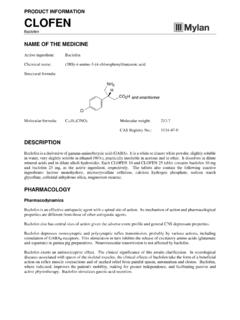
1 PRODUCT INFORMATION Paxam Clonazepam NAME OF THE MEDICINE Active ingredient : Clonazepam Chemical name : 5-(2-chlorophenyl)-1,3-dihydro-7-nitro-2 H-1,4-benzodiazepin-2-one Structural formula : Molecular formula : C15H10 ClN3O3 Molecular weight : CAS Registry no. : 1622-61-3 DESCRIPTION Clonazepam is a light yellow powder which is practically insoluble in water. Paxam tablets contain mg of clonazepam. Each tablet also contains lactose monohydrate, microcrystalline cellulose, maize starch and magnesium stearate and sunset yellow FCF CI15985.
2 Paxam 2 tablets contain 2 mg of clonazepam. Each tablet also contains lactose monohydrate, microcrystalline cellulose, maize starch and magnesium stearate. PHARMACOLOGY Actions Clonazepam is an anticonvulsant, which exhibits several pharmacological properties characteristic of the benzodiazepine class of Medicines . The exact site and mode of action of the anticonvulsant action of clonazepam is unknown. Benzodiazepines enhance the polysynaptic inhibitory processes at all levels of the central nervous system.
3 Clonazepam is more effective in blocking spread of electrical activity in the lesion itself. Pharmacokinetics Absorption and Bioavailability Clonazepam is rapidly and almost completely (82 98%) absorbed after oral administration, with peak serum levels being reached between 2 to 3 hours. The absorption half-life is 24 min. With continuous therapy, accumulation occurs, and although values differ in different reports, the therapeutic serum level appears to be Paxam PRODUCT INFORMATION 2 between 10 and 80 nanogram/mL.
4 In one study with increase in dosage to 5 mg/day, the average level of clonazepam after 15 days was 54 nanogram/mL. A steady state is usually reached within 2 to 3 weeks. Plasma concentrations of clonazepam at steady states for once daily dosage regimens are 3-fold higher than those after single oral doses. Following multiple oral doses of 2 mg three times daily, steady-state pre-dose plasma concentrations of clonazepam ranged from 30 - 80 nanogram/mL. The plasma concentration-dose relationship of clonazepam is linear.
5 The absolute bioavailability is 90%. Distribution Clonazepam enters the cerebral tissues rapidly. The distribution half-life is approximately between - 1 hour. The apparent volume of distribution (3 L/kg) suggests concentration in some tissues. The plasma protein binding of clonazepam ranges from 82 - 86%. Metabolism Clonazepam is metabolised in the liver. The metabolic pathways include hydroxylation, reduction of the nitro groups to an amine and addition of acetate to the amino grouping. Clonazepam is extensively metabolised by reduction to 7-amino-clonazepam and by N-acetylation to 7-acetamido-clonazepam.
6 Hydroxylation at the C-3 position also occurs. Hepatic cytochrome P-450 3A4 is implicated in the nitroreduction of clonazepam to pharmacologically inactive metabolites. Elimination The mean elimination half-life is hours. The mean clearance SD is mL/min following a single dose of 2 mg clonazepam given intravenously. 50 70% of the dose is excreted in the urine and 10 - 30% in the faeces as metabolites. The urinary excretion of unchanged clonazepam is usually less than 2% of the administered dose.
7 The metabolites are present in urine both as free and conjugated (glucuronide and sulphate) compounds. Clinical significance of pharmacokinetics With chronic dosing, accumulation occurs. However, there is a wide variation in therapeutic plasma levels and a correlation between adverse effects with plasma levels or the rate of increase in plasma concentration of clonazepam and its metabolites has not been established. Consequently, monitoring of plasma levels, as is often done with some anticonvulsants, would be valuable.
8 It should be emphasised that because of the effect of clonazepam on plasma levels of other anticonvulsants administered concomitantly (and vice versa) the patient should be monitored carefully in the initial stages for clinical response and occurrence of side effects. Pharmacokinetics in Special Populations Renal Impairment: Renal Impairment does not affect the pharmacokinetics of clonazepam. Therefore, based on pharmacokinetic considerations, no dosage adjustment may be required in patients with renal impairment.
9 The pharmacodynamics of probable accumulated clonazepam metabolites may necessitate dosage review in these patients. Paxam PRODUCT INFORMATION 3 Hepatic Impairment: The influence of hepatic disease on clonazepam pharmacokinetics has not been investigated. However, due to the sole hepatic metabolism of clonazepam, the pharmacokinetics of clonazepam are expected to be affected on theoretical grounds. Elderly Patients: The pharmacokinetics of clonazepam in the elderly has not been established. Neonates: Although the elimination half-life ( hours) and clearance values in neonates pre-treated with phenobarbital are the same order of magnitude as those reported in non-pretreated adults, post-natal age does however affect the clearance of clonazepam under normal conditions.
10 INDICATIONS Most types of epilepsy in children, especially absences (petit mal), myoclonic seizures and tonic-clonic fits, whether due to primary generalised epilepsy, or to secondary generalisation of partial epilepsy. In adults, all varieties of generalised epilepsy (including myoclonic, akinetic, tonic and tonic-clonic seizures), and in partial epilepsy (including psychomotor seizures). CONTRAINDICATIONS Clonazepam is contraindicated in patients with known hypersensitivity to benzodiazepines known hypersensitivity to any of the excipients in Paxam chronic obstructive airways disease with incipient respiratory failure dependence on drugs of abuse and CNS depressants including alcohol severe hepatic impairment as benzodiazepines may precipitate hepatic encephalopathy PRECAUTIONS Some loss of effect may occur during the course of clonazepam treatment.