Transcription of Product Name: Perchloroethylene MATERIAL …
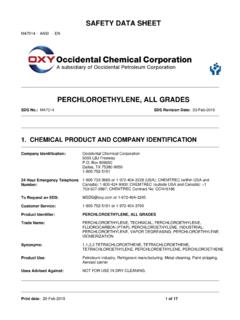
1 Product name : Perchloroethylene MATERIAL SAFETY DATA SHEET Page: 1 of 6 This revision issued: July, 2010 Issued by: Solvents Australia Pty Ltd Phone: 02 9979 6866 Poisons Information Centre: 13 1126 from anywhere in Australia, (0800 764 766 in New Zealand) Section 1 - Identification of The MATERIAL and Supplier Chemical nature: Chlorinated hydrocarbon. Trade name : Perchloroethylene Product Use: Dry cleaning solvent; Vapour degreasing solvent; Drying agent for metals and certain other solids. Used also as a heat transfer medium and in the manufacture of fluorocarbons. Creation Date: March, 2006 This version issued: July, 2010 and is valid for 5 years from this date.
2 SECTION 2 - HAZARDS IDENTIFICATION Statement of Hazardous Nature This Product is classified as: Hazardous according to the criteria of SWA Australia. Dangerous according to the Australian Dangerous Goods (ADG) Code. Risk Phrases: R25, R40, R51/53. Toxic if swallowed. Possible risk of irreversible effects. Toxic to aquatic organisms, may cause long-term adverse effects to the aquatic environment. Safety Phrases: S2, S20, S23, S61, S36/37. Keep out of reach of children. When using, do not eat or drink. Do not breathe vapours or mists. Avoid release to the environment. Refer to special instructions/Safety Data Sheets. Wear suitable protective clothing and gloves.
3 SUSDP Classification: S6 ADG Classification: Class : Toxic substances. UN Number: 1897, TETRACHLOROETHYLENE Emergency Overview Physical Description & colour: Clear, colourless liquid. Odour: Ether-like odour. Major Health Hazards: toxic if swallowed, may cause irreversible effects. Potential Health Effects Inhalation Short term exposure: In confined or poorly ventilated areas vapours can readily accumulate and can cause unconsciousness and death. Dizziness may occur at 200 ppm; progressively higher levels may also cause nasal irritation, nausea, incoordination, drunkenness; and over 1000 ppm, unconsciousness and death. A single brief (minutes) inhalation exposure to levels above 6000 ppm may be immediately fatal.
4 Based on structural analogy and/or equivocal data in animals, excessive exposure may potentially increase sensitivity to epinephrine and increase myocardial irritability (irregular heartbeats.) Alcohol consumed before or after exposure may increase adverse effects. Long Term exposure: No data for health effects associated with long term inhalation. Skin Contact: Short term exposure: Short single exposure not likely to cause significant skin irritation. Prolonged or repeated exposure may cause skin irritation, even a burn. A single prolonged exposure is not likely to result in the MATERIAL being absorbed through skin in harmful amounts. Long Term exposure: Repeated contact may cause drying or flaking of skin.
5 Product name : Perchloroethylene MATERIAL SAFETY DATA SHEET Page: 2 of 6 This revision issued: July, 2010 Issued by: Solvents Australia Pty Ltd Phone: 02 9979 6866 Poisons Information Centre: 13 1126 from anywhere in Australia, (0800 764 766 in New Zealand) Eye Contact: Short term exposure: This Product may be irritating to eyes, but is unlikely to cause anything more than mild transient discomfort. Long Term exposure: No data for health effects associated with long term eye exposure. Ingestion: Short term exposure: Significant oral exposure is considered to be unlikely. Available data shows that this Product is toxic, but further symptoms are not available.
6 However, this Product may be irritating to mucous membranes but is unlikely to cause anything more than transient discomfort. Long Term exposure: No data for health effects associated with long term ingestion. Carcinogen Status: SWA: Perchloroethylene is classified by SWA as a Class 3 Carcinogen, possibly carcinogenic to humans. See the SWA website for further details. A web address has not been provided as addresses frequently change. NTP: Perchloroethylene is classified by NTP as reasonably anticipated to be carcinogenic to humans. See the NTP website for further details. A web address has not been provided as addresses frequently change.
7 IARC: Perchloroethylene is classed 2a by IARC - probably carcinogenic to humans. See the IARC website for further details. A web address has not been provided as addresses frequently change. SECTION 3 - COMPOSITION/INFORMATION ON INGREDIENTS Ingredients CAS No Conc,% TWA (mg/m3) STEL (mg/m3) Perchloroethylene 127-18-4 pure * 340 1020 * Commercially pure.
8 May include small quantities of materials due to manufacturing or reaction processes. This is a commercial Product whose exact ratio of components may vary slightly. Minor quantities of other non hazardous ingredients are also possible. The TWA exposure value is the average airborne concentration of a particular substance when calculated over a normal 8 hour working day for a 5 day working week. The STEL (Short Term Exposure Limit) is an exposure value that may be equalled (but should not be exceeded) for no longer than 15 minutes and should not be repeated more than 4 times per day. There should be at least 60 minutes between successive exposures at the STEL.
9 The term "peak "is used when the TWA limit, because of the rapid action of the substance, should never be exceeded, even briefly. SECTION 4 - FIRST AID MEASURES General Information: You should call The Poisons Information Centre if you feel that you may have been poisoned, burned or irritated by this Product . The number is 13 1126 from anywhere in Australia (0800 764 766 in New Zealand) and is available at all times. Have this MSDS with you when you call. Inhalation: No first aid measures normally required. However, if inhalation has occurred, and irritation has developed, remove to fresh air and observe until recovered. If irritation becomes painful or persists more than about 30 minutes, seek medical advice.
10 Skin Contact: Wash gently and thoroughly with water (use non-abrasive soap if necessary) for 5 minutes or until chemical is removed. Eye Contact: No effects expected. If irritation does occur, flush contaminated eye(s) with lukewarm, gently flowing water for 5 minutes or until the Product is removed. Obtain medical advice if irritation becomes painful or lasts more than a few minutes. Take special care if exposed person is wearing contact lenses. Ingestion: If swallowed, do NOT induce vomiting; rinse mouth thoroughly with water and contact a Poisons Information Centre, or call a doctor at once. Give activated charcoal if instructed. SECTION 5 - FIRE FIGHTING MEASURES Fire and Explosion Hazards: There is no risk of an explosion from this Product under normal circumstances if it is involved in a fire.