Transcription of PSYCHOLOGY (8 55) - cisce.org
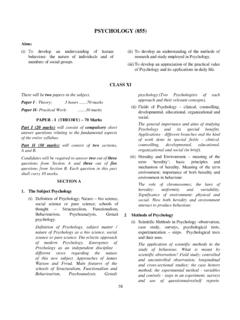
1 71 PSYCHOLOGY (855)Aims:(i)To develop an understanding of humanbehaviour: the nature of individuals and ofmembers of social groups.(ii)To develop an understanding of the methods ofresearch and study employed in PSYCHOLOGY .(iii)To develop an appreciation of thepracticalvalue of PSYCHOLOGY and its applications in XIThere will betwopapers in the I-Theory:3 hours ..70 marksPaper II-Practical Work:..30 marksPAPER-I (THEORY) 70 MarksPart I (20 marks)will consist ofcompulsoryshortanswer questions relating to the fundamental aspectsof the entire II (50 marks)will consist oftwosections,A and will be required to answertwoout ofthreequestions from Section A andthreeout offivequestions from Section B.
2 Each question in this partshall carry 10 Subject PSYCHOLOGY (i)Definition of PSYCHOLOGY ; Nature bioscience, social science or pure science; schoolsof thought Structuralism, Functionalism,Behaviourism, Psychoanalysis, of PSYCHOLOGY , subject matter /nature of PSYCHOLOGY as abio science, socialscience or pure science. The eclecticapproach of modern PSYCHOLOGY . Emergenceof PSYCHOLOGY as an independent discipline-different views regarding the natureof this new subject. Approaches of JamesWatson and Freud. Main features of theschools of Structuralism, Functionalism andBehaviourism,Psychoanalysis, Gestaltpsychology (two Psychologists ofeachapproach and their relevant concepts).
3 (ii)Fields of PSYCHOLOGY clinical, counselling,developmental, educational, organizationaland general importance and aims of studyingPsychology and its special branches and the kindof work done in special fields-clinical,counselling, developmental, educational,organizational and social (in brief).(iii)Heredity and Environment meaning of theterm heredity ; basic principles andmechanism of heredity. Meaningof the termenvironment; importance of both heredity andenvironment in role of chromosomes; the laws ofheredity: uniformity and of environment: physical andsocial. How both heredity and environmentinteract to produce of PSYCHOLOGY (i)Scientific Methods in PSYCHOLOGY -observation, case study, surveys,psychological tests, experimentation tests and their application of scientific methods in thestudy of behaviour.
4 What is meant byscientific observation? Field study; controlledand uncontrolled observation; longitudinaland cross-sectional studies; the case historymethod; the experimental method-variablesand controls-steps in an experiment; surveysand use of questionnaires/self of samples-random, biased,representative population. Psychologicaltests-definition, (ii)Interpretation of research results use ofstatistics in interpretation of data-understanding of why statistics is used(descriptive & inferential). Basic statisticalconcepts statistics, sample, statistics is used in PSYCHOLOGY -interpretation of findings: describing andsummarizing data, comparing individuals/groups, investigating relationships betweenvariables, predicting.
5 Descriptive statistics-for summarizing scores. Inferential statistics-to determine whether observed differencesbetween groups are likely/unlikely to haveoccurred by scores are grouped into frequencydistributions; central tendency of a frequencydistribution-mean, median, mode and wheneach measure is used; dispersion: the extentto which scores are spread out-range,variance, standard deviation; why bothcentral tendency and variability are importantin and Perception(i)Nature of attention-its inner and importance of attention in perception-how bothphysical factors such as size, colour,movement, change, intensity, contrast andpsychologicalfactorssuch as need, interestand emotion determine attention andperception.
6 (ii)Perceptual processes-difference betweensensation and perception. Organizationalprinciples of perception-laws, constancies,depth and colour involved intransforming sensation toperception. Important factors in perceptualprocess-figure and ground, laws ofgrouping: similarity, proximity, continuation,simplicity, good figure; constancy of size,shape and colour; factors involved in depthperception-monocular and binocular cues;how colour is perceived-biological andpsychological factors attributes of colour-hue, brightness and saturation; laws of colourmixture; colour blindness, adaptation andafter-images.(iii)Errors in perception-illusionsof size andshape; what is meant by extra-sensoryperception (ESP).
7 False interpretations-illusions: Muller-Lyer,Height-Width, Ponzo, Zoellner, Poggendorf(details of experiments are required); ESP-perceptions not based on any of the knownsenses (general understanding of ESP).SECTION B4. Emotions and Motivation(i)What is meant by emotion; the and cognitive experience,physiological reactions and overt emotions-fear, anger, joy, sorrow,affection.(ii)Theories of emotion dealing withphysiological, subjective and Lange, Cannon Bard, Schachter-Singer theories.(iii)What is meant by motives, needs andinstincts; unconscious as an internal forcegenerating certain behaviour-biologicalneeds and homeostasis; instincts asunlearned and physiological desires; evidenceindicating the existence of unconsciousmotives.
8 Intrinsic-the desire to performactivities for their own sake.(iv)Theories of and push theories, Optimum Arousaltheory and Expectancy theory-Graphicrepresentation of Maslow's Needs Hierarchy.(v)Social distinctively human motives:Achievement-accomplishing difficult tasks;Power-exerting influence over others;Aggression-learning and control of humanaggression, causes and (vi)Frustration-blocking of motives; conflictamong as a result of motives not findingfree or adequate expression. Different types ofconflict among motives: approach-approach,avoidance-avoidance, multiple approach-avoidance (with examples). (i)What is meant by learning; how learning takesplace-Classical and Operant Conditioning;Insight learning, Observational LearningandLearning of learning-Pavlov and ClassicalConditioning; Thorndike and Trial and Error;Skinner and Operant Conditioning;experiments, findings and principlesestablished.
9 Insight and ObservationalLearning-Kohler and Bandura's Styles Auditory, Visual andKinesthetic(ii) Learning disabilities: definition and of the disabilities-Dyslexia,dyscalculia, dysgraphia, problems and coping withacademics (symptoms and management). and Forgetting(i)The memory system-how it memory, Short and Long termMemory-encoding, storage, and Procedural memory-the Atkinson ShiffrinModel and Parallel Distributed Processing.(ii)Why and how forgetting decay, retro and pro activeinterference, amnesia-retrograde andanterograde; Alzheimer's disease; Dementia.(iii)How memory can be , use of imagery, Mnemonic devices,application of principles of , Problem Solving and Creativity(i)What is meant by and elements of thinking: images,concepts and language-interdependence oflanguage and thought; different kinds ofthinking: convergent, divergent, creative,goal-oriented and aimless thinking.
10 (ii)Concepts and how they are of concepts inthinking-artificial, natural, simple andcomplex concepts.(iii)Reasoning-how it is carried out; commonerrors in reasoning, how reasoning can bemade more effective. Decisionmaking andproblem solving-heuristics and specific conclusions from availableinformation-deductive and inductivereasoning; common errors-faulty premises,biases, fallacy of single case, rationalization,hindsight. Improving reasoning-avoidingerrors, examining premises and ambiguities,guarding against emotion. Decision Makingand Problem Solving-steps involved,optimum expected utility, means-end-analysis,analogy.(iv)Creative thinking-what is meant byconvergent and divergent thinking; stages increative thinking, how creativity can of divergent thinking in creativity-stagesin creative thinking, preparation, incubation,illumination, verification/validation.