Transcription of PWR!Moves Instructor Workshop
1 Parkinson Wellness Recovery 3849 E. Broadway Blvd. #163 Tucson, AZ 85716 T: F: 2015 NeuroFit Networks | Parkinson Wellness Recovery PWR!Moves InstructorWorkshop Train Amplitude and Make FUNction Exercise Date January 12-13, 2018 Location PWR!Gym 140 W. Fort Lowell Rd. Tucson AZ, 85705 Target Audience Required for Certification Certified Personal Trainers, Group Fitness Instructors, KT s PT s, PTA s, OT s, COTA s. Individuals holding a 2/4-year degree in health, exercise science, recreation or physical activity related field with 2 years of experience in the field.
2 Approved for CEC s: American Council on Exercise (ACE) National Academy of Sports Medicine (NASM) American Academy of Sports Medicine (ACSM) British Columbia Recreation & Parks Association Registration Fees $475 per person Group Discounts: $425 per person for 2 or more from same facility $50 Late Fee (if registering after registration deadline check availability) Implement PD-Specific Research-Based Exercise Programs NOW Help People with Parkinson Disease get BETTER and STAY BETTER with Exercise. For more information call Vanessa at 520-591-5346, or to register online, visit Parkinson Wellness Recovery 3849 E.
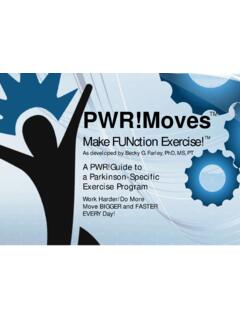
3 Broadway Blvd. #163 Tucson, AZ 85716 T: F: 2015 NeuroFit Networks | Parkinson Wellness Recovery PWR!Moves InstructorWorkshop PWR!Moves Instructor Training and Certification Workshop Course Description: Recent advances in basic and clinical science research suggest exercise and learning approaches that promote aerobics and skill acquisition may protect vulnerable neurons, repair damaged circuits, and optimize function in persons with Parkinson disease (PD). Participants will learn a PD-specific approach to skill acquisition called PWR!Moves . PWR!Moves is a stand-alone exercise program that can also be integrated into other exercise approaches.
4 The Basic4 | PWR!Moves (UP/ROCK/TWIST/STEP) are building blocks for everyday movement and are always performed with large amplitude, high effort, and attention to action in multiple positions (floor/sitting/standing). Participants will learn how to use these foundational PWR!Moves exercises to target symptoms that interfere with everyday movement. Rigidity: PWR!Moves are performed slowly, rhythmically and with sustained effort. Bradykinesia: PWR!Moves are performed as fast as possible with repetitive high effort. Incoordination: PWR!Moves are linked together into longer and longer sequences that mimic everyday movements.
5 Automaticity, PWR!Moves are progressed in complexity through the addition of common dual tasks (PWR!Boosts). This course will provide participants with the background and unique skills to teach an evidenced based PD-specific approach in group or personal training. Participants will learn two group formats ( PWR!Moves Group or PWR!Moves Circuit). Both of these class formats can be adapted for individuals with minimal to moderate levels of disease severity. Participants will have the opportunity to practice the PWR!Moves , develop class activities, and teach PWR!
6 Moves classes while interacting with PWR! faculty and people with Parkinson disease during the Workshop . Participants will also be introduced to how to implement essential principles of learning and neuroplasticity founded upon research in the fields of exercise science, motor control, and motor learning. These essential principles are the how of what you do to achieve optimal benefit to quality of life, function, symptoms, and slowing the progression of PD. Instructors will learn to use the group structure and their feedback and instructional methods to empower and educate class participants about their true potential.
7 Emphasis will be on promoting an environment for learning that embraces an atmosphere of empowerment, motivation, social enrichment, and FUN ction! The goal for individuals with PD is that they not only improve their performance in the class, but that they learn to recognize when they need to self-correct their slow/small movements for better movement, posture and balance in everyday life. Parkinson Wellness Recovery 3849 E. Broadway Blvd. #163 Tucson, AZ 85716 T: F: 2015 NeuroFit Networks | Parkinson Wellness Recovery PWR!Moves InstructorWorkshop Objectives/Goals: 1) Possess general knowledge about PD to include: who gets it, what causes it, major symptoms, and how it impacts FUNCTION (mobility, balance, flexibility, and coordination) in individuals with PD.
8 2) Describe how medications, deep brain surgery, and symptoms (non motor/motor) may affect an individuals ability to participate in, or benefit from exercise. 3) Explain the significance of targeting the training of amplitude into function ( PWR!Moves ) as the foundation for a PD-specific program. 4) Teach the Basic4 | PWR!Moves in different positions in a group format: floor prone/supine, all4 s, sitting, standing. 5) Be able to explain how the goals of PREPARE/ACTIVATE/FLOW target the primary symptoms of PD and include examples of each. 6) Identify how each of the Basic 4 | PWR!
9 Moves target common PD-specific problems related to flexibility, strength, coordination, balance, and posture in different positions. 7) Demonstrate how each of the PWR!Boosts can be integrated into PWR!Moves exercises and be prepared to discuss why their purpose, or why they are important. 8) Able to use modeling, mental imagery, voice, cues, instruction, and reward-based feedback to achieve optimal alignment motor output (effort), and engagement. 9) Discuss how PWR!Moves can be integrated into function/ADL/lifestyle during a class at least 3 times. 10) What is the significance that PWR!
10 Moves may be implemented across settings (therapy/community), and reinforced in other community research exercise programming (treadmill, cycling, pole walking, yoga, boxing, dance, Tai Chi). 11) Demonstrate how PWR!Moves in different positions may be adapted for individuals with different disease severity levels. 12) Integrate the PWR!Moves into a circuit format using more typical fitness equipment or approaches that require individuals to work more independently, discuss goals of that activity, and demonstrate how it may be progressed in difficulty or complexity for different individuals.