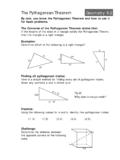
Transcription of Pythagoras’ theorem - Mathematics resources
1 pythagoras theoremmc-TY- pythagoras -2009-1 pythagoras theorem is well-known from schooldays. In thisunit we revise the theorem and useit to solve problems involving right-angled triangles. We will also meet a less-familiar form of order to master the techniques explained here it is vital that you undertake plenty of practiceexercises so that they become second reading this text, and/or viewing the video tutorial on this topic, you should be able to: state pythagoras theorem use pythagoras theorem to solve problems involving right-angled theorem of Pythagorasa2+b2= further application of the in cartesian final mathcentre 20091. IntroductionThe theorem of pythagoras is a well-known theorem . It is alsoa very old one, not only does itbear the name of pythagoras , an ancient Greek, but it was alsoknown to the ancient Babyloniansand to the ancient Egyptians. Most school students learn of it asa2+b2=c2.
2 The actualstatement of the theorem is more to do with areas. So, let s have a look at the statement ofthe The theorem of PythagorasThe theorem makes reference to a right-angled triangle suchas that shown in Figure 1. Theside opposite the right-angle is the longest side and is called 1. A right-angled triangle with hypotenuse the theorem says is that the area of the square on the hypotenuse is equal to the sum of theareas of the squares on the two shorter sides. Figure 2 shows squares drawn on the hypotenuseand on the two shorter sides. The theorem tells us that area A +area B = area 2. A right-angled triangle with squares drawn on excellent demonstration of this is available on the accompanying video. If we denote thelengths of the sides of the triangle asa,bandc, as shown, then area A =a2, area B =b2andarea C =c2. So, using pythagoras theoremarea A + area B=area Ca2+b2=c2 This is the traditional mathcentre 2009 Key PointPythagoras theorem :abca2+b2=c2 ExampleSuppose we wish to find the length of the hypotenuse of the right-angled triangle shown in Figure4.
3 We have labelled the 3b= 4cFigure the theorem :a2+b2=c232+ 42=c29 + 16 =c225 =c25 =cSo 5 is the length of the hypotenuse, the longest side of the this Example we will assume we know the length of the 5yz= 13 Figure mathcentre 2009 The corresponding statement of pythagoras theorem isx2+y2=z2. So,x2+y2=z252+y2= 13225 +y2= 169y2= 144y= 144 = 12So, 12 is the length of the unknown we wish to find the lengthqin Figure 6. The statement of the theorem is nowp2+q2=r2p=15qr= 17 Figure +q2=r2152+q2= 172225 +q2= 289q2= 64q= 8So, 8 is the length of the unknown each of these three Examples, the answers have been exact and they have been whole numbervalues. These whole number triples, ((3,4,5), (5,12,13), (8,15,17)), orPythagorean triples,as we call them, occur quite frequently. When you do questions like these, you probably won tbe so lucky to get exact answers as we have done here; you almost certainly will have to usea calculator for many of them and you have to decide to approximate the answer to a givennumber of decimal places or a given number of significant 11.
4 Determine, to 2 decimal places, the length of the hypotenuses of the right-angled triangleswhose two shorter sides have the lengths given ) 5 cm, 12 cm b) 1 cm, 2 cmc) 3 cm, 4 cmd) 1 cm, 1 cm e) cm, 1 cm f) 2 cm, 5 cm2. Determine, to 2 decimal places, the length of the third sides of the right-angled triangleswhere the hypotenuse and other side have the lengths given ) 8 cm, 2 cm b) 5 cm, 4 cm c) 2 cm, 1 cmd) 6 cm, 5 cm e) 10 cm, 7 cm f) 1 cm, mathcentre 20093. A further application of the theoremLet s have a look at another application of pythagoras at the cuboid shown in Figure 7. Suppose we wish to find thelength,y, of the diagonalof this cuboid. This is the bold line in Figure 7. Note that ABCis a right-angled triangle withthe right-angle at C. Note also, that ACD is a right-angled triangle with hypotenuse AC. Let AChave lengthx, as 51243 ABCDxyFigure to triangle ACD and using pythagoras theorem :32+ 42=x29 + 16 =x2x2= 25x= 5 Now let the length of the diagonal AB bey.
5 Using pythagoras theorem in triangle ABC:52+ 122=y225 + 144 =y2169 =y2y= 169 = 13So we can use the theorem of pythagoras in 3-dimensions; we can use it to solve problems thatare set up in 3-dimensional 21. Calculate the length of the diagonals of the following cuboidsa)2 3 4b)1 1 3c)5 5 5 Give your answers to 2 decimal mathcentre 20094. Applications in cartesian geometryCartesian geometry is geometry that is set out on a plane thatuses cartesian are the familiar(x, y)coordinates you will have seen before. We have already seen thatPythagoras theorem gives us a relationship which is satisfied between the lengths of the sidesof a right-angled triangle. However, we can turn this theorem around. If we study any triangle,and find that the area of the square on the longest side is equalto the sum of the areas of thesquares on the two shorter sides of the triangle, then the triangle must be right-angled.
6 So wecan use pythagoras theorem to tell whether a triangle is right-angled or we have the co-ordinates of three points:(3,4) (2,6) (1,0)Can we use pythagoras theorem to find out whether they form the corners of a right-angledtriangle ? The points are plotted in Figure 8. Looking at Figure 8 we might guess that thetriangle does contain a right-angle, but we can t be sure. The scales on the two axes are notquite the same and so appearances can be (3,4)(2,6)(1,0)Figure Figure 8 note that(AB)2= 12+ 62= 1 + 36= 37(BC)2= 22+ 12= 4 + 1= 5(AC)2= 22+ 42= 4 + 16= 20 Now ask the question. Do the squares of the shorter sides add together to give the square ofthe longer side ?(AC)2+ (BC)2= 5 + 20 = 256= 37So we do not have a right-angled triangle. In fact because thelongest side,AB, is greater thanthat which would be required to form a right-angle ( 25 = 5) we can deduce that the angleatCis in fact greater than90.
7 ThusCis an obtuse angle. This is not immediately obviousfrom a mathcentre 2009 Exercise 31. The lengths of the sides of a number of different triangles are given below. In each case,determine whether the largest angle is obtuse, right angle or ) 1, 1, 1 b) 1, 1, 2 c) 4, 3, 2 d) 5, 7, 9e) 5, 12, 13 f) 2, 6, 4 g) 8, 10, 6 h) 1, 2, 22. The co-ordinates of the vertices of a number of triangles are given below. In each case,determine if the triangle is right ) (1,2), (2,3), (5,0) b) (2,1), (4,2), (2,6) c) (3,2), (5,1), (2,5)5. A final resultFinally, the fact that pythagoras theorem is about squaresis fairly well-known. What is notso well-known, although it is fairly obvious once you have seen it, is that if you take any regularfigure or similar figures and place them on the sides of a right-angled triangle, then the area ofthe figure on the hypotenuse is equal to the sum of the areas of the figures on the two shortersides.
8 Consider, for example, Figure 9 where we have drawn semi-circles on each side of theright-angled 9. Semi-circles drawn on the sides of the right-angled the formula for the area of a circle:Area ofA=12 (a2)2= 8a2 Area ofB=12 (b2)2= 8b2 Area ofC=12 (c2)2= 8c2and soArea ofA+ Area ofB= 8a2+ 8b2= 8(a2+b2)But from pythagoras theorema2+b2=c2and soArea ofA+ Area ofB= 8c2= Area ofCand so it is true thatArea ofA+ Area ofB= Area mathcentre 2009 AnswersExercise 11. a) 13 cm b) cm c) 5 cm d) cm e) cm f) cm2. a) cm b) 3 cm c) cm d) cm e) cm f) cmExercise 21. a) b) c) 31. a) acute b) obtuse c) obtuse d) obtuse e) right angle f) obtuse g) right angle h) acute2. a) Yes b) Yes c) mathcentre 2009