Transcription of Questions with Answers- Replication, Transcription ...
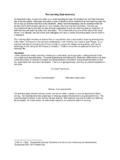
1 Questions with answers - replication , Transcription , & Protein Synthesis A. dna replication is studied in a newly discovered bacterium. It takes 30 min for the bacterium to complete a round of replication at 37oC. Autoradiography of the replicating DNA molecule shows the following structure. B III A C D A Meselson-Stahl-type experiment was also performed. The bacteria were grown for several generations in 14N-medium and then switched to 15N-medium. The DNA molecules were then analyzed.
2 ( Questions 1-7) Which is a characteristic of Meselson-Stahl experiments? a) DNA molecules are separated based on size. b) DNA molecules reach an equilibrium position in the centrifuge tube. c) CsCl binds to the DNA and pulls it down through the solution. d) CsCl becomes separated into different bands when centrifuged. If the mechanism of dna replication in this bacterium were dispersive, what results would be found when the double-stranded DNA was analyzed in a CsCl gradient after two generations in 15N-medium? a) One band would be observed containing all the DNA.
3 B) Two bands would be observed containing equal amounts of DNA. c) Two bands would be observed containing unequal amounts of DNA. d) The DNA cannot form any bands if replication is dispersive. If the mechanism of dna replication in this bacterium were semi-conservative, what results would be found when the double-stranded DNA was analyzed in a CsCl density gradient after three generations in 15N-medium? a) The DNA would form three bands: one with hybrid density, one with light density, and one with heavy density. b) The DNA would form one band with hybrid density. c) The DNA would form two bands: one with heavy density and one with hybrid density. d) The DNA would form two bands: one with light density and one with hybrid density.
4 After one generation in 15N-medium, the DNA is denatured and analyzed in a CsCl gradient. If the single-stranded DNA forms two bands, one with heavy density and one with light density, what conclusion could be drawn about the mechanism of dna replication in this bacterium? a) The mechanism must be conservative. b) The mechanism must be semi-conservative. c) The mechanism could be either conservative or semi-conservative. d) No conclusions about the mechanism can be made by analyzing single-stranded DNA. Which conclusion can be made about dna replication in this bacterium based only on the autoradiography structure? a) replication in this bacterium could occur bidirectionally from an origin at point A.
5 B) replication in this bacterium could occur unidirectionally from an origin at point D. c) replication in this bacterium could terminate at point B. d) replication in this bacterium could terminate at point C. If this bacterium is similar to E. coli in its mechanism of dna replication , then which will occur when the bacterium is grown at 37oC? a) There will be two replication forks when replication occurs in poor medium. b) There will be four replication forks when replication occurs in rich medium. c) The rate of polymerization will vary depending upon the medium.
6 D) The frequency of initiation will be constant regardless of the medium. If this bacterium is similar to E. coli in its mechanism of dna replication , then which will occur when the bacterium is grown at 37oC? a) At least one round of replication will be occurring at all times. b) Only one round of replication can take place at a given time. c) The newly synthesized DNA strands will bond together in a double-helix. d) All rounds of replication start at a specific sequence on the chromosome. _____ B. The mechanism of dna replication is studied in an E. coli replication fork. ( Questions 8-13) 5 I III 3 IV 5 II 3 Which is a characteristic of this replication fork?
7 A) Strands I and II have base sequences that are identical to each other. b) Strands II and IV have an antiparallel orientation as the fork moves to the right. c) Strands I and III will be covalently bonded to each other when replication is completed. d) Strands III and IV will be H-bonded to each other when replication is completed. Which is a characteristic of this replication fork? a) Strand I is replicated continuously while strand II is replicated discontinuously. b) Strand III is a lagging strand template while strand IV is a leading strand template.
8 C) The double-helix containing strands I and III must be denatured in order for replication to continue. d) The double-helix containing strands II and IV will form base-pairs using phosphodiester bonds. Which is a property of Okazaki pieces in an E. coli replication fork? a) Okazaki pieces are joined together by DNA polymerase I to form a long chain. b) Okazaki pieces are polymerized in the 3 5 direction by DNA polymerase III. c) An Okazaki piece for the leading strand is polymerized to a length of 1000-2000 nucleotides. d) An Okazaki piece for the lagging strand has a base sequence complementary to its template.
9 Which is a property of RNA primers in an E. coli replication fork? a) RNA primers are synthesized using a DNA template and NDPs. b) Each RNA primer is joined to an Okazaki piece through a non-covalent bond. c) Each RNA primer is both polymerized and degraded in the 5 3 direction. d) RNA primers are synthesized and proof-read by the primase enzyme. 12. _____ When will this fork stop replicating DNA? a) when its movement is halted by a Ter sequence b) when it is denatured by the Tus protein c) when it reaches the OriC region d) when a topoisomerase removes supercoils Which is a characteristic of an E.
10 Coli replication fork and a eukaryotic replication fork? a) Both forks contain a leading strand and a lagging strand. b) Polymerization occurs more rapidly in eukaryotes. c) Okazaki pieces are smaller in prokaryotes. d) Both forks can synthesize DNA only during S phase. _____ C. The proteins needed for all stages of dna replication in E. coli are studied. ( Questions 14-25) During initiation of replication a) DNA polymerases denature A-T rich sequences at the origin. b) replication begins when Dna A protein binds the origin and synthesizes primers. c) DnaB protein cleaves the double-helix to produce template strands. d) two replication forks need to be created to establish bidirectional replication .