Transcription of Chapter 11 Lecture Notes: The Structure of DNA
1 Chapter 11 Lecture notes : The Structure of DNAI. Prelude to the discovery of DNA as the genetic materialA. Genes were known to be associated with specific character traits but their physicalnature was Genes were known to be carried on Chromosomes were known to contain DNA and The composition of DNA was known, and it was thought to be too simple to carrythe genetic Criteria needed for a molecule to be the carrier of genetic Ability to store genetic information and transmit it to the cell as Ability to transfer the information to daughter cell with minimal Physical and chemical stability so that information is not Capacity for genetic The discovery that DNA was the genetic materialA.
2 Griffith s transformation experiment (1928) precursor to the Avery experiment(From: AN INTRODUCTION TO GENETIC ANALYSIS 6/E BY Griffiths, Miller, Suzuki, Leontin, Gelbart 1996 by W. H. Freeman and Company. Used with permission.)B. Avery, MacLeod, and McCarty experiment (1944)Showed that transforming material in Griffith s experiment was DNA(From: AN INTRODUCTION TO GENETIC ANALYSIS 6/E BY Griffiths, Miller, Suzuki, Leontin, Gelbart 1996 by W. H. Freeman and Company. Used with permission.)C. Hershey-Chase experiment (1952)Hershey and Chase knew that phage infection of E.
3 Coli required introduction ofviral genetic information. Selectively labeled the phage protein with 35S and thephage DNA with 32P Infected E. coli with labeled phage After infection,removed empty phage heads Looked to see whether the labeled DNA or theprotein was in E. coli Found 32P in bacteria so DNA carried the genetic infoIII. The discovery of the Structure of DNAA. The composition of DNA was Composed of 4 different nucleotides. A nucleotide is composed of aphosphate group, a deoyribose sugar, and a nitrogen Chargraff s rules (in each DNA molecule: T+C =A+G and T=A and C=G)C.
4 Franklin and Wilkins x-ray diffraction data suggested that the molecule was long andskinny, had two parallel components, and was helicalD. Watson and Crick put it all together to solve the Structure of DNA in 1953IV. The Structure of DNAA. Important features of the DNA Structure :1. Right-handed double helix2. The helices are antiparallel3. Each helix has a series of nucleotides held together with phosphodiester bondsbetween the OH groups in two adjacent sugar The helices themselves are held together by hydrogen bond between thenitrogen bases (G pairs with C; A pairs with T).
5 5. basepairs per turn of the Acid (DNA)4 different nucleotidesphosphateNitrogen basesDeoxyribose sugaradenineguaninethyminecytosine= A= G= T= C} Purines} Pyrimidines(From: AN INTRODUCTION TO GENETIC ANALYSIS 6/E BY Griffiths, Miller, Suzuki, Leontin, Gelbart 1996 by W. H. Freeman and Company. Used with permission.)B. DNA molecule has major and minor grooves (Figure 11-9)C. DNA molecule usually depicted as an inflexible rod, but it can be bent or Stabilization forces in DNA are from the hydrogen bonding between bases (GC basepair provides more stability because 3 H bonds vs.)
6 2 H bonds for AT basepair) and the stacking of the bases which excludes water Several alternative structural forms of DNA have been found:1. B form DNA is the typical A form DNA is formed in less hydrated Z form DNA is formed when the DNA molecules have alternating G s andC s on the same Discovery of semiconservative dna replication in prokaryotes (no nucleus, circularchromosome)A. Original 3 hypothesis for the mechanism of dna replication (From: AN INTRODUCTION TO GENETIC ANALYSIS 6/E BY Griffiths, Miller, Suzuki, Leontin, Gelbart 1996 by W.
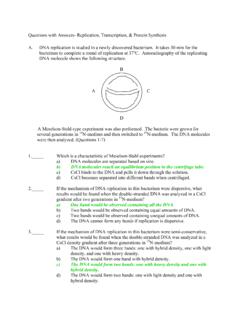
7 H. Freeman and Company. Used with permission.)B. The Meselson-Stahl experimentMeselson and Stahl used nitrogen isotopes that had different densities to followDNA replication in E. E. coli in 15N for several generations so that all the DNA was labeled Shifted cells to 14N media and allowed them to replicate their DNA 1 time Sample of DNA was taken Cells were allowed to replicate their DNA again(total of 2 times) Sample of DNA was taken Used CsCl gradientcentrifugation of DNA samples to determine the isotope composition and patternof labeling in the DNA found pattern matched semiconservativeExpected results (From.
8 AN INTRODUCTION TO GENETIC ANALYSIS 6/E BY Griffiths, Miller, Suzuki, Leontin, Gelbart 1996 by W. H. Freeman and Company. Used with permission.)VI. Mechanism of dna replication in prokaryotesA. Requirements for dna replication in prokaryotes1. origin of replication (oriC) which is a 245 basepair site that contains multipledirect repeats where dna replication begins2. DnaA (unwinds the DNA strands at oriC)3. SSB (single stranded binding protein to keep the DNA strands apart)4. Primosomea) Primase (synthesizes RNA primers to start dna replication )b) DnaB, DnaT, PriA, PriB, PriC5.
9 Rep is a helicase that disrupts ( melts or denatures ) the H bonds at thereplication DNA polymerase (there are 3 types of DNA polymerase that have beenisolated from E. coli all require Mg2+)Main function5 3 polymerase3 5 exonuclease5 3 exonuclease# per cellgenesDNA pol IRemoving RNAprimers & gap fill inYYY400polADNA pol IIDNA repairYYN?polBDNA pol IIIMain polymeraseYYN10-20**dnaEdnaQholB** For DNA pol III, alpha, epsilon, and theta subunits constitute the core enzyme and 6 other subunits are importantfor loading the enzyme on the DNA and for holding the enzyme together; holoenzyme (complete enzyme with all itssubunits) is a dimer7.
10 Deoxyribonucleotides to incorporate into the new DNA8. Template DNA9. Ribonucleotides to make primers (From: AN INTRODUCTION TO GENETIC ANALYSIS 6/E BY Griffiths, Miller, Suzuki, Leontin,Gelbart 1996 by W. H. Freeman and Company. Used with permission.)B. Direction of synthesis of each new strand is 5 3 C. replication is bidirectional(From: AN INTRODUCTION TO GENETIC ANALYSIS 6/E BY Griffiths, Miller, Suzuki, Leontin, Gelbart 1996 by W. H. Freeman and Company. Used with permission.)D. Speed 100 kilobasepairs/minuteE.